Escalating Diplomatic Pressure with Threats to Close the Strait of Hormuz by Iran
Iran’s Islamic Consultative Assembly intends to exert diplomatic pressure on the international community by threatening to close the Strait of Hormuz.
The Islamic Consultative Assembly on June 22, corresponding to the 1st of Tir, approved a plan to close the Strait of Hormuz. Implementation of this plan is contingent upon final approval by the Supreme National Security Council, headed by Iranian President Masoud Pezeshkian, but it remains unclear whether this action will be carried out.
In fact, Iran intends to use threats to close the Strait of Hormuz as a form of diplomatic pressure and psychological warfare on the international community in response to attacks by Israel and the United States.
Abbas Araghchi, Iran’s Foreign Minister, who traveled to Istanbul, responded to a question about the likelihood of the Strait of Hormuz being closed by saying: “We have all options on the table and will use all legitimate tools to defend ourselves.”
U.S. Vice President JD Vance, in response to Iran’s threat to close the Strait of Hormuz, stated: “Iran’s attempt to disrupt shipping in the Strait of Hormuz would be ‘suicide’ for that country.”
Reports about the accelerated passage of ships through the Strait of Hormuz indicate ships’ fear of closure, as they seek rapid exit from the strait. The increased transit traffic through the strait confirms growing concerns about its potential closure. Currently, approximately 50 large oil tankers are attempting to exit the strait.
The CEO of Shell, one of the world’s oil giants, previously warned about the impact of the Iran-Israel conflict: “We warn about the potential widespread impact of the closure of the Strait of Hormuz and a major shock to oil markets. Ship insurance costs have increased up to 2.5 times, and longer, more expensive routes have been substituted. This situation has led to increased oil prices.”
The U.S. airstrikes in the early hours of Sunday, the 1st of Tir, on the nuclear sites of Fordow, Natanz, and Isfahan have increased concerns about the closure of the Strait of Hormuz and the expansion of the conflict into the Persian Gulf. The closure of this strait, which previously seemed unlikely, has become a probable scenario following U.S. involvement in Israel’s conflict with Iran, and concerns about its closure have intensified. These concerns have also involved Gulf states, particularly those bordering the Persian Gulf.
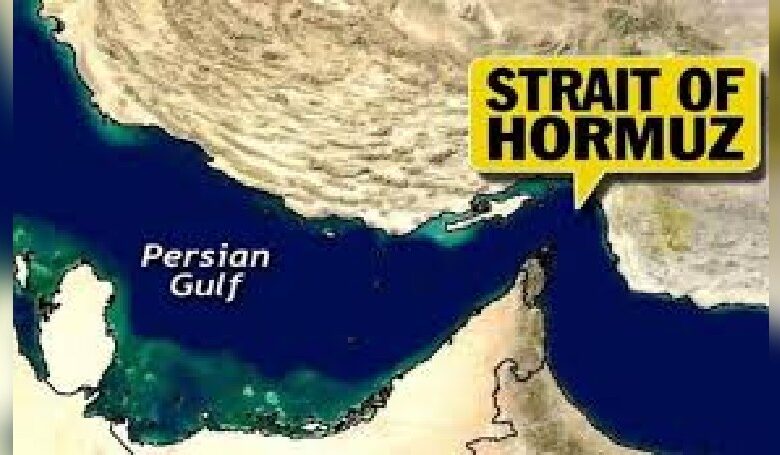
The Strait of Hormuz is bordered by Iran from the north and by the UAE and Oman from the south, with approximately 20 percent of global oil supply passing through this strait. Kepler, a ship tracking agency, reported that approximately 50 large oil tankers are currently attempting to exit the Strait of Hormuz. The oil industry also predicts that the strait will be closed in the future.
According to some analysts, if the Strait of Hormuz were to be closed, oil prices would rise sharply and exceed the $90 mark, in which case countries would need to await the release of strategic oil reserves by the United States and China to control the market. China and the United States can each provide up to two million barrels from their strategic reserves.
Russia and Saudi Arabia, as members of “OPEC Plus,” have announced that their oil reserves are sufficient to compensate for Iran’s oil supply. The announcement of these countries’ readiness to supply oil means that if Iran’s oil supply is disrupted, other countries will serve as substitutes. However, the point is that if the Strait of Hormuz is closed, the countries bordering the Persian Gulf would also become involved in Israel’s conflict with Iran, which would lead to the expansion of the war.
The question is whether Iran can easily close the Strait of Hormuz and how it would be able to do so? And would closing this strait drag the war into the Persian Gulf? In response to these questions, it can be said that the U.S. aircraft carrier Vinson is stationed 80 kilometers away from the Strait of Hormuz, and the Nimitz carrier has been deployed from the South China Sea toward the Persian Gulf to further stabilize the Vinson and strengthen U.S. presence.
Iran has now threatened to close the Strait of Hormuz, while closing this strait is not a simple task. Closing this strait can be accomplished in several ways: 1. Deployment of naval mines 2. Use of speedboats and coast-to-sea missiles 3. Physical occupation of strategic points in the strait 4. Legal prohibition or formal warning to ships.
However, the problem is that doing so is not simple, because exactly in the lower part of Hormuz Island, the transit of oil tankers and others is not within Iran’s control and passes through waters closer to Oman, which is beyond Iran’s reach. Iran’s only winning card for closing the Strait of Hormuz is the three islands; because within 100 kilometers west of the Strait of Hormuz, ships are forced to pass exactly between Qeshm Island, the Tunbs, and Abu Musa, which are islands under Iranian control.
For this reason, Iran’s three islands hold significant strategic importance, and the UAE is also seeking to reclaim these islands. Based on this information, Iran can only control ship routes and use the 4 aforementioned methods to stop ship traffic and, so to speak, close the Strait of Hormuz, but the consequences of such action would be very severe.
As a result of the above information, it can be said that on average approximately 82 ships per day, or about 17 million barrels of oil and liquefied gas, equivalent to 20 percent of the world’s total oil, exits this region through the strait, which belongs to the exports of all countries in the Persian Gulf region, including Iraq, Kuwait, Bahrain, Qatar, Saudi Arabia, and the UAE, to dozens of countries across all continents of the world, and closing this strait would directly and rapidly undermine the world’s energy. As a result of the closure, it would immediately cause severe global economic consequences and lead to direct military conflict with the United States, NATO, and neighboring exporting countries. For this reason, closing the Strait of Hormuz would be easy in speech but very difficult in practice.
The question now is whether Iran will actually implement the closure of the Strait of Hormuz despite all these consequences?