An Incomplete Face of Truth and Tragedies That Remained Unanswered
The narrative of Iran’s bitter and mysterious events, from Abadan Rex Cinema to the explosion at Shahid Rajaei Port
Over the past half century, Iran has witnessed a series of mysterious events and bloody disasters, most of which have ended without fully clarifying the causes and accepting responsibilities.
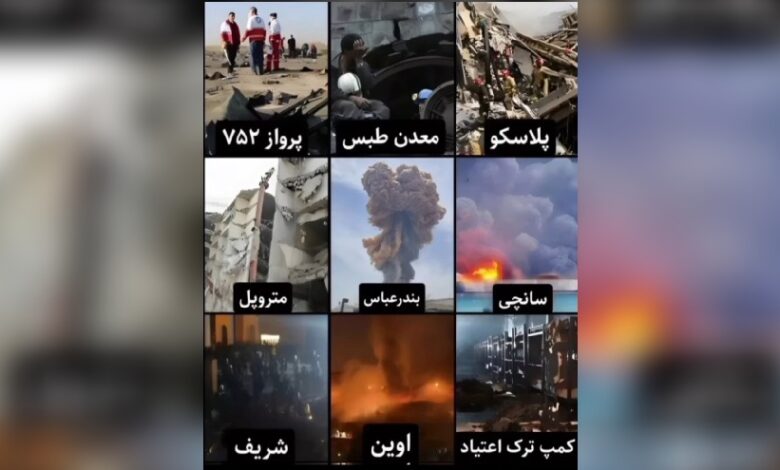
From the fire at Abadan Rex Cinema in 1357 that sparked the flames of the Islamic Revolution to the murder of Christian priests, the collapse of the Metropol building, the explosion of the Sanchi oil tanker, the Evin Prison fire, nationwide protests, Sharif University and many other tragedies, and now the explosion at Shahid Rajaei Port in Bandar Abbas—disasters that have left many questions unanswered.
The Abadan Rex Cinema disaster, a spark for the revolution
On August 19, 1978, Abadan Rex Cinema was turned to ashes in an intentional fire. More than 400 people present in the cinema were trapped and ultimately lost their lives. Although the Pahlavi regime initially blamed opposition forces, later some documents and accounts pointed to the role of government forces of that time in the disaster. To this day, the main perpetrators of this crime and the exact manner of its occurrence have not been fully clarified.
The massacre of Christians and confiscation of church property and Christian citizens’ assets
The massacre of Christians began exactly one week after the revolution’s victory in 1979. Reverend Siyahiyat was the first Christian martyr who was brutally murdered by opponents, and such killings continued afterward. Many churches and their affiliated properties were confiscated and some Christian families were forced to leave Iran. These events were also accompanied by many ambiguities regarding the main perpetrators.
Zemestan Yurt Mine, a deadly explosion in the depths of the earth
The explosion at Zemestan Yurt Mine in Azadshahr, Golestan Province occurred on May 3, 2017. At least 43 miners lost their lives in this explosion and over 100 were wounded. They were trapped at a depth of 1,300 meters in a space filled with carbon monoxide and methane gas. The absence of a gas leak detection sensor meant the gas leak was not detected and a terrible explosion occurred. Ultimately, weak safety measures and mismanagement were cited as the main factors, but the case of this accident was closed without effective accountability.
The Tabas coal mine incident, repetition of another tragedy and massacre of workers
On September 21, 2024, another incident occurred at Tabas mine. The Tabas coal mine explosion was the most fatal incident related to mines in Iran. This incident, which was caused by methane gas leakage, led to an explosion in Block C of the mine. At the time of the explosion, approximately 17 workers were present in the location who unfortunately lost their lives because the exit route from the relevant section was blocked. The total number of deaths in this explosion was 52 people and 22 wounded. Investigations into the primary cause of the incident did not reach clear conclusions and criticism regarding the safety situation of mines continues. The French union confederation described this disaster as a massacre of mine workers and held the government responsible for the occurrence of this incident.
The Plasco incident, the collapse of a symbol
A widespread fire broke out at the Plasco commercial building in Tehran on January 19, 2017, which led to the complete collapse of this structure and the deaths of a number of firefighters and citizens under the rubble caused by the collapse, and others outside the building. Contradictory statistics were reported about the number of deaths and injured, approximately 235 people were injured in this incident and some were also missing, but no accurate statistics of the number of deaths were reported. Issues related to building safety and how the crisis was managed continue to be the subject of serious criticism.
The Sanchi oil tanker, mysteries in the heart of the sea
The collision of the Iranian oil tanker Sanchi with a Chinese cargo ship on January 6, 2018 and its sinking marked one of the deadliest maritime disasters in Iran. This oil tanker belonged to the National Iranian Oil Tanker Company and carried 136,000 tons of liquefied gas condensate, which collided with the Chinese bulk carrier “CF Crystal” in waters east of China. In this incident, 30 Iranians and two Bangladeshi nationals went missing, and after three days of search, only the bodies of 3 people were found. There are many ambiguities about rescue efforts, the fate of the crew, and the recording of the ship’s black box, for which no official and clear answer was ever provided.
The November 2019 protests, Bloody November
Iran’s 2019 protests or Bloody November were a series of popular and anti-government demonstrations throughout Iran. These protests took shape following a sudden 200 percent increase in gasoline prices across Iran, which was accompanied by severe suppression and considerable violence. Official statistics on the number of deaths in that crackdown have not yet been released and many ambiguities exist regarding their cases.
Flight PS752, a crash shrouded in ambiguity
In the early morning of January 8, 2020, Ukrainian flight 752 was shot down by two missiles from the Islamic Revolutionary Guard Corps air defense system around Tehran. All 176 passengers on this commercial aircraft lost their lives. After three days of denial, the shooting down of this aircraft was confirmed but the trial process and transparent accountability did not take place, and after several years, the families of the victims continue to call for independent investigations and clarification of the decisions that led to this disaster.
The collapse of the Metropol Tower, an incident that went unanswered
In June 2022, the Metropol Tower in Abadan collapsed while it was still incomplete. This incident left 43 dead and 37 injured. This collapse occurred due to structural failure as a result of violation of technical standards and regulations. Despite the arrest of the project owner and some city officials, public opinion about the role of systematic corruption, weak supervision, and lack of technical control has remained unanswered.
The death of Mahsa Amini and the beginning of nationwide protests
On September 13, 2022, Mahsa Amini, after being arrested by the morality police for allegedly not observing mandatory hijab, suffered a skull fracture and brain death due to blows from morality police officers. After three days of hospitalization at Kasravi Hospital in Tehran, she died from injuries sustained by the blows. This incident triggered a widespread wave of reactions and massive protests throughout Iran, which were violently suppressed by regime forces, resulting in the deaths of many other citizens in various cities. These protests continue, but the cases of victims in these protests have remained unresolved, and the families of victims are still under threat, suppression, and detention.
Evin Prison fire, in search of truth
On October 15, 2022, coinciding with widespread nationwide protests in Iran, Evin Prison in Tehran experienced a large fire in which 4 prisoners were killed and 61 were injured, but after several days, four more of the injured lost their lives. Despite the publication of official statements, the precise details of the extent of the incident, the actual number of deaths, and how the fire started were not fully clarified, and ambiguity about this incident still remains.
Sharif University events, a crisis at the heart of knowledge
In October 2022, following student protests, Sharif University of Technology in Tehran witnessed an attack by security forces and widespread arrests of students. Security officers, while beating, shooting, wounded an unknown number of students, arrested them, and transferred them to unknown locations. Conflicting accounts of how students were treated and the status of the detained continue to be a matter of concern for human rights organizations, for which complete clarification has not yet been provided.
Shahid Rajaei Port explosion, an explosion with ambiguous narratives
On the afternoon of Saturday, April 26, 2025, a severe explosion occurred in the compound of the dock at the important Shahid Rajaei Port in Bandar Abbas. Contradictory information about the cause of the incident was released, and no official verified report about the exact reasons for this explosion has been released so far. So far, the number of deaths in this explosion is 70 people, 1,242 injured, 6 missing, and 5 others have suffered severe burns. This port is the most important commercial maritime link in Iran and has a very sensitive role, such that approximately 80 percent of all commercial cargo enters or leaves the country through it. Now this port, along with its citizens, mourn their loved ones.
A review of these disasters shows that lack of transparency in news reporting, weakness in institutional accountability, ineffectiveness in crisis management, and failure to conduct independent investigations have been common features of many tragic events in Iran. The continued ambiguity about events such as Rex Cinema, the collapse of Metropol, flight 752, Tabas mine, the Sanchi explosion, nationwide protests, and many other incidents, and now the severe explosion at Shahid Rajaei Port, has added to the gap of distrust between people, officials, and even some elements of the system itself. Transparency, accountability, and justice are demands that have not only not faded with the passage of time, but appear more prominent than ever.
Author: M. R.