Maximum Support for the Iranian People, Along with Maximum Pressure Against the Islamic Republic Government
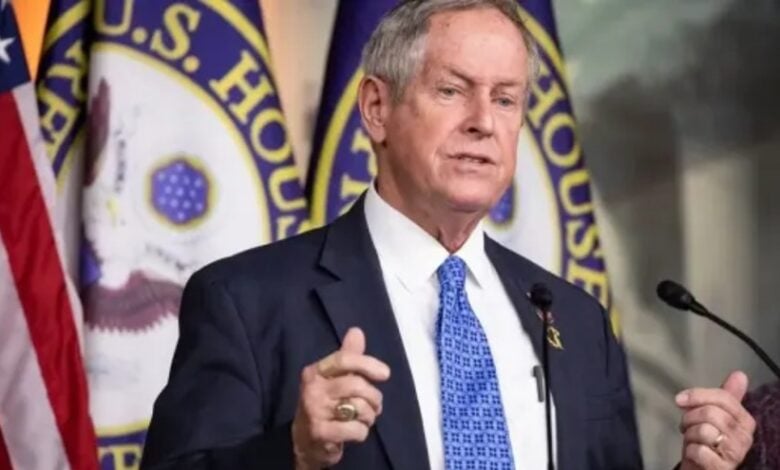
“Joe Wilson” announced a bipartisan plan based on “maximum support for the Iranian people, along with maximum pressure against the Islamic Republic government.”
In recent weeks, the U.S. government has been seeking direct negotiations with the Iranian government over a nuclear agreement and has deployed its aircraft carriers and bombers in the Middle East to apply maximum pressure on the Iranian government, so that in the event of no nuclear agreement, it can launch a military attack against Iran.
While various options for negotiations or military attack are being considered, “Joe Wilson,” a Republican representative from South Carolina, and “Jaime Herrera Beutler,” a Democratic representative from California, presented a bipartisan plan to the U.S. Congress. According to this plan, the U.S. government is obligated to pursue a coherent and effective policy to support opponents of the Islamic Republic.
By presenting this plan to Congress, Joe Wilson issued a statement saying: “The Iranian government will collapse sooner than it thinks, just as Assad’s collapse in Syria happened in 12 days. These regimes are much weaker than they appear to be. I am pleased to introduce this bipartisan plan to provide maximum support to the Iranian people in their struggle for democracy and human rights. Maximum pressure on the government must be accompanied by maximum support for the people.”
Jaime Penta, a Democratic representative from California, also stated in a separate statement: “The Iranian government continues to oppress its people through internet censorship and repression. The Maximum Support Act, by expanding internet freedom, seizing government assets to support democratic movements, and supporting dissidents, addresses these repressions. We must stand with the Iranian people.”
A special session will be held next Monday, April 7, corresponding to April 18 (Farvardin 18), regarding this plan, which will be co-hosted by the “National Union for Democracy in Iran” and the “Foundation for the Defense of Democracies.” It should be noted that the National Union and the Foundation for the Defense of Democracies played a role in drafting this plan and have also supported its passage in Congress.
At the aforementioned session, in addition to Joe Wilson, who will speak, Prince Reza Pahlavi will also attend and will have a special conversation with “Cliff May,” founder and president of the Foundation for the Defense of Democracies. In addition to the speakers, “Behnam Bentallao,” senior director of the Iran Program at the Foundation for the Defense of Democracies, and “Kamran Khavansari Nia,” vice president of the National Union for Democracy in Iran, will examine Iran’s current conditions and how to combine maximum support for the people with maximum pressure against the government.
According to the two organizations mentioned, while Iran’s nuclear program has intensified, economic conditions have deteriorated, and Tehran’s relations with authoritarian governments and terrorist groups have strengthened, the United States also has an unprecedented opportunity to implement alternative solutions to combine maximum support for the Iranian people with maximum pressure against the Islamic Republic government.
The details of this plan, based on the “Maximum Support Act,” are as follows: “The Maximum Support Act is a bipartisan plan in the U.S. Congress that has been developed with the aim of providing direct support to the Iranian people in their pursuit of democracy, human rights, and a free society. This law, alongside the Trump administration’s maximum pressure policy on Iran, emphasizes internet freedom, strategic support for democratic change, and targeted sanctions against regime officials rather than ordinary people. This plan also affirms the right of the Iranian people to determine their own destiny beyond the Islamic Republic.
According to this plan, the White House is obligated to present a clear and decisive strategy for supporting the Iranian people and to designate a special envoy to coordinate U.S. government efforts in implementing the maximum support policy. Additionally, in this bipartisan plan, special attention is paid to internet freedom, according to which an inter-agency working group should be established to develop secure internet access for the Iranian people, and services such as secure VPNs, satellite technology, eSIM cards, and anti-surveillance tools should be provided to Iranian citizens.
In addition to the above-mentioned solutions, significant emphasis has been placed on strengthening cyber support for Iranian protesters and improving the performance of the U.S. international media organizations to better inform Iranians and counter Iranian government propaganda. The U.S. international media organizations oversee Voice of America and Radio Farda.
In another section of the bipartisan plan presented to the U.S. Congress, it is written that Iranian government assets that fall under U.S. jurisdiction should be frozen and seized, and these resources should be allocated to non-violent pro-democracy movements such as support for protesting workers and providing humanitarian aid.
Joe Wilson and Jaime Penta asked the U.S. Congress in this plan to develop a comprehensive strategy to support officials and security forces who have defected from the Islamic Republic, establish secure communication channels for these individuals to provide information and cooperate with the U.S. government, and form an inter-agency working group to manage and verify information received from defectors from the Iranian government.”
Complementary plans to increase maximum pressure on the government are as follows: “The law to legalize and intensify the Trump administration’s maximum pressure sanctions,” “The law to revoke sanctions waivers to prevent the lifting of sanctions and also to prohibit economic exemptions,” “The Iran Energy Act to sanction Iran’s energy exports to Iraq,” “The law to prevent Iranian terrorism to impose additional sanctions on the Houthis and other proxy groups of the Islamic Republic,” “The law not to revoke sanctions for terrorists that sets the end of the Islamic Republic’s support for terrorism as the final condition for lifting sanctions,” “The law to stop the corruption of oligarchs and affiliated institutions that requires the U.S. government to conduct a comprehensive review of the assets of Islamic Republic officials.”
This bipartisan plan also includes two separate laws and a resolution in which it is written: “The No to Hezbollah in Our Hemisphere Act, which requires the U.S. government to develop a comprehensive strategy to counter Hezbollah in Latin America and to sanction those Latin American officials who are supporters of this group.
Also, the Iraq Liberation from Iranian Influence Act, which imposes sanctions on proxy groups of the Islamic Republic in Iraq and prevents these groups from accessing U.S. aid to Iraq.”
And finally, House Resolution 139, in which three European countries are asked to activate the snapback mechanism to restore all UN Security Council sanctions.