Kianush Sanjari’s Suicide in Protest Over Political Prisoners
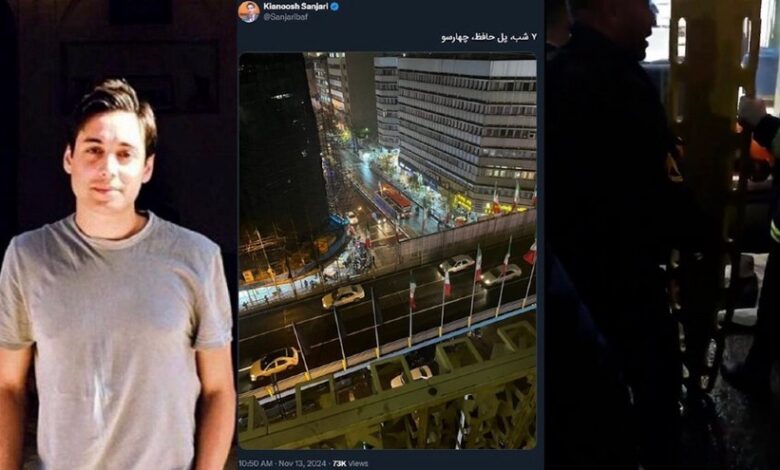
Kianush Sanjari took his own life in protest against the conditions of political prisoners in the Islamic Republic.
Kianush Sanjari, a journalist, human rights activist, and former collaborator of Voice of America who had resided outside the country for years, returned to Iran and protested the conditions of political prisoners. Ultimately, last week he ended his life in protest of this issue.
One day before his suicide, he posted on the social media platform X, writing: “If by 7 PM on Wednesday, November 23, 1403, Fatima Sepehri, Nasrin Shakarmami, Tomaj Salehi, and Arsham Rezaei are not released from prison and their release is not announced on the Judiciary’s news website, I will end my life in protest against Khamenei’s dictatorship and his accomplices.”
Reports and videos released yesterday and today regarding Kianush Sanjari report his suicide by jumping from the balcony of the Chaharsu Bazaar building in Tehran. Some of Kianush’s friends released a statement yesterday, Monday, in which they shared a video of his final moments of life. They announced that they had shown the original and complete version of the video to Kianush’s family and that the family had verified the authenticity of its content and events.
After two screenshots from videos recorded by security cameras in the Chaharsu building, which captured moments of Kianush’s suicide, were released but doubts were raised about those images, his friends decided to release Kianush’s videos.
In a statement they released regarding Kianush’s suicide, they wrote: “Although this document is being made available to the public, it should be noted that the release of such documents at a time when investigations are still ongoing not only disrupts the proper and scientific investigation process and verification hierarchies, but also poses serious challenges to the physical, psychological, and even privacy security of witnesses and individuals who have been assisting in finding the truth, most of whom are in Iran and within reach of the repressive institutions of the Islamic Republic. These kinds of pressures and the false atmosphere of distrust related to the cyber activities of security institutions may deter them from continuing their cooperation and cause disruption in the investigations.”
While noting that people have the right to know accurate information, they added: “While respecting the public’s right to know the truth and the free circulation of information, we ask you to exercise patience and, while remaining prepared to thwart the insane security project regarding Kianush that was discussed in the previous statement, dedicate your energy to the goal and intention for which Kianush sacrificed his life.
As stated in the second statement, our investigation as Kianush’s friends and comrades continues, and the results of this investigation, with details and collected evidence, will be released. The Iranian government, like all of us, was aware of Kianush’s decision. Although it had the ability to intervene and prevent his death in protest, it knowingly and passively watched his death. If the Islamic Republic were not involved, Kianush and other immortal patriots of the nation would be alive now, and the criminal Islamic regime, in every way, is responsible for the death of the courageous Kianush.” It should be noted that Ahmad Batebi, Sepideh Pouraqayi, Ardeshir Zarrezadeh, Behrouz Javadtehrani, Farzad Hamidi, Abbas Khorsandi, Kaveh Shirzad, Bahman Sadeghian-Nour, Kourosh Sahati, Hamid Alizadeh, Mehrdad Lohrasbi, Said Kalanki, Manoochehr Mohammadi, and Reza Meibein are signatories of the aforementioned statement.