Global Reactions Continue to Execution Verdict for November Protesters
The global hashtag “#DontExecute” has moved from Twitter and cyberspace to the pages of Iranian and international newspapers. Iranian newspapers published with headlines such as “Hold Back!” The German newspaper “Die Welt” wrote that the decision regarding the verdict rests with Ali Khamenei.
Requests to halt the execution of three protesters arrested during the nationwide demonstrations in November 2019 continue across Iran and the world with the hashtag “#DontExecute”.
The front pages of some Tehran publications, including Etemaad and Hamshahri newspapers on Thursday, July 16 (July 16), were dedicated to the news of execution verdicts.
Previously, Amnesty International and Human Rights Watch, two reputable human rights organizations, had criticized the issuance of execution verdicts for three Iranian protesters. According to these two international bodies, the trial of these three individuals was “unjust” and “confessions” were extracted under severe torture.
U.S. President Donald Trump also supported the campaign to halt the execution verdict by sending a Persian-language tweet and wrote, “The execution of these three people sends a shameful message to the world and should not be carried out.”
Besides Trump, Ann Linde, Sweden’s Foreign Minister, and Jeppe Kofod, Denmark’s Foreign Minister, also expressed concerns about these verdicts.
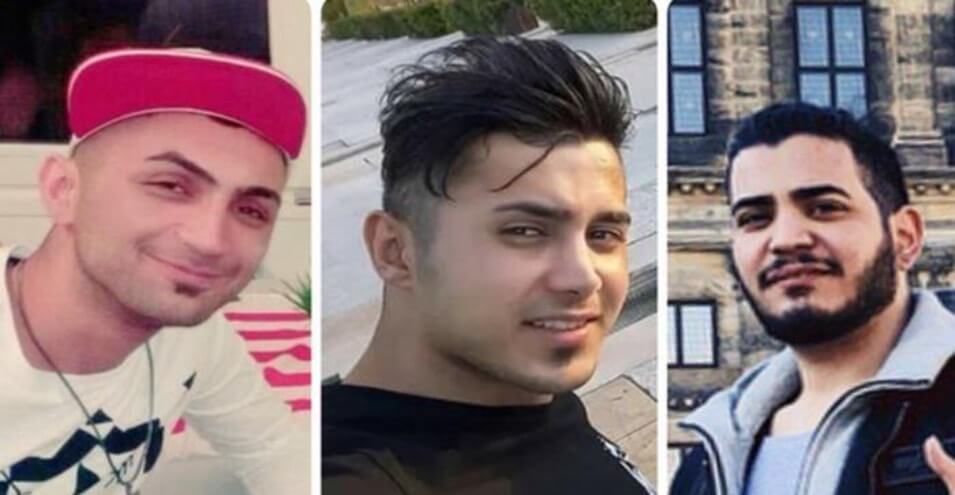
Internet users are calling for the cancellation of the execution sentences for Amirhossein Moradi, Saeed Tamjidi, and Mohammad Rajabi. These three individuals were among those arrested during the November 2019 protests.
The news of the confirmation of the execution verdict for Moradi, Tamjidi, and Rajabi was published by one of their lawyers a few days earlier, and the spokesperson of the Judiciary announced the confirmation of this news officially on Tuesday, July 15.
The Etemaad newspaper, with the headline “Hold Back,” wrote that “everyone is waiting for the decision of the Chief Justice regarding the execution verdict for three young November protesters.”
Etemaad also conducted an interview with Babak Paknia, the lawyer of one of the three young men sentenced to death.
Etemaad writes: “The hashtag ‘Don’t Execute’ is one of the most serious demands raised in recent days and is a protest by users and Iranians present on social networks.
Etemaad emphasizes that there was “neither coordination nor foreign space-making” for this demand.
The Hamshahri newspaper also published on Thursday, July 16, with the front-page headline “Waiting for a Verdict to be Halted.” This newspaper wrote that social media users and political and civil activists called for the reconsideration of the verdict of the three November defendants.
Kayhan Newspaper’s Response
However, not all Iranian newspapers that covered this topic shared the same view. The Kayhan newspaper, for example, wrote in a report on this matter, “If criminals are not punished, the security of society will be the first casualty.”
Kayhan writes: “An examination of the reactions of anti-Iranian users to tweets opposing the #DontExecute hashtag shows that many of them are natural-born murderers who, under the pretext of the execution verdict for three armed rioters, reveal their true faces.”
Kayhan, contrary to the Etemaad newspaper, wrote that “the nature of the tweets and their user accounts makes it clear that the organization of these users and the hashtag in question is directed from outside the country.”
Khamenei’s Decision on the Executions
However, the protest that had begun in cyberspace also reached global media outlets. The Der Spiegel German magazine’s website (Spiegel Online) reported on the issue and stated that the Islamic Republic of Iran still has not announced the number of victims and deaths of the November 2019 protests.
The German newspaper “Die Welt” also references the impact of social media in its report and writes that social networks, which were previously known mainly for spreading hate speech, fake news, or superficial issues, have now taken on a different nature.
According to Die Welt, “The current protest against the Iranian regime shows that Twitter and company can perform well.”
The German newspaper continues: “A Persian hashtag incomprehensible to most Germans has, over the past 24 hours, opened social networks around the world and has been used millions of times on Twitter and Instagram.”
Die Welt continues: “These protests are against the execution of Amirhossein Moradi, Saeed Tamjidi, and Mohammad Rajabi, who participated in demonstrations against the Iranian regime last year and now only Ayatollah Ali Khamenei, Iran’s leader, can cancel these execution verdicts, as the Supreme Court had previously confirmed these verdicts.”
Die Welt also addresses Germany’s policy toward Iran in relation to this issue and writes: “Heiko Maas, the current Foreign Minister, now faces the question of what diplomatic opportunities the German government will use to end injustice in Iran.”
Die Welt further emphasizes that online protests may not be able to save lives, but such protests can be described as a light in the darkness.
According to German media outlets, including Die Welt, the leaders of the Islamic Republic “understand the power of social media and limit the internet in their country to counter it.”
Source: DW