Workers’ Gatherings Protesting Seventh Development Plan; Reza Shahabi: They Have Unveiled ‘Modern Slavery’
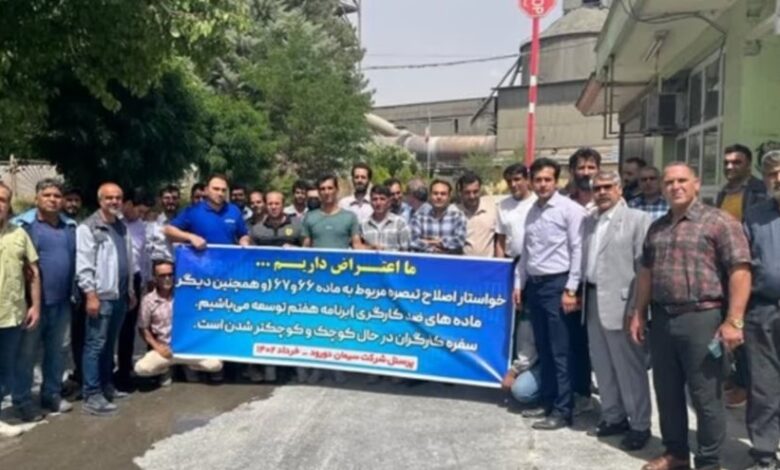
Several workers from Dorud Cement Factory in Lorestan Province gathered on Tuesday, June 23rd, to protest the “anti-worker clauses” of the Seventh Development Plan bill. Three days prior, workers from Hepco Factory in Arak had also gathered in protest of this plan.
In this regard, Reza Shahabi, imprisoned member of the board of directors of the Union of Bus Workers of Tehran and its Suburbs, wrote in a statement: “The government has publicly unveiled modern slavery and, in a sense, forced labor camps.”
According to ILNA news agency, the protesting workers of Dorud Cement said: “We believe that if these provisions are approved by parliament representatives, a large portion of workers’ legal benefits will be targeted.”
They added: “For years, under the most difficult conditions, we have worked in hopes of a better future and family stability, paying insurance premiums. Yet, incredibly, the government intends to raise the retirement age.”
The Dorud cement workers called on parliament representatives not to pass this “bill that violates the law” and to force the government to amend and revise it, so that “the workers’ community can find peace.”
Earlier, workers from Hepco Factory in Arak gathered on Saturday, June 20th, in the industrial facility’s courtyard and demanded that “the anti-worker clauses of the Seventh Development Plan, particularly the provisions of articles 66 and 67 of this plan, be deleted.”
The protesters’ reference was to “raising the retirement age and making early retirement conditions more difficult for workers,” which they said was “unjust.”
According to ILNA, one of the workers said: “The government should not play games with the fate of millions of workers” and emphasized: “Raising the retirement age and the anti-worker clauses of the Seventh Development Plan contradict workers’ collective interests and must be removed.”
This worker asked parliament representatives to “not agree to the approval of such destructive reforms.”
Several activists and independent labor and professional associations have also severely criticized the Seventh Development Plan in recent days.
The latest response comes from Reza Shahabi, imprisoned member of the board of directors of the Union of Bus Workers of Tehran and its Suburbs. Currently serving his sentence at Tehran’s Evin Prison, he wrote in a statement released this week: “The scissors of the Seventh Development Plan have two blades; one is the suppression and elimination of independent workers’ organizations, and the complementary blade is the increasing destabilization of workers’ lives and labor, to expose them to maximum exploitation.”
According to the report from the Union of Bus Workers of Tehran and its Suburbs channel, Mr. Shahabi noted that “the government has publicly unveiled modern slavery and, in a sense, forced labor camps.”
This imprisoned labor activist wrote in his statement: “A better future, accompanied by job security, welfare, health, medical care, free education, equality and justice in all areas, etc., will be realized when in every profession and trade, unions and other independent organizations establish themselves and, by uniting, pursue and achieve their demands.”
He concluded: “Alongside pursuing more fundamental struggles for the workers’ class, with these limited capacities of existing laws, we must also challenge the Seventh Development Plan and other anti-worker decisions of the authorities, put them in a difficult position, and not postpone today’s work entirely to tomorrow.”
The Free Union of Iranian Workers, in response to Article 15 of the plan, called it “indicative of extremely anti-worker and inhumane laws of the Islamic capitalist system in Iran.”
Article 15 of this plan states that in order to remove obstacles affecting employers’ hiring of new labor and business development, as well as attracting new entrants to the labor market and reviving the apprenticeship system and promoting practical on-the-job training in the first three years of employment, regulations exist such as paying half the approved minimum wage and the possibility of unilateral contract termination by the employer.
This labor organization wrote regarding Article 15 of this bill, which relates to temporary contracts with workers: “The employer, using the authority to terminate contracts at the end of three years, can easily dismiss workers and will not wait for workers’ contracts to reach four years.”
The Free Union of Iranian Workers added: “In Article 16 of this bill, it is also emphasized that employers are allowed to pay individuals with special conditions who are under the coverage of relief committees and welfare less than the approved minimum wage.” Based on this clause, individuals referred by the “Prison Organization” will also be included in this arrangement.
The Coordinating Committee to Assist in the Formation of Labor Organizations also called the Seventh Development Plan “the legalization of modern slavery” and added that this plan should “rightfully be considered one of the most important anti-worker bills since the 1979 Revolution.”
This organization added: “If the working class, even with the full amount of the approved minimum wage set by the Supreme Labor Council, was forced to disregard the initial and necessary costs of living and live in perpetual poverty and deprivation, with the passage of this bill, we will openly enter the era of modern slavery. Perhaps with the difference that in the ancient slavery system, at least the slave did not have to worry about food and shelter provided by the slave owner.”
The Council for Organizing Informal Oil Workers’ Protests (Arkan Third) also wrote: “The fact that this bill was drafted with deceptive justifications of reducing government costs, facilitating the recruitment of productive human resources to improve the community’s economic conditions, and in line with the slogan of resistance economy, is one of the obvious premises of the same thinking that considered workers’ wage increases as the main cause of inflation.”
Following intensified criticism of the Seventh Development Plan and its classification as “anti-worker” by labor organizations, the Islamic Republic’s Labor Minister announced the possibility of removing some anti-worker provisions from the Seventh Development Plan.
Soleimane Mortazavi says that “I think in the final revision of the Seventh Development Plan bill, Articles 15 and 16 have been deleted” and “it is likely this matter is no longer on the agenda.”
Nevertheless, Soleimane Mortazavi’s statements have not been confirmed or denied by any other official in the Islamic Republic, particularly the Planning and Budget Organization.
The Seventh Development Plan is designed for the years 1402 to 1406 (2023-2027), comprising 22 chapters and 7 main sections, and is meant to “determine the country’s macro strategies for the next five years.”
According to ISNA news agency, Davoud Manzoori, head of the Planning and Budget Organization, stated that with the implementation of the Seventh Development Plan, within five years, “the intended objectives in the fields of food security, inflation reduction and single-digit inflation, and economic growth” will be achieved.