Attorney General Acknowledges Iran Government’s Failed Attempts to Control Cyberspace
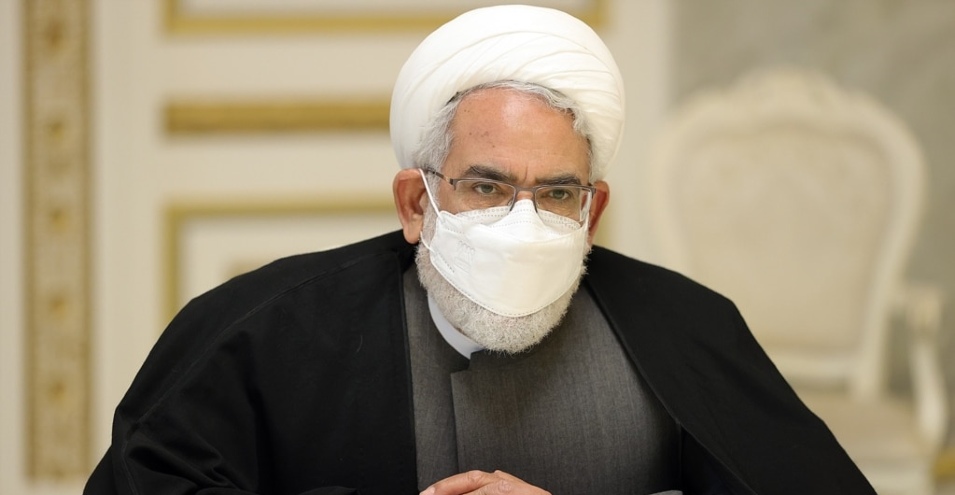
The country’s Attorney General described ongoing protests in Iran as a “cultural onslaught” and, while attacking previous government officials, said that years ago when Ali Khamenei called for “countering cultural aggression in cyberspace,” a “national information network” should have been created.
Mohammad Jafar Montazeri, the Attorney General, said on Tuesday, October 3rd, at the “Legislative Branch Mobilization Center”: “The fact that sixteen-year-old youth are participating in these current movements is due to cyberspace.”
He also, referring to the widespread presence of Iranian people conducting business on social networks, said: “We should have thought ahead at that time when people’s businesses were not yet in cyberspace, so that instead of using foreign applications and with the help of young people’s ideas, we could have created a domestic network.”
Islamic Republic officials, coinciding with the expansion of ongoing protests to various cities in Iran, imposed severe restrictions on users’ internet access.
On Tuesday, Iranian media reported that due to Instagram being filtered, in just two weeks, each Iranian store on this network suffered 50 million tomans in damages.
However, it does not appear that Islamic Republic officials intend to lift the filter on Instagram and WhatsApp in the near future, and Montazeri also claimed that “classes for crime and delinquency, indecency and immorality” are being held on WhatsApp and Instagram.
The Attorney General of the country added without naming anyone: “Today, a person who in the past was responsible for creating this network, in a tweet questioned filtering the internet. I wish there had been a meeting and debate so that I could prove with clear evidence that he had a hand in this crime.”
A few days ago, Mohammad Javad Azari Jahromi, Minister of Communications in Hassan Rouhani’s administration, wrote on his Telegram channel about the Islamic Republic’s policy to further restrict the internet: “Whenever I say something or raise a criticism, people start screaming that such and such didn’t happen in your time or such and such a system wasn’t established in your time.”
He added: “With all these experiences you mention, I must say that this path of interaction with cyberspace is certainly wrong and testing the tried and true is a mistake.”
The Islamic Republic has in recent years, by creating “cyber units” under the supervision of the Basij and Islamic Revolutionary Guard Corps and spending considerable amounts for implementing openly announced plans including the “National Internet,” extensively attempted to control social networks in Iran.
Likewise, the plan to further restrict the internet known as the “Protection Plan” was later placed on the parliament’s agenda after Ali Khamenei, the leader of the Islamic Republic, in multiple speeches called cyberspace in Iran “neglected and abandoned” and criticized relevant institutions for not restricting it.
However, before the start of recent protests, in mid-September, media reported the circulation of the Islamic Republic’s strategic document on cyberspace to relevant agencies for implementation.
Days later, a member of the Islamic Consultative Assembly revealed that the plan to control and restrict the internet in Iran was approved in the Supreme Council of Cyberspace by “circumventing” parliament.
Source: Radio Farda