“Negotiations to Lift House Arrest Not Harder Than Nuclear Deal”
A reformist member of parliament says issues such as “lifting Khatami’s media ban or lifting house arrest” require negotiation and discussion. These were part of the demands of Rouhani’s supporters at campaign rallies.
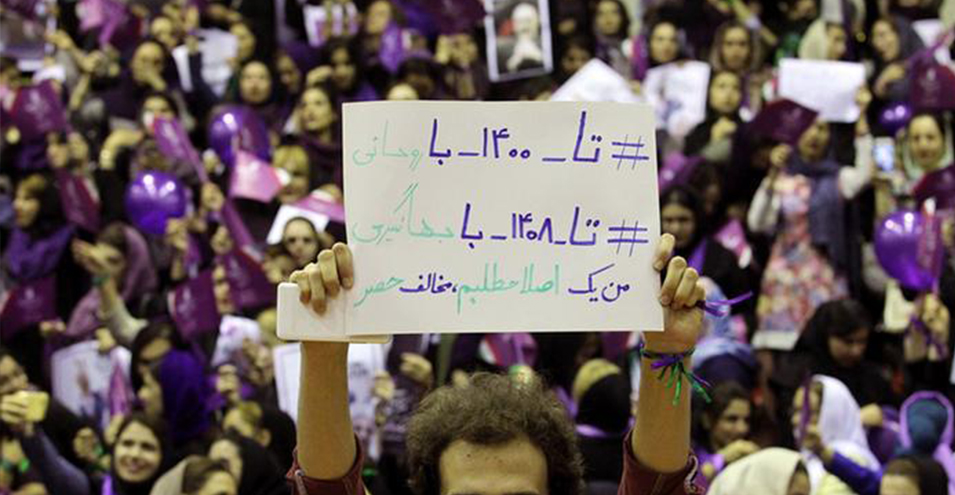
Ending the house arrest of two protesting candidates in the 2009 elections, Mir-Hossein Mousavi and Mehdi Karoubi, and Zahra Rahnavard, Mousavi’s wife, over the past four years was one of the demands of Hassan Rouhani’s supporters, which was repeated even more at campaign rallies in 2017.
“Our message is clear, house arrest must be broken,” was a slogan heard in almost all of Hassan Rouhani’s election speeches. Support for former President Mohammad Khatami and a request to lift the restrictions imposed on him also accompanied Rouhani in his election campaigns.
The eleventh government’s president, in his campaign speech in Tabriz and in response to a crowd chanting “Our message is clear…,” said: “I openly declare that with your high vote, your wish is also possible.”
The reformist representative of Gachsaran and head of the parliament’s Planning and Budget Commission said on this matter: “In any case, issues such as lifting Khatami’s media ban or lifting house arrest require negotiation and discussion. What is certain is that this problem is not harder than the nuclear deal. The question is: is it harder to sit at the negotiating table with the Americans or is it harder to lift house arrest or Khatami’s media ban?”
Hope for Khamenei’s Flexibility
Gholamreza Tajgardoon said on June 23 to ILNA news agency: “Accordingly, when the leader has accepted the issue of negotiations and the nuclear deal and helped solve this problem, they will certainly help solve these internal problems as well.”
At Rouhani’s first press conference after winning the twelfth presidential election, a reporter from one of the principlist media outlets asked him “why he doesn’t speak transparently for once about house arrest.”
The eleventh government’s president, in response to this question without specific reference to the house arrest of protesters against the announced results of the 2009 elections, emphasized that he is doing his best within his capacity to protect the rights of all citizens and one of the goals of the twelfth government is to pursue the implementation of the Citizen Rights Charter.
A member of the Hope faction in the tenth parliament says raising this issue by a reporter from a principlist media outlet “is more to disrupt the scene.” He expressed regret that “some of our friends” are acting the same way.
Tajgardoon told ILNA: “My political understanding and analysis is that sometimes when these issues reach stages close to being resolved, some friends make moves or statements that provoke the other side and create obstacles in the path of resolving these problems.”
Awaiting Rouhani’s Taboo-Breaking
Hassan Rouhani received more than 23 million and 549 thousand votes in this election round, which is close to 5 million votes and about six percent more than the 2013 elections.
The next four years will show to what extent Rouhani, with increased public support, will be able to implement his unfulfilled campaign promises from the 2013 elections, including regarding the freedom of political prisoners and ending the house arrest of Mousavi, Karoubi, and Rahnavard.
Tajgardoon believes that Rouhani and his main rival Ebrahim Raisi demonstrated “high courage” in discussing various issues during their election campaigns. He expressed hope that the twelfth government’s president will be able to break the “taboo of not using religious, ethnic minorities and women in the cabinet” by continuing the positive effects of the open election atmosphere.
Source: DW