Ibrahim Raisi Again Defends His Role in Summer 1988 Executions
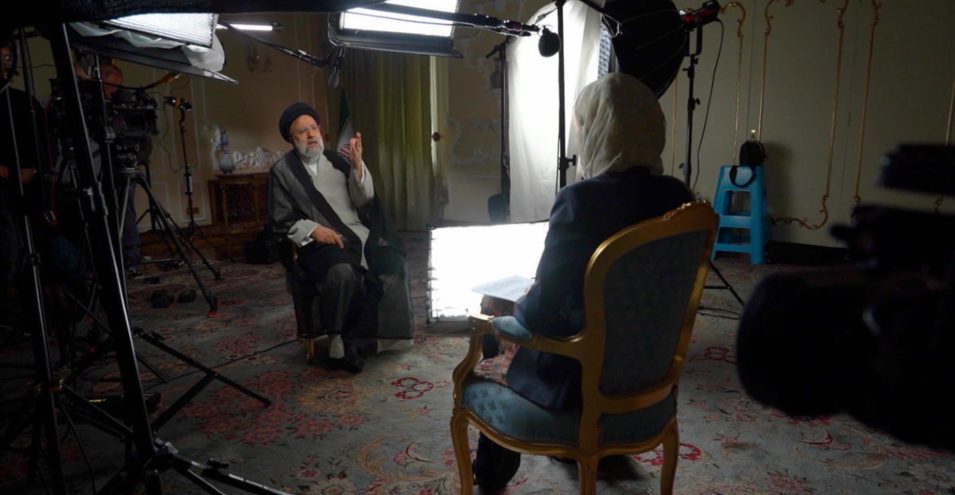
Ibrahim Raisi, in an interview with American CBS News that was recorded in Tehran last week and aired on Sunday, September 18, once again defended the execution of thousands of political prisoners in the summer of 1988, in which he played a direct role.
Iran’s president said in this interview that “what happened to them was exactly proportionate to what they did” and reiterated the claim that “they were assassinating people and their crimes had been addressed.”
The summer 1988 executions were carried out on the order of Ayatollah Khomeini, who appointed a four-member panel known as the “Death Committee” to determine the fate of thousands of political and ideological prisoners who were serving their sentences.
The result of this action was the execution of thousands of these prisoners in a short period of time; an action that Hossein-Ali Montazeri, then Ayatollah Khomeini’s deputy, also called a “crime” in a secret session with members of this committee.
Hossein-Ali Nairi, Morteza Ashraqi, Ibrahim Raisi, and Mostafa Pourmohammadi were the four judicial officials and main figures of the “Death Committee” in the summer 1988 executions.
Ibrahim Raisi had previously, following the 2021 presidential election, also defended his role as prosecutor in the 1988 executions and said he should be “commended and rewarded.”
This is while Human Rights Watch announced in June this year by publishing a research document that the execution of thousands of political prisoners in 1988 in the Islamic Republic constituted “crimes against humanity.”
Mr. Raisi, in response to a CBS News reporter about the Holocaust, also refused to confirm the occurrence of the Holocaust and said: “Historical events should be examined by researchers and historians.”
Iran’s president also added: “There are signs that this event (the Holocaust) happened. If so, allow it to be investigated and examined.”
The Holocaust refers to the killing of more than six million European Jews between 1939 and 1945 by the Nazis and their supporters, but it is not the first time that denial and doubt about its occurrence has been expressed by officials of the Islamic Republic.
Ayatollah Khamenei, the leader of the Islamic Republic, has repeatedly questioned the reality of the Holocaust and, for example, in a speech on March 21, 2014, said: “It is not clear whether the essence of this matter is true or not, or if it is true, what form it took.”
In previous years, Mahmoud Ahmadinejad, then president, repeatedly denied the Holocaust and called it “one of the great lies,” which also resulted in widespread global reactions.
Ibrahim Raisi also commented on negotiations to revive the JCPOA in his interview with CBS News and again raised “guarantees for the permanence of any potential agreement” as a condition of the Islamic Republic.
Raisi, who left on Monday for New York to participate in the United Nations General Assembly, also reiterated his previous position in this interview regarding the possibility of a meeting and talks with U.S. President Joe Biden, saying that in his view there is “no difference” between the performance of the Biden and Trump administrations.
He also added that the issue of prisoner exchange between Iran and the United States remains, referring to Iranian prisoners in the United States as those “imprisoned for attempting to circumvent sanctions.”
Despite the failure of the negotiations to revive the JCPOA and its suspension after the Islamic Republic presented two conditions regarding permanent guarantees and resolving issues related to the nuclear program, Ibrahim Raisi emphasized that “prisoner exchange with the United States is a humanitarian matter and subject to examination.”
This is while Robert Malley, the U.S. State Department’s Special Representative for Iran Affairs, has previously emphasized that a nuclear agreement with Iran without the release of American prisoners is unlikely.
Currently, Siamak Namazi, Emad Sharghi, and Morad Tahbaz are three Iranian-American citizens who are imprisoned in Iran on security charges such as “espionage” or “action against the security of the Islamic Republic.”
Also, the Islamic Republic is preventing Baquer Namazi, the father of Siamak Namazi, from leaving Iran and returning to the United States.
The Islamic Republic of Iran is accused of “taking hostage” dual-nationals or foreign nationals in order to pressure foreign governments to release its desired prisoners in other countries and advance its demands.
Source: Radio Farda