Khamenei Says ‘Security Forces and Basij Were Wronged the Most in These Events’
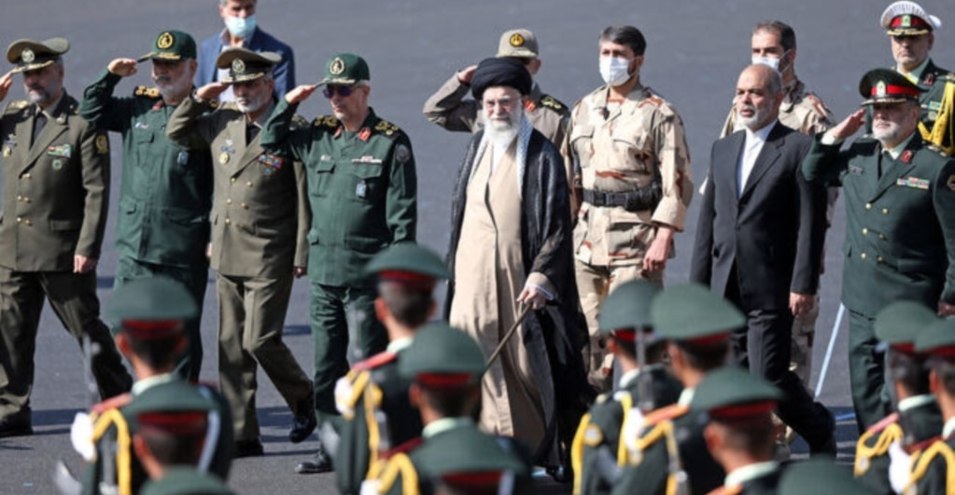
Iran’s domestic media reported on Monday, October 2, a statement from Ali Khamenei, the leader of the Islamic Republic, which they said was made after his visit to “a joint graduation ceremony of students from armed forces universities at the Imam Hassan Military Academy and Police Training College.”
According to this report, in his statement, Ali Khamenei characterized all of the recent ongoing protest movements of the people that have taken place in most Iranian cities as the “work of spy agencies and stubborn foreign policymakers” and described them as “designed” by the United States and Israel, saying that “in these events, the police organization and the Basij were wronged the most.”
This comes despite reports and videos released showing that security forces and Basij have used severe violence against protesters during the demonstrations, killing approximately one hundred protesters, including several children, through direct fire with military ammunition.
Furthermore, the police force, which has been accused of “killing” Mahsa Amini, has refused to provide accurate accountability and publish documents related to her arrest.
In his statement, Ali Khamenei claimed: “I clearly say these riots and insecurity were designed by America and the usurping, fake Zionist regime, and their employees and some traitorous Iranians abroad helped them.”
Officials of the Islamic Republic refer to Israel with titles such as “the Zionist regime.”
He added that in his opinion, “this work has no cause other than spy agencies and stubborn foreign policymakers, and these bullies are behind the recent events, and the dispute is not about the death of a young girl or about the hijab and improper hijab.”
The leader of the Islamic Republic provided no evidence or documentation for this claim and provided no details.
His statement about the veil not being relevant to the protests is made while the issue of protesting mandatory hijab is among the main topics of the people’s protests over the past seventeen days in Iran’s streets, as evidenced by the slogans and headscarves being burned by protesters.
Ali Khamenei also considered the death of Mahsa Amini due to her arrest by the Morality Police as something “not certain” and that there has been no “investigation” into it.
This is despite eyewitnesses reporting on the beating of Mahsa Amini during her arrest by “Morality Police” forces, and independent doctors have confirmed after reviewing Mahsa Amini’s brain CT scan the fracture of her skull resulting from a severe blow.
Ayatollah Khamenei further claimed that in the people’s protests “they set the Quran on fire, removed the hijab from the heads of hijab-wearing women, and set fire to mosques and hussainiyas.” He provided no documentation for any of these claims either.
Ali Khamenei had not appeared in public in recent days, and despite three weeks having passed since the anti-government protests in Iran, he had not previously commented on these protests.
Earlier, Khamenei’s website reported on a speech he gave on September 21 among military personnel, in which the leader of the Islamic Republic made no reference to Mahsa Amini’s death and the subsequent protests.
This comes despite the New York Times reporting before the start of the protests that Ali Khamenei had fallen ill and undergone surgery.
The New York Times also confirmed during the protests that its report about the illness and recent surgery of Iran’s Islamic Republic leader was accurate.
Furthermore, before the start of the protests, following the cancellation of the official ceremony for members of the Assembly of Experts to meet with Khamenei and also the cancellation of his speech to the Basij in Gorgan, speculation arose about his physical condition, particularly on social media.
Since 1989, Ali Khamenei has held the position of “Supreme Leader” and Commander-in-Chief of the Armed Forces, holding Iran’s government’s main power.
The release of news about “Khamenei’s meeting with the armed forces” during Iran’s protests could be seen as his support for the suppression of Iran’s protests.
The Issue of Famous Figures
Ali Khamenei then, referring to the positions taken by an increasing number of Iranian sports and entertainment figures against the Islamic Republic in recent days, said: “In my view, these positions are of no importance and we should not be sensitive about them.”
He then questioned the “honor” of figures who align themselves with protesting people and said: “Our artistic and sports community is healthy and it does not lack believing and honorable elements, and the position of a few people is of no value.”
The leader of the Islamic Republic also said about Iranian celebrities: “Determining whether their positions have criminal connotations or not is the responsibility of the judiciary, but from a public perspective, the position of these individuals is of no value, and the artistic and sports community will not be tainted by these enemy-pleasing positions.”
During the protests, many famous Iranian and foreign entertainment and sports figures supported the protesters, with the support of some Iranian figures particularly angering Islamic Republic officials.
Former footballer Ali Karimi, satirist Mehran Modiri, and Sardar Azmoun, striker for Iran’s national football team, are among these figures.
Gholamhossein Mohseni Eje’i, the head of the Islamic Republic’s judiciary, on Monday, September 26, threatened figures supporting the protests living inside the country, saying they should pay for the “material and moral damages” caused by the protests.
Source: Radio Farda