Alongside Street Sleepers and Cardboard Dwellers; Sewage Pipes Become Shelter for Another Stratum of Underprivileged in Isfahan
Hrana News Agency – A number of underprivileged and addicted individuals on the outskirts of Isfahan city are forced to spend their days and nights inside sewage pipes due to lack of housing and living space. Among these people, referred to as “pipe sleepers,” are unemployed citizens from provinces such as Chaharmahal and Bakhtiari, Kermanshah, and southern provinces of the country, as well as nationals of neighboring countries. There is no precise statistics on the number of pipe sleepers, but they are said to be part of one million marginal residents in the country. The following report describes the lives of some of these citizens.
According to Hrana News Agency, citing Shargh newspaper, a number of underprivileged and addicted individuals on the outskirts of Isfahan city are forced to spend their days and nights inside sewage pipes due to lack of housing and living space.
Based on this report, among these people are unemployed citizens from low-income provinces such as Chaharmahal and Bakhtiari, Kermanshah, and southern provinces of the country, as well as nationals of neighboring countries.
In the following report, Shargh newspaper describes the lives of some of these individuals:
“In the middle of the airport highway where you stand, you can see dilapidated houses from afar that seem to have no end. At the end of these houses lies barren earth whose sunsets have a different hue. Sandy hills and concrete pipes stuck together, extending beyond the boundary clinging to the veins of earth; we step hard on its reddish soil and climb up. Gray pipe shelters are visible from afar; people have huddled beside the pipe walls, the pipes at the edge of the wasteland, on the northernmost point of Isfahan, like Hollywood apocalyptic films.
No matter how far you look, there is nothing but the desert with cement pipes acting as a barrier between it and its two halves so that the addicted individuals cannot be easily seen. Days here are mourning days good home-dwellers’ days. Memories don’t let them be for a moment; a time when they served life fully in their homes and now in the plunder of these ruins, they’ve forgotten about love.
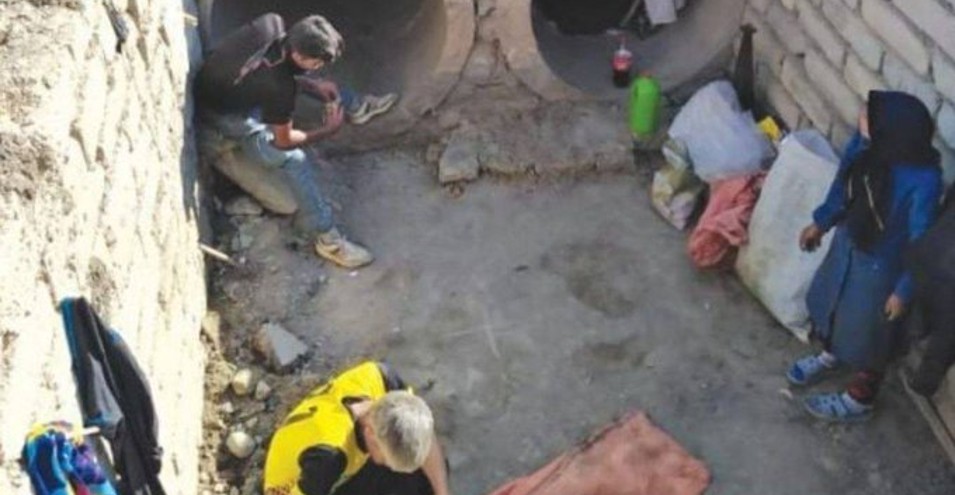
Here, the eyes of pipe sleepers end at the diameter of cement pipes; a ceiling that has a different meaning for Reza and has now become his ceiling. He squeezes himself into a pipe where he has hidden all his existence. A few dirt sacks and a faded jacket for cold days, plastic bags hanging that each have become pregnant with his remnants; from a wounded eye to a glass, a lighter, and a sugar bowl.
Reza’s home and those like him is here. Distressed inhabitants of homes without doors, without windows, without pillars that are barely the width of a thin man’s shoulders. Many of them have been patched to these cement pipes due to some misfortune or bankruptcy or any other trivial reason, and their homes are stuck in tunnels; a place where death, every day in the presence of a cloudless sky, bows respectfully and the alleyways fill with lingering stench.
Downtown has its own special world. From those monotonous and simple worlds and sometimes with its own special complexities. Fallen shutters, juice shops and dirty sandwich stalls, quiet butcher shops and silent alleys and groceries that are themselves a whole story amidst sufferings that their people have grown accustomed to. Suffering here is different, like a lonely chair that you’ve crushed, but it still retains its shape.
Why go the long way. There’s no news of those wide and long monotonous streets nor of the charm of fresh trees and newly built houses. The air on the margins is cold and icy. As if it has a fever. As if you should put a sack of ice on your body so that all groaning steam rises and the air goes away. When you go lower, to where the cardboard dwellers lean on the bodies of ruins, you see sleeping graves that smell of death. Women, humiliated and plundered, have become one with the hot bodies of lands whose bodies are sealed like hot clay.
From up here, from beside the entrance gate if you look at it, it’s as if you’ve stepped into nowhere; an endless passage; terrifying and dreadful with its sunset sun turning blue. A tangle of confused people in pits, in cement pipes, clinging to the veins of earth and crushed and hidden in heat. The air heat seems to peel your skin and sting your whole body with needles. Until the hideouts that have taken the name of home, there is no path, but heat each time kicks in your face to make Reza’s verbosity unbearable.
A little further, drunkenness runs through Reza’s skin and bones and he leans back against the pipes gazing at the sky. Amid his rambling, he barely lights an atomic lighter and takes it under a foil whose edges have turned black; the flame spreads and black liquid comes to life on the foil and Reza inhales its smoke.
Here a pipe with a few blankets and plastics hanging from it is the shelter for Reza’s hot and cold days and the rest. Sedighe is also one of the pipe sleepers of this neighborhood; since she came here, she has named herself Shaghayegh. It takes a while to see the features of a beautiful twenty-year-old woman between her blackened teeth with one missing. Before the ruins plundered her face, Sedighe had been with a smile and piercing black eyes. It takes half an hour for her frozen vein to accept the needle’s sharp tip, the thin stream of her vein swallows all the heroin and she leans against the hot cement pipe in front of the highway that is hardly visible from afar.
She sits on a mat of junk that has filled a few cubits of the pipe floor, the contents of the pipe starting from all kinds of old fabrics, dust-covered bottles until reaching garbage that has rotted in this mobile room. Forty pieces of mats of different materials that carpet the floor of Reza’s small home and the rest. Thick smoke rises from the side of old houses into the air. The pipe dwellers watch us tiredly.
Alleyways mostly have no end and women and children are the main actors in the alley scenes. The smell of poverty even spills out through the thin cracks of walls and doors, mixes with outside air and fills a person’s nostrils.
Gray Homes with Dome Roofs
It is two o’clock in the afternoon in Khordad and thick heat waves through the air and the body of the pipes seems to have boils. The air is more merciless than one can tolerate plastic patches to breathe suffocating air. The house owners seem to have been plundered.
Masumeh says: “Do you see the month wherever we are, we are one. Wherever we are we are close. We have each other. We’ve gotten used to each other. We are cellmates. We are pipe-mates. This is all our life.” She’s right; what they all share are some quilts and threadbare clothes and burnt mats that fit in gray homes with dome roofs.
The conversation starts; I ask, you live here?! A man in his sixties, as he lies crumpled in a pipe, shakes his head and says: “Why? We live here; me and ‘this’,” referring to ‘this’ as the boy next to him. Iman interrupts his speech, as he raises his head the redness of his eyes shows in pleasure, his eyes are sunken. His bluish lips quiver, uttering incomprehensible words from his mouth, the gist of which becomes that we are only here surviving and then we go to our own homes.
Beside him is a girl who speaks more clearly. It’s been two years since she’s been addicted and still not as practiced as the rest… In short, she has a whole world to say; so much so that only fragments and washed-out curses from her companion’s mouth shut his mouth. Her name is “Nazanin.” I ask about her addiction; her gaze remains fixed on the ground; the stares have made her restless; one of the addicts throws something and she prefers to be silent.
Asghar is also one of the pipe residents. Squatted beside a low fire, like an old turtle, bending and straightening. Asghar’s daily hangover curses mixed with wheezing: “You don’t know. It’s as if needles are raining from the air, by God my face is burning. The palm of my hand has become like a furnace from the heat.”
Half a cigarette, in the curve of his finger without taking a drag, has turned to ash and each time with the trembling of his hand, it falls to the ground and dies. Nothing passes before he painfully fills the syringe with heroin syrup. He taps on his ankle to reveal the abandoned vein, his own. Several times dried tissue, wounded until he finally finds a healthy gray vein.
He sighs from the depth of his throat and pushes life into his putrid arteries; then as if they’ve pulled him by four nails, he’s released onto ground fevered from heat. It’s neither his first time nor his last time until drunkenness flickers again in his eyes and with moments of consciousness he says goodbye and becomes like a moving corpse.
Asghar is now part of half a million marginal dwellers who neither fit among the marginals nor the cardboard dwellers; he drags the name pipe sleeper. There are no official and acceptable statistics on the number of pipe sleepers. They are migrants who have either come from around and villages or drawn from neighboring countries by the tune of a better life here. Among these people are unemployed citizens from low-income provinces such as Chaharmahal and Bakhtiari, Kermanshah, and southern provinces of the country, as well as nationals of neighboring countries.
The expelled ones in the unequal distribution of economic resources, according to unofficial statistics, their population doesn’t have much number or figures and are counted as part of half a million marginal dwellers that have been solved in the unequal distribution of resources and have now come to pipe sleeping.
Asghar, as he lies stretched out, raises his hand and says: This is the end of the world. Then his eyes fix on the sky that is wounded and turning to darkness. The air is twilight and the population of pipe sleepers is no longer countable. The inhabitants return home, to their beds so that tomorrow another day begins for the monotonous gray homes.”
Source: Hrana