92nd Session of Hamid Nouri’s Court: Defendant’s Lawyers Claim Court Lacks Authority to Review Indictment
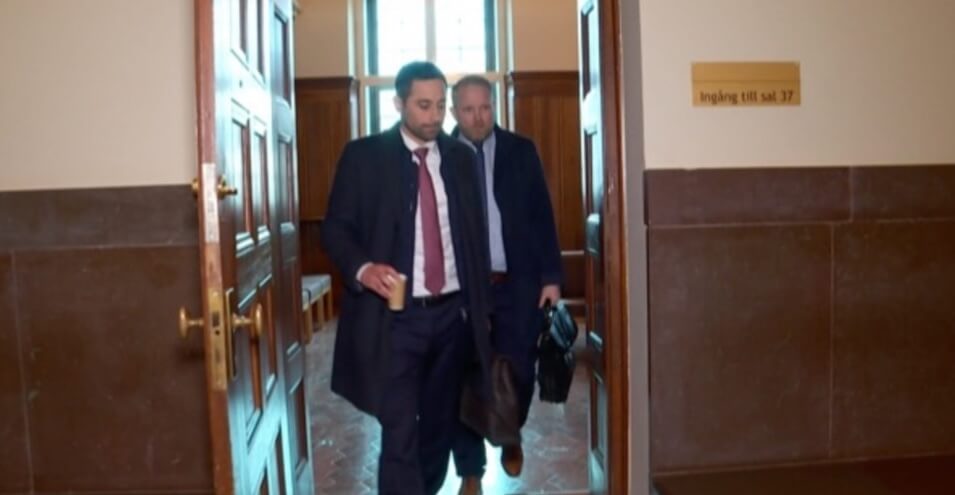
The 92nd session of Hamid Nouri’s court, who is accused of participating in the execution of political prisoners in the summer of 1988 at Gohardasht Prison, was held on Tuesday, the 13th of Ordibehesht 1401 [April 2, 2022] with the first final defense session of the defendant’s lawyers in Stockholm, Sweden. According to the pre-arranged schedule, the final defense of Nouri’s lawyers will be presented to the court over two days.
The first session of the defense was dedicated to the legal and judicial defense of the client, and many legal matters were examined and analyzed in light of Swedish domestic laws and international laws applicable in this court.
Thomas Sandler, the court judge, referred at the beginning of the session to a written objection submitted by the defendant’s lawyers recently to the court. The judge asked the defense lawyers to begin their defense from this written objection if they wished.
Hamid Nouri’s defense lawyer congratulated his client and all Muslims celebrating Eid al-Fitr at the beginning of the session. He outlined the beginning of the defendant’s defense in three sections:
- Examination of the Swedish court’s jurisdiction or lack thereof to handle the defendant’s case
- Examination and comparison of international and non-international armed conflict and the possible relationship of each in this case
- Identification and determination of Hamid Nouri’s identity by witnesses
- Hamid Nouri’s personal status
Hamid Nouri’s defense lawyer stated categorically regarding the jurisdiction of the Swedish court that the Swedish court does not even have the authority to review the indictment in this case. He said that first and foremost, the Swedish court lacks jurisdiction to try events that occurred thirty-four years ago, not in Sweden but in Iran. Second, Swedish laws do not apply to this case. Ultimately, this case has no connection whatsoever to Sweden and its interests.
The defendant’s defense lawyer spoke about the particularity of this case and said there are key points in this case that cause the entire case and the credibility of its evidentiary evidence to be questioned, including:
- The very long passage of time since the commission of the crime, meaning the period of the executions
- Believing the statements of witnesses and complainants and their credibility
- The role of memory and its fading over time
- The effect of complainants’ and witnesses’ statements on each other’s statements
- The role and impact of voice as a factor creating contamination in testimonies
- Insufficient control of evidence by prosecutors due to the specific problems of the case
- Inability to visit the crime scene [Evin Prison building] and mass graves
The defendant’s lawyer questioned the motives of the case’s witnesses and complainants and said that testimonies have been presented to the court with political motives, and their accuracy and credibility cannot be pursued and proven due to the specific position of the case.
Nouri’s lawyer mentioned the reason for the complainants and witnesses’ presence in this case as condemning the Iranian government and changing it by the case’s complainants and witnesses and their related political movements, and said: “If this [Hamid Nouri] is not convicted, Iran will not be convicted.”
The defendant’s lawyer questioned the credibility of the Friday prayer on the 6th of Mordad 1367 [July 28, 1988] and said it is unclear to us when and by whom this Friday prayer was held. He emphasized that the necessary and essential investigations in this matter have either not been conducted at all or are impossible.
The defendant’s defense lawyer said that based on Chapter Two of Sweden’s Penal Code, we can convict a person of crimes against humanity or at least a sentence of four years’ imprisonment or more. This is known as the “four-year rule.” The defendant’s defense lawyers believe that based on these definitions, the case cannot be tried in this court.
The defendant’s defense lawyer said these crimes [executions] were committed thirty-four years ago in Iran. Hamid Nouri was deceived and brought here, and even before the plane left Stockholm’s Arlanda airport, he was arrested.
The defendant’s defense lawyers spoke about the distribution of photos of their client before the start of the trial in cyberspace and its unavoidable impact on witnesses and the court proceedings.
The defendant’s defense lawyer said that based on Chapter Two of Sweden’s Penal Code, we can convict a person of crimes against humanity or at least a sentence of four years’ imprisonment or more. This is known as the “four-year rule.” The defendant’s defense lawyers believe that based on these definitions, the case cannot be tried in this court.
The defendant’s lawyers: “Sweden’s four-year rule contradicts the public law of nations [at the international level].”
The defendant’s lawyers: “In the proposed new legislation in 2020, the Swedish four-year rule was mentioned, which contradicts the public law of nations. Additional provisions must be added to limit the jurisdiction of courts so that Swedish laws and regulations do not contradict the rights of nations.”
The defendant’s lawyers: “A state in whose jurisdiction a murder has been committed has the authority to conduct judicial proceedings of the murder case.”
The defense lawyer stated categorically in the legal and judicial defense section of the defendant: “The court should generally reject the filing of the lawsuit in this case.” They say there should be no slightest doubt about the credibility of evidentiary evidence. In a standard case, evidentiary evidence must be properly considered and executed. In this case, there are violations in the prosecutors’ investigations, testimonies, and written evidence.
Nouri’s defense lawyers stated categorically that even the prosecutors themselves do not know what happened. Many questions have remained unanswered. Even regarding the beginning of Operation Forough-e Javidan (Mersad), the information and data differ. There is no definitive opinion in this regard. Nouri’s lawyer asked: What time did the Iranian government’s counter-attack occur in the first place? What was the type of weapons and the number of armed people from both sides and how many were killed?
Hamid Nouri’s defense lawyers in this session attempted to evaluate the case from both aspects of international and non-international armed conflict. They concluded that in either case, Swedish law is a deterrent to the nature of this court and its possible verdict. Nouri’s lawyer said that the case prosecutor believes the conflict between the Mujahedin-e Khalq Organization and the Iranian government can be considered within the framework of international or regional armed conflicts. He said that in comparing Swedish laws with international laws, we conclude that in either case, Swedish laws do not apply to this case. The conditions of this case are not sufficient within the framework of Swedish jurisdiction for this country to try this case.
Nouri’s lawyer said that in reviewing an armed conflict, the following matters should be considered; matters that either do not exist in this case at all or are severely lacking. Matters such as:
- The necessity of considering the continuity and intensity of operations
- Considering the type of weapons and equipment used in the conflict
- Considering the amount of ammunition fired
- Examining the number of forces that participated in the conflict
- The number of those killed
- The extent of material damage
The defendant’s defense lawyers questioned the nature of Ayatollah Khomeini’s fatwa and the relationship between this fatwa and the cause of the executions. The defendant’s lawyer said that this fatwa has no date, and this is in itself a strange thing. This fatwa does not have an official government seal. He said Hamid says that government documents are generally stamped with an official seal. We have had documents in this case that were officially stamped. Nouri’s lawyer questioned the identity of the fatwa issuer and said the person who wrote it is unknown. He said the author of the letter is unknown.
He referred to the expert opinion of Rozbe Parsi, who told the court that Ahmad Khomeini wrote the letter. But again, it has not been determined. The investigation into the origin of this letter is unclear. They also claimed that no handwriting analysis was conducted, and if it was, they have not seen it.
Nouri’s lawyer said regarding the connection between the fatwa and the motivation for the executions that the prosecutors failed to establish this connection. The fatwa writings have no connection to the armed conflict. He said that even in the Amnesty International report, it came that the carrying out of these executions was planned before the execution of Operation Forough-e Javidan (Mersad). Therefore, it can be concluded that there is no connection between this operation and the fatwa and executions.
Nouri’s lawyer completely questioned the testimonies. He said these testimonies are copied from each other. He believes there are gross discrepancies between what the complainants and witnesses said in police interrogations and their testimony in court. The defendant’s lawyers believe that there are very gross discrepancies between these two, and over these two years, the testimonies have changed greatly. He said if in these two years all these statements and testimonies have changed, then see how much the narratives and statements have increased and decreased over thirty-odd years.
He described the possibility of viewing events through window blinds as impossible. Nouri’s lawyer said that this subject has been addressed in Iraj Mesdaghi’s book and the rest have repeated it. He said the subject of bending window blinds to see events during the executions is a fabricated story by the complainants. He said the complainants and witnesses presented this fabricated story to justify how they saw events during the executions. Nouri’s lawyers said we do not accept such claims in any way.
Hamid Nouri’s lawyers explained that prisoners were blindfolded when being transferred to the death corridor and in front of the death committee. Nouri’s lawyer for the umpteenth time in court stated that the prosecutors made their work easy and did not conduct the necessary and sufficient investigation and examination. Nouri’s lawyer said: “If the prosecutor had gone into details, the matters would not make sense. The prosecutor himself knows this.”
He said the use of blindfolds was a normal practice in Iranian prisons, and Hamid Nouri personally confirmed this. He dismissed the testimonies about having personal blindfolds as incredible. He said this subject was also mentioned in Iraj Mesdaghi’s book and “lameness” was discussed. Prisoners claimed that they personally chose the type of blindfold. Nouri’s lawyer said this is absolutely not believable, and we question the statements of these people—whether they were lame or blindfolded.
Nouri’s lawyer claimed that Iraj’s statements about the use of lameness or blindfolds after the executions are contradictory. Nouri’s lawyer did not deny the transfer of materials by trucks and said it is natural that trucks be used for prison work. He said regarding the trucks, the type of materials they carry is important. Nouri’s lawyer claimed that testimonies about the type of truck, appearance, and things they transported are different and contradictory.
Nouri’s lawyer said there is no logical explanation for these testimonies. He called the testimonies about the trucks fabricated as well. He even called people’s testimonies about the route of the trucks unusual and surprising. Nouri’s lawyer said regarding Manouchehr Puyandeh, he saw corpses that were scattered in the prison yard. He said: “We question all these statements.”
Nouri’s lawyers compared Atiabi’s statements in conversation with Iran’s human rights documents in 2009 with his testimony in court and called his explanations different. Atiabi is the same prisoner who testified to the events of the executions in a calendar he had at the prison at that time.
Nouri’s lawyer said: “The testimony of an individual like Atiabi has no evidentiary value in the case. You should be careful with respect to this evidentiary evidence.” The defendant’s lawyers say that by considering the material differences between Iraj Mesdaghi’s writings and testimonies and Atiabi’s statements, we conclude that the testimonies and statements are contradictory. The defendant claimed that Atiabi’s statements are completely different from the rest of the witnesses.
In one part of the court, Nouri’s lawyer compared the statements of Iraj Mesdaghi, Mahmoud Royaei, and a list of Mujahedin-e Khalq Organization members regarding the date of the start of executions and the number of executions with each other and claimed that there are gross contradictions between them.
Source: Voice of America