Exclusive Interview with the Wife of Imprisoned Shahab Delili: Security Officials Told Me to Observe a ‘Silence Fast’
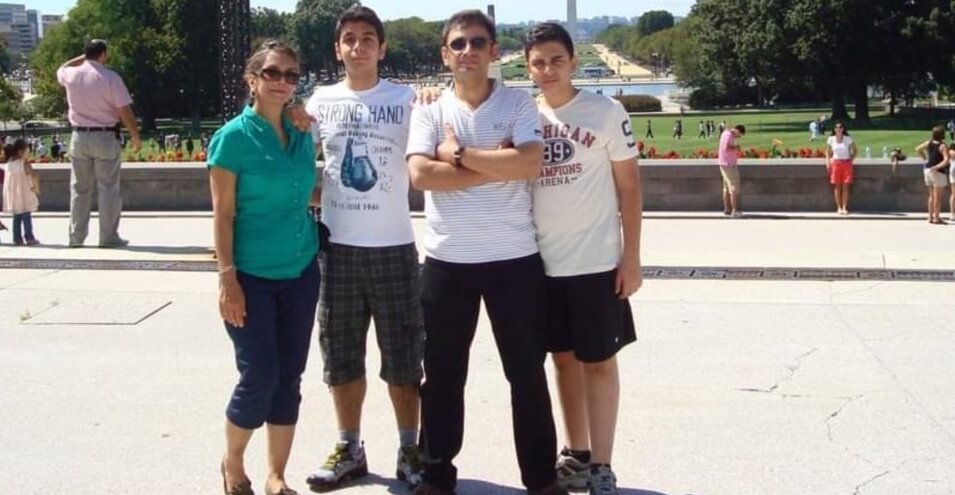
Shahab Delili, an Iranian citizen with permanent residency in the United States, has been imprisoned in Iran for approximately six years. He traveled to Iran in 2016 to attend his father’s funeral, but was arrested while attempting to leave the country and was subsequently sentenced to ten years in prison on charges of what was described as “cooperation with a hostile state.”
The family of Shahab Delili had maintained silence due to threats and promises made by Iranian security officials, hoping that cooperation might lead to his release. However, after six long years of false hopes and various threats, the Delili family finally decided to make his arrest and imprisonment public.
Mr. Delili’s wife, in her first media interview, spoke exclusively with the Persian service of Voice of America about her husband’s situation and case.
Nahid, the wife of Shahab Delili, told Voice of America: “We had been in America for one year, and this was his first return to Iran. He only went for one week and was arrested on his way back at the airport. It has now been six years since we have seen him.”
Shahab Delili traveled to Iran in April 2016 to attend his father’s funeral when he was arrested. Shahab’s mother passed away last year; however, Mr. Delili, despite being in Iran, was unable to attend his mother’s funeral because he was not granted leave.
Nahid Delili stated: “The charge against him was contact with the hostile country of America. For two years, the court status and verdict were unclear. People who identified themselves as Ministry of Intelligence officials contacted me and told me to remain silent. The term they used was a ‘silence fast.’ They told me that I should observe a silence fast. They also asked me for money to help him. Of course, I was certain that Shahab was innocent and that the court would acquit him when it was held. But I think these contacts were fraudulent because when Shahab’s verdict was issued and he was sentenced to 10 years in prison on charges of contact with the hostile country of America, these contacts stopped.”
When asked what caused her to break this silence, Mrs. Delili said: “Making this decision was very difficult for me, and I was worried that if I made the wrong decision, the outcome of Shahab’s case could worsen, and I would be responsible. After about two years, Shahab was able to come home on a four-day furlough by posting bail. And for a prisoner, even these four days are a blessing so he could see his family and his mother while still alive. Unfortunately, last year, when Shahab was still in prison, his mother passed away, and even though Shahab was in Iran, he was not allowed to attend his mother’s funeral.”
In explaining her silence over the past six years, Shahab Delili’s wife said: “We thought that because we listened to and complied with their silence fast, furloughs would be granted, and perhaps by speaking up, I would create problems in his case. I was always hopeful that perhaps justice would prevail and perhaps Shahab’s sentence would be changed, or perhaps he would receive a pardon or conditional release.”
Nahid Delili, referring to ongoing negotiations for the release of American prisoners held in Iranian prisons, called on the US government to pursue her husband’s case in its negotiations with Iranian officials. She said: “I have heard that America is currently negotiating for the release of hostages in Iran, and certain names are being mentioned, while Shahab’s name is not among them. For this reason, I decided to make this matter public and convey my message to President Biden and others who care about the freedom of people, that Shahab has been in prison for six years, and I ask them not to forget Shahab in these negotiations.”
Regarding her husband’s work and background, Nahid Delili said: “Shahab was a captain in Iran’s Islamic Republic Shipping Company and served in shipping for 30 years. During this time, he had an outstanding record and received commendations. He had no connection to any hostile country and only performed the duties assigned to him. He traveled to various countries and was always trusted.”
Nahid Delili, referring to their emigration to America through family connections, added: “I tell you right now, I can never believe that the charges against Shahab could be true. But in court, the judge said that any contact, even speaking to an American person, even about Iran’s weather, is considered a crime.”
Referring to her husband’s poor conditions in prison, Nahid said: “Shahab never complains about the conditions there so we won’t be upset, but in the midst of our conversations, I understood that there are insects there, and other prisoners use pesticide and other things to get rid of them, and they are forced to constantly disinfect where they sleep. He has told me about cockroaches, about the sewage there. None of these were direct complaints, but when we talk to each other, he wants to know what we are doing throughout the day and to be involved in our life, and he also tells me, and between his words I can understand that conditions are not suitable, but he doesn’t complain so we won’t be upset.”
Currently, other foreign nationals or dual-nationality Iranians imprisoned in Iran include Siamak and Baquer Namazi, Iranian-American citizens; Emad Sharghi, an Iranian-American citizen; Mehrdad Raouf, an Iranian-British citizen; Ahmadrezа Jalali, an Iranian-Swedish researcher; Masoud Mosaheb and Kamran Ghaderi, Iranian-Austrian citizens; Fariba Adelkhah, an Iranian-French citizen; Nahid Taghvai, a German-Iranian citizen; as well as Benjamin Brière, a French tourist.