Vienna Talks; Bagheri: No Guarantee for Crossing the Finish Line
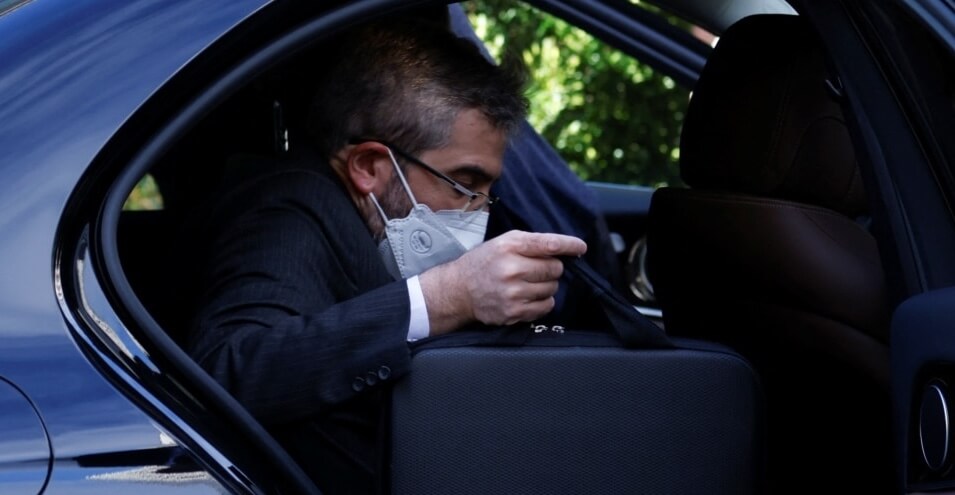
While Ali Bagheri, Iran’s senior negotiator, says that no matter how close we get to the finish line of negotiations, “there is no guarantee to cross it,” Ali Shamkhani, secretary of Iran’s Supreme National Security Council, considers achieving a good agreement “possible.”
Mr. Bagheri on Twitter attributed all responsibility for concluding the negotiations to the Western parties and wrote: “To complete the work, there are specific decisions that the Western parties must make.”
This is while Ali Shamkhani tweeted: “Achieving a good agreement is possible due to notable progress in negotiations, which has mainly resulted from Iranian initiatives.”
He, however, conditioned the final stage of Vienna talks to “balancing” the agreement, which according to him can be achieved through “Western political decision-making.”
Shamkhani had previously, in different statements, described the JCPOA as an “empty shell.”
Iran’s Foreign Minister Hossein Amir-Abdollahian also, in a phone conversation with Liz Truss, his British counterpart, made acceleration of the process of reaching an agreement conditional on “taking bold and realistic political decisions by Western parties to ensure and secure Iran’s interests.”
He, among other things, emphasized “the practical removal of sanctions,” which according to him will lead to “a sustainable agreement.”
The statements of these two senior officials of the Islamic Republic’s foreign policy are being raised at a time when Western powers in recent weeks have repeatedly warned Iran that there is not much opportunity left for an agreement.
Iranian media have also reported that Ali Bagheri left for Tehran on Wednesday evening, March 25, on a “very short trip,” but members of Iran’s expert delegation in Vienna will remain present and continue consultations.
Behrouz Kamalvandi, spokesman for this organization, has also traveled to Vienna to conduct technical consultations between Iran and the International Atomic Energy Agency.
The eighth round of talks aimed at reviving the JCPOA continues in Vienna with the participation of representatives from Iran, Russia, China, France, Britain, Germany, the European Union, and the United States. American representatives are indirectly present in these talks, and Iranian officials say they are not willing to negotiate directly with them.
The ultimate goal of these talks is to return to the spirit of the nuclear agreement of June 2015 between Iran and world powers, namely the lifting of sanctions against Iran, including important sanctions on industry and oil exports in exchange for limiting Tehran’s nuclear activities and extending the time needed to produce enriched uranium necessary for nuclear weapons production.
Donald Trump’s administration exited the JCPOA in April 2018 and, after a few months, resumed severe sanctions against Iran. Iran’s government, in response to this U.S. action, suspended the implementation of some of its commitments under the JCPOA and increased the volume and ratio of uranium enrichment.
While it was predicted that by the end of this week, news of an agreement on reviving the JCPOA would be released, it is unclear what impact Russia’s attack on Ukraine and the intensification of differences between the West and Russia, which participate in the JCPOA talks, will have on the process of reaching an agreement.
Source: Radio Farda