Fifty-Fourth Session of Hamid Nouri’s Trial; Witness: The Defendant Would Bang My Head on the Table and Say You Don’t Deserve Freedom
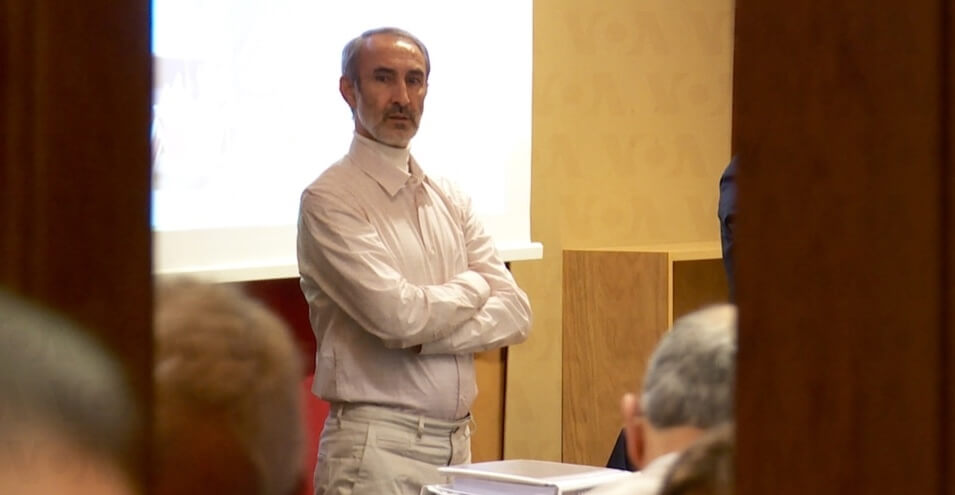
The fifty-fourth session of the trial of Hamid Nouri, accused of war crimes and participation in the massacre of political prisoners in the summer of 1988, was held on Thursday, December 16, 2021, with testimony from Mehrzad Dashtbani in Stockholm, Sweden.
The witness testified in court based on the prosecutor’s indictment against Hamid Nouri regarding the charge of “intentional killing” of left-wing political prisoners in 1988.
Mehrzad Dashtbani was first arrested in autumn 1981 on suspicion of supporting the Mujahedin-e Khalq organization, and a second time in late 1982 for activities in the Organization for the Struggle to Free the Working Class. The witness was taken to Ward 209 of Evin Prison and was later sentenced to five years in prison.
Mehrzad Dashtbani was imprisoned in Gohardasht Prison from 1985 to 1987. He had encountered Hamid Nouri multiple times in Gohardasht and Evin prisons. During his entire prison term, he had only one in-person visit, which took place in the presence of Hamid Nouri.
Hamid Nouri had tried to use this visit to obtain a commitment and signature from the prisoner through his parents. He had said that [Mehrzad Dashtbani] himself wants to remain in prison and if he signs, he will be released immediately. He had emphasized that prison authorities would have no responsibility for the consequences of this matter thereafter.
The witness explained today in court how, after refusing to write a renunciation letter and written commitment at the end of his five-year sentence, he was subjected to severe beatings by Hamid Nouri in Gohardasht Prison. The witness said that Hamid Nouri grabbed his throat and squeezed it. While doing so, Nouri banged his head on the table and shouted that he did not deserve freedom and that he himself would kill him. The witness also experienced group beatings by Nouri and his colleagues. Dashtbani was transferred to Evin Prison shortly after this incident and was held in solitary confinement from late 1987 until the acceptance of the resolution.
He was later transferred to Gohardasht with a number of other left-wing prisoners and was held in pairs in solitary cells and above the ward of “Nationalists.” He was later moved into the “Nationalists” ward and saw almost none of the Mujahedin there. Only a handful of Mujahedin-e Khalq remained, and most of them had been massacred.
Mehrzad Dashtbani witnessed three beige Mercedes cars entering the prison courtyard after a Friday. The death commission, consisting of Raisi, Mobasheri, and Eshraqi, got out of the cars and left, while the drivers lay down on the hoods of the cars. In another part of his testimony, while elaborating on this scene, the witness said that half an hour later, a helicopter entered the prison, piloted by Mousavi Ardabili, then head of the judiciary.
Mehrzad Dashtbani also confirmed the identity and execution of several individuals listed in the indictment, including Hossein Haj Mohsen, Majid Walid, Sarkhosh, Mahmoud Ghazi, and Mohammad Ali Pejman.
The witness recounted what prisoners in the “Nationalists” ward said about Abbas Raisi, a supporter of the Pikaar organization and law student. Abbas Raisi had said the night before his execution that he could not return to the south and tell oil company workers that he is a Muslim and prays. He had said that everyone must make their own personal decision. Abbas Raisi preferred to be executed in Gohardasht Prison.
Mehrzad Dashtbani, today’s witness in court, was again transferred to Gohardasht Prison in August 1988. Regarding events after the executions, he said that prisoners were pressured to pray. When prison officials heard the answer “no,” they attacked prisoners with cables, fists, and kicks. Mehrzad Dashtbani was released from Gohardasht Prison in early 1989.
The next session of the court will be held on Monday, December 20, with testimony from Hossein Maleki in Stockholm.
Source: Voice of America