Deputy Interior Minister Acknowledges Increased Desire for Fundamental Changes in Iran
According to the Deputy Minister of Interior, in recent years the resilience of the Iranian people has declined and the desire for fundamental changes in the country is increasing. He says that people’s distrust in the effectiveness of religious governance in addressing existing challenges is a warning sign.
Taghi Rostamvandi, Deputy Minister of Interior and Head of the Social Affairs Organization, presented statistics at a conference held in cooperation with Shahid Beheshti University about the increase in social harms in Iran and the decline of people’s resilience due to intensified economic pressures.
According to Fars News Agency, the second national conference on addressing social harms from an Islamic perspective began on Sunday morning, December 26, with the presence of Interior Minister Ahmad Vahidi, several of his deputies, and a number of parliamentary representatives.
The Head of the Social Affairs Organization said in recent research studies, indicators have been obtained including regarding the desire to emigrate that are “highly concerning.”
Desire for Fundamental Changes, Inclination Toward Non-Religious Government
Taghi Rostamvandi says the desire for fundamental changes in Iran is increasing. He called the indicator of desire for protest as another concerning factor.
The Deputy Interior Minister, referring to the indicator of inclination toward non-religious government, said: “If we feel that due to ineffectiveness, people’s views are moving in a direction as if religious government has not been successful in solving the country’s challenges and perhaps another government such as a secular and non-religious government could solve the country’s problems, then an alarm bell rings for us.”
The Islamic Republic introduces itself as a religious government based on Shia Islamic laws, and over the past four decades has not only been ineffective in addressing challenges but has also fueled problems such as corruption and poverty.
Desire for Protest as “Norm-Breaking”
Taghi Rostamvandi, referring to the indicator of desire for protest, said: “This protest can manifest itself in the form of norm-breaking behaviors or deviance. On the other hand, in recent years with the increase in economic and livelihood pressures, people’s resilience has declined.”
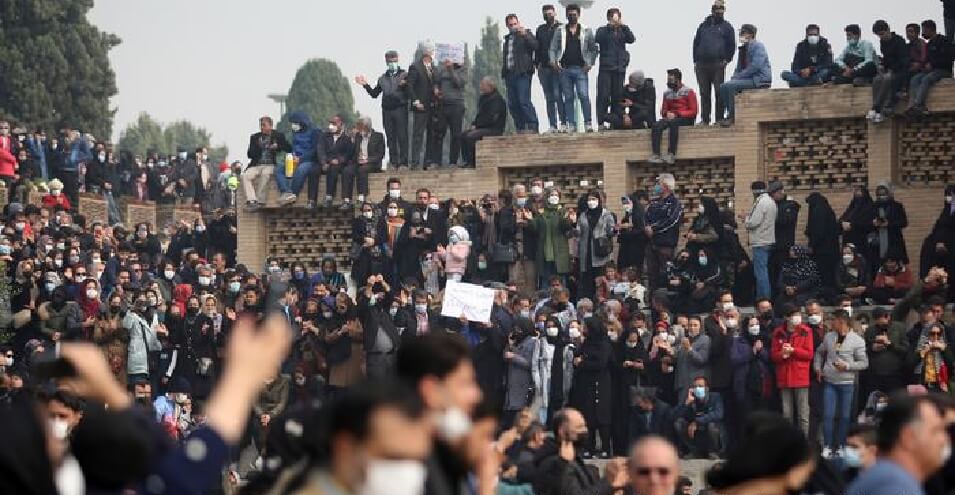
In recent years, the scope and intensity of social protests in Iran have expanded and the time intervals between them have continuously shortened. One of the characteristics of protest movements, especially since 2017 onwards, has been the rapid anti-government nature of these movements, which is apparently called “norm-breaking and deviance.”
According to the Head of the Social Affairs Organization, 40 to 45 percent of citizens believe that neither people nor officials respect the law, and 50 percent of them believe that the degree of justice and equality in society is inadequate.
Increase in Poverty and Marginalization Under Religious Government
The ineffectiveness of Iran’s religious government is also evident in the severe increase in poverty and destitution. The Ministry of Labor announced in a report in September this year that more than one-third of Iran’s population lives in absolute poverty.
Farshad Momeni, Head of the Institute for the Study of Religion and Economics, also said in November, based on the latest research, that during the three-year period between 2017 and 2020, Iran’s population below the poverty line more than doubled.
Now the Head of the Social Affairs Organization has identified marginalization as one of the social harms and says 11 to 13 million people in Iran live in “informal settlements” and measures must be taken to organize them.
Alcohol Consumption, Suicide, Abortion
The Head of the Social Affairs Organization, in another part of his remarks, referred to the increase in alcohol consumption in Iran and said it is estimated that between 9 to 10 percent of people aged 15 to 64 consume alcohol, which amounts to approximately five million people.
Taghi Rostamvandi also said that approximately 100,000 people commit suicide in Iran per year, between 5,000 to 5,500 of whom lose their lives, and this process has an “upward trend” that must be controlled.
He says according to the Ministry of Health statistics, 230,000 illegal abortions are performed in Iran annually, but some research estimates this number at 300,000 to 400,000 cases per year.
Alcohol consumption, suicide, and abortion are actions that in the Islamic Republic are considered forbidden and prohibited according to Islamic laws.
Source: DW