Iranian Government’s Efforts to Further Restrict Internet; National Information Network Budget Tripled
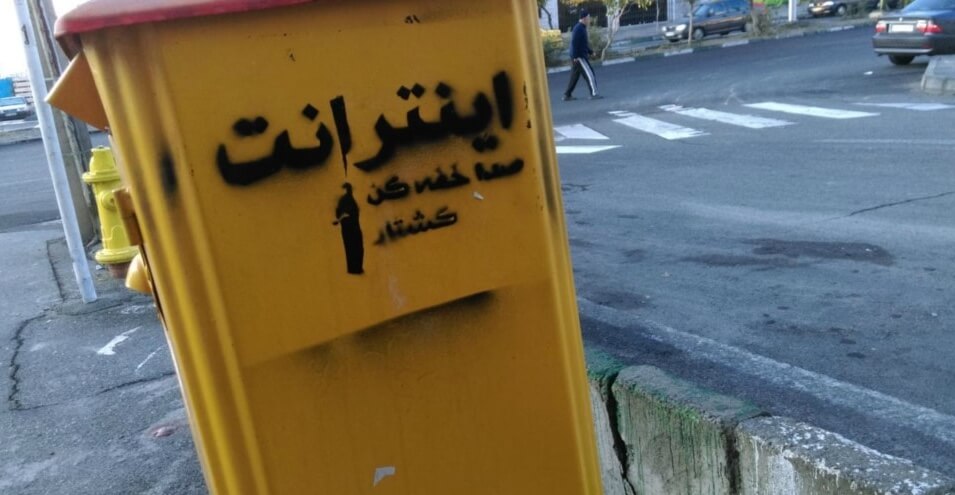
Despite severe economic difficulties that have led to a sharp decline in Iran’s government revenues, plans to restrict the internet have intensified, and Ali Asghar Ansari, Deputy Minister of Communications of Iran, has announced that the budget for the National Information Network will be tripled in next year’s budget.
For years, the Iranian government has been attempting to disconnect the domestic internet (intranet) from the global internet under the pretext of launching a “National Network” for security reasons and to control protests, suppress them, or censor suppression events. This plan, which is referred to as the “switch to disconnect from the global internet,” is scheduled to be finalized by the end of 2023.
The Deputy Minister of Communications told Mehr News Agency that in next year’s budget, funds allocated for “supporting messengers and social networks and other applicable services” will be spent. In previous years, the Iranian government spent enormous sums to support domestic messengers and social networks, most of which ended in failure.
As the Research Center of the Iranian Parliament estimated in May of this year, approximately 19 trillion tomans have been spent on creating the “National Internet” up to last year.
Issa Zarepour, Minister of Communications and Information Technology, recently noted that 35 to 40 percent of this network has been launched and promised that the network would be fully operational within the next three years.
Describing himself as the “field commander” of launching this network, he emphasized that “virtual space must be launched in line with the Islamic Revolution.”
The Iranian government’s planning and investment in further restricting the internet is taking place while “Freedom House” (Freedom House) in its latest report for 2021 announced the internet freedom index of countries around the world, and in this table Iran is ranked among the worst countries with the least internet freedom—even lower than countries such as Belarus, Uzbekistan, and Pakistan.
In recent months, after the Leader of the Islamic Republic, in his remarks, called the virtual space in Iran “neglected and abandoned” and criticized responsible institutions for not restricting it, the “Protection of Virtual Space” bill was placed on the agenda of the Iranian Parliament, whose focus is limiting social networks.
The bill referred to as “Support for User Rights and Basic Applicable Services in Virtual Space” and also known as the “Protection Bill,” is organized in 37 articles and is currently under review at the Research Center of the Parliament.
Opponents of the “Bill for Protection of User Rights in Virtual Space” have warned that the issue is not limited to restricting important foreign messengers like Instagram, and if this bill is passed, fundamental changes will occur in the way users operate, internet monitoring, and bandwidth, and its goal is to impose severe restrictions on internet access.
Critics also say that supporters of this bill are seeking to implement wider filtering and then replace some applications. One of the proposed applications is the Rubino application, which is set to replace Instagram.
This application is managed by a company affiliated with the Execution Headquarters of the Imam’s Order. The Execution Headquarters of the Imam’s Order is the largest economic holding affiliated with the office of the Leader of the Islamic Republic.
Source: Radio Farda