Elimination of Arts and Foreign Language Programs from Some Iranian Universities
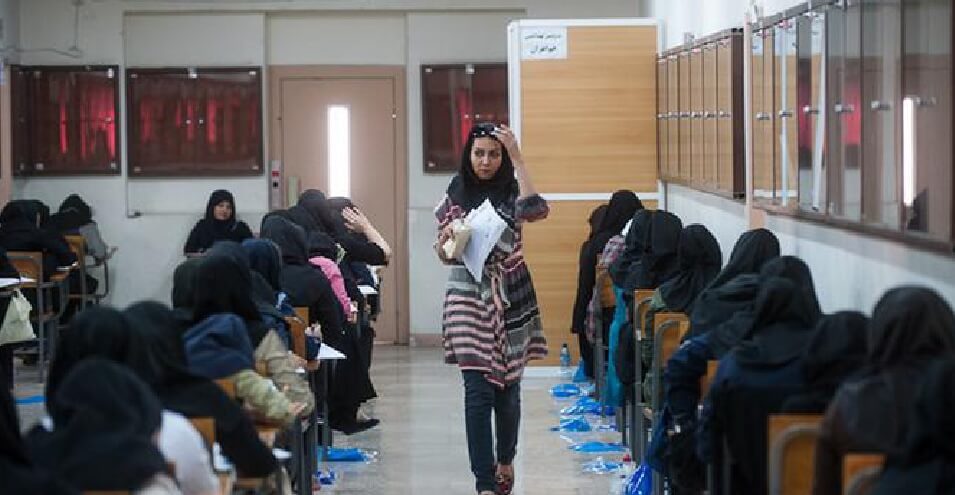
This year, there has been a significant reduction in capacity for several academic programs at Iranian universities, including Persian Literature, Arts, Foreign Languages, Archaeology, Film Direction, and many others. The curriculum of 100 programs has also been changed.
According to a report published by “Hamshahri,” in this year’s university entrance exam, approximately 60 percent of universities offering Persian Language and Literature programs at the undergraduate level have reduced their admission capacity by up to 30 percent. The capacity for Arabic Language and Literature programs has also been reduced.
The report states: “In some universities such as Mazandaran University, this program faced a 40 percent reduction.”
This reduction applies to various programs across universities throughout Iran, and the list is very long: Geography, Arts and Foreign Languages, Archaeology, Calligraphy and Manuscript Illumination, Dramatic Literature and English Language Teaching, Historic Building Restoration, Television Direction, Painting, and Handicrafts.
The report noted: “Some universities such as Shiraz School of Art have announced that, unlike last year, they do not have dormitories for new students. According to the announcement of this university, in programs such as Dramatic Literature, Visual Communication, Archaeology and Museum Studies, which previously had no gender-based restrictions in admission, this year admission capacity will be equally divided between male and female applicants.”
Curriculum Changes in 100 Programs
Another issue that students in 100 academic programs will face is changes to their curricula. This change affects primarily Humanities and Technical-Engineering programs.
MohammadReza Ahanchian, Director General of the Office of Higher Education Planning, said: “In total, university programs have three thousand curricula, many of which date back to before or the early days of the Islamic Revolution. Over the past four years, the Office of Higher Education Planning has reviewed 360 curricula.”
Approximately 100 curricula have been reviewed, and these changes “are being implemented in universities for the first time starting from the new academic year.”
What Is the Reason?
Abdolreza Ouhadi Hamadani, Director General of the Office of Expanding Higher Education at the Ministry of Science, told Hamshahri that capacities should “be allocated based on the number and rank of faculty members at each university” and “therefore this year we are facing a gradual reduction process in admission capacity for some programs both in public universities and in non-profit institutes and universities” because they “do not have sufficient faculty members.”
According to him, universities may “increase or decrease the capacity of certain programs based on market demand or market saturation.”
Regarding the reason for eliminating some programs from this year’s national university entrance exam booklet, he said this decision has been left to the universities’ discretion, and “universities can even admit students in one year and set the admission capacity to zero in another year, based on their own wishes and for any reason in programs for which they have authorization. Additionally, one reason for zeroing student admission in some programs is the accumulation of graduates in those fields.”
Another reason, according to what he said, is that “a program is completely abolished, and as a result, no other university can admit students in that program.”
Lack of Labor Market Demand
The Director General of the Office of Expanding Higher Education at the Ministry of Science cited “lack of demand or unsuitable labor market” as one of the reasons for eliminating some programs.
Hamshahri reported him as saying: “Among different groups, we are witnessing a severe decline in applicants in the Basic Sciences group. When there is no suitable job for applicants in society, the number of applicants for those programs decreases.”
It is unclear with what objective many academic programs are being eliminated and the content of some programs is being changed, and whether it is truly to align with international standards or not. The history of manipulations by the Ministry of Science of the Islamic Republic does not provide a positive answer to this question.
The Islamic Republic has long sought to empty Humanities programs of content in line with international standards and to change the educational curriculum of universities in this field.
Last year, Sadiq Zibakalam, Professor of Political Science at Tehran University, announced fundamental changes to the Political Science program at Tehran University on his Telegram channel and sharply criticized its new content. He wrote: “Specialized courses in the Political Science program have been reduced, and in their place, 45 units of Islamic courses have taken the place of specialized courses in this program.”
Source: DW