Land Subsidence Crisis: Half of Iran’s Plains Have Turned Into Desert
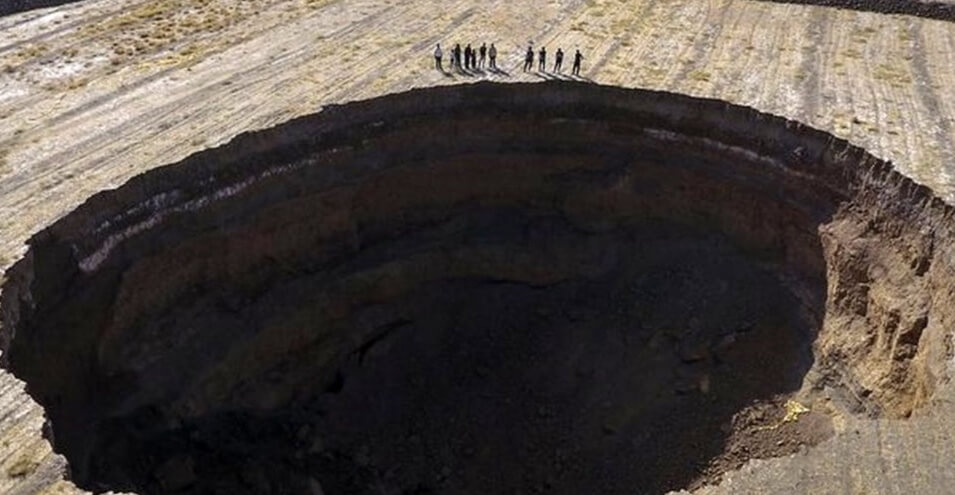
Coinciding with the release of new satellite images regarding the severe situation of land subsidence in Iran, officials are also reporting that half of the country’s plains have been transformed into desert due to subsidence, as well as land subsidence around Tehran tripling.
For a long time in Iran, uncontrolled and unplanned extraction of water from underground aquifers has caused land collapse and, consequently, the destruction of these cavities and water sources, such that subsequent rainfall can no longer refill these resources.
In recent days, the research institute “Intel Lab” released new satellite images regarding land subsidence around Tehran, describing this phenomenon as a “quiet and silent time bomb” that severely threatens the basic infrastructure and lives of the capital’s residents.
In connection with this process, Ali Bitalahi, a member of the scientific board of the Road, Housing and Urban Development Research Center, told the ILNA news agency on Monday, July 5 that “precisely, of the 609 plains in our country, half of them have become desert due to subsidence and groundwater depletion, and the other half do not have favorable conditions and are on the verge of crisis and danger.”
He added that “currently, the Varamin, Mahyar, Ashtar, and Shahriar plains are on the brink of crisis, and we must prevent their desertification as soon as possible.”
Mr. Bitalahi explained that in the southwestern areas of Tehran, namely areas 18 and 19, the rate of subsidence is approximately 24 centimeters per year, while international standards define 4 millimeters of annual subsidence as the “critical threshold.”
The member of the urban development research center added: “Now that in the southwest of Tehran, infrastructure such as oil reservoirs in Rey, oil refineries, and various industrial complexes are located, and oil and gas pipelines are densely concentrated in this area.”
Ali Bitalahi also referred to the existence of 30,000 unauthorized wells in Tehran Province and “the construction of long water pools in these well areas by influential individuals,” and said “it is the Ministry of Energy’s responsibility to prevent the drilling of unauthorized wells.”
The Ministry of Energy officials have also recently attributed part of Tehran’s recent blackouts to the high electricity consumption of these 30,000 unauthorized wells, and despite the fact that officials’ statements about these wells have been repeated for years, no reports of serious action against this problem have been made so far.
Meanwhile, the Geological Survey also announced on Monday that the situation of land subsidence in the Tehran suburbs has become “three times” worse over the past decade, and although this organization has been warning officials for 20 years about the danger of the spread of this phenomenon for Iran’s future, “these warnings were never heeded.”
Reza Shahbazi, head of the Department of Geological and Environmental Hazard Assessment of the Geological Survey and Mining Exploration Organization, told the ISNA news agency: “Our studies show that the level of ground involvement in the area around the southwest of Tehran with the subsidence phenomenon has increased approximately two to three times over the past decade.”
He said that this organization has been aware of the spread of this phenomenon in Iran for 40 years and has issued the necessary warnings to officials for about 20 years, but authorities ignored these warnings.
Before him, Alireza Shahidi, the head of the Geological Survey, also referred to the situation of land subsidence in Iran on June 30 as a “catastrophe” and “silent earthquake,” and with warnings about the death of plants, animals, and human communities in the country, said that “we are leading the country towards destruction.”
Stating that subsidence will create security crises for the country, he reminded: “Drought causes people to migrate from south to north of the country and causes large parts of the country to become depopulated, and it is observed in statistics that 4 millimeters of subsidence in the European Union is considered a crisis, while in Isfahan up to 17 centimeters and in Tehran 36 centimeters per year has been observed.”
Source: Radio Farda