Cuba Arrests Over a Hundred Journalists and Civil Activists
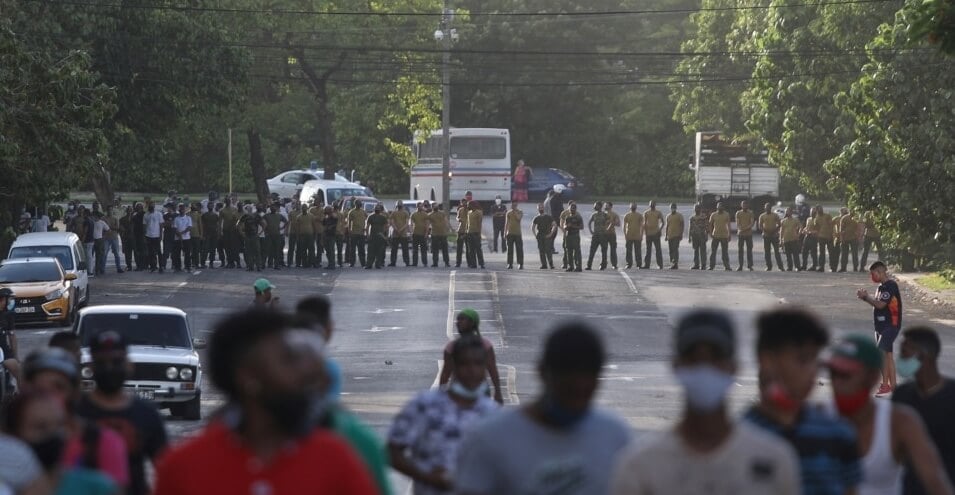
The Cuban government attributed the historic protests that took place in the country over the weekend to U.S. economic pressure and arrested several prominent activists in the nation.
The streets of Havana were calm on Monday, with only a heavy police presence visible. Reports indicate disruptions in mobile internet, the primary means through which most Cubans access the web.
Thousands of Cubans took to the streets in various cities across the country on Sunday, from Havana to Santiago, in what became the largest anti-government protests in decades on the communist-governed island.
The protests were directed at the country’s economic crisis and Cuba’s government management of the coronavirus outbreak, but many protesters went further and called for an end to communist rule.
According to a report by the human rights group Cubaleks, whose members are in exile, at least one hundred prominent activists and independent journalists have been arrested in Cuba since Sunday, with some arrests occurring among the protesters and others in their homes.
Michael, a twenty-one-year-old resident of Havana, said: “Life here has become impossible. I don’t know if these protests will happen again, because Havana has turned into a barracks. However, Cubans’ fear is spilling over.”
Reuters reports that some Cubans have told the news agency that they hope the protests do not repeat, as they are concerned about violence and prefer to dialogue with the government.
The protests emerged amid Cuba’s deepest economic crisis and a surge in coronavirus cases. This is the most severe economic crisis Cuba has faced since the collapse of the Soviet Union, its former ally.
Reuters reports that the intensification of U.S. economic sanctions against Cuba during Donald Trump’s presidency and the pandemic have led to shortages of food and medicine in the country. Frequent power outages are another major issue Cubans face today.
Miguel Díaz-Canel, Cuba’s president, in a televised speech accompanied by his cabinet that lasted over four hours, said that “a counter-revolutionary minority engaged in sedition.”
Mr. Díaz-Canel also called on his supporters on Sunday to take to the streets and counter “provocative actions.”
However, opponents argue that the problem is Díaz-Canel himself and Cuba’s single-party communist system, which has created these conditions in the country.
On the same day, Joe Biden, the U.S. president, expressed support for Cuban protesters against the ruling system in the country, saying that America stands with the Cuban people for freedom and relief from both the coronavirus pandemic and decades of repression.
Among the slogans of Cuban protesters were “freedom” and “death to dictatorship.”
Source: Radio Farda