Head of Mashhad Medical Organization: If Vaccines Don’t Arrive, a Human Catastrophe Will Occur
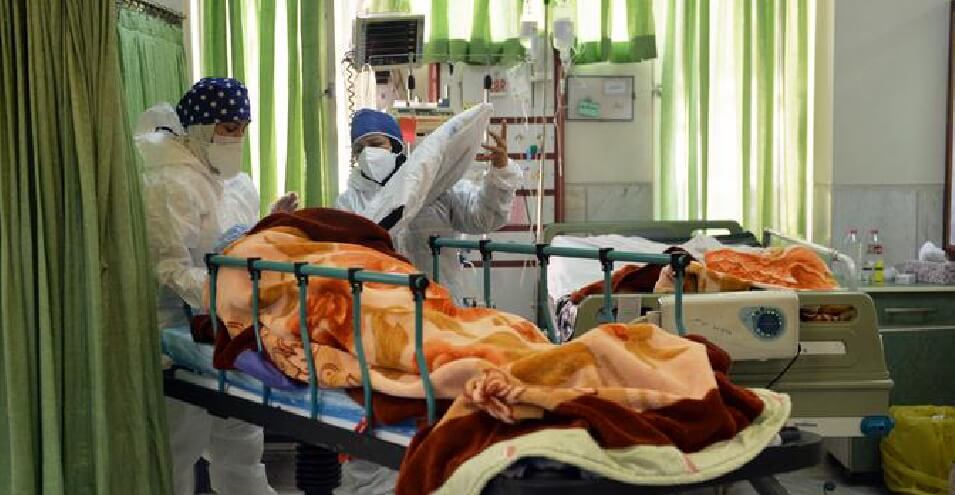
As the number of deaths and infections from the fourth wave of coronavirus surge, Iranian officials are seeking to assign blame. The Medical Organization is calling for a “lockdown” or closure, but politicians say this requires a budget.
Shakrollah Solmanzadeh, Dean of Abadan School of Medical Sciences, says: “If restrictions are not implemented and people move freely in markets and cities and mass gatherings are held, there is no hope for improvement.”
He says: “In the third peak of the disease, we were dealing with a mutated virus that has very high transmission. But now that the virus has become more severe, we have done the opposite and treat this virus normally.”
Earlier, Saeid Namaki, the Health Minister, said: “The map of coronavirus infection in the country is turning black.” The Ministry of Health, Treatment, and Medical Education also announced in its latest statement: “257 cities in the country are in a red situation and a two-week closure of the entire country is necessary.”
Simultaneously with these criticisms and requests, Mahmoud Vaezi, the Chief of Staff of Hassan Rouhani, Iran’s President, replied: “Perhaps it is easy for a doctor to say the first action is for us to close the entire country, but first we need to provide a large budget so that for someone who has a shop and pays rent, taxes, and checks for it, we have a solution.”
Critics say that previously when restrictions were implemented and according to government decision, only group one businesses were allowed to operate, but no economic and relief measures were considered for other groups.
On the other hand, shops and food distribution centers, health centers, pharmacies, manufacturing plants and industrial and mining centers, media, postal and telecommunications activities, public transportation of goods and passengers were classified in group one, and government offices should also work with one-half to one-third of their personnel.
Under these circumstances, Shakrollah Solmanzadeh says: “Currently, in red cities, even the restrictions of yellow cities are not implemented; all occupational groups in red cities are active and all professional units are open.”
Warning from Mashhad Medical Organization Head
Ali Birjandi-nejad, Head of the Mashhad Medical Organization, says: “Many officials, instead of taking urgent action, are seeking to find someone to blame; spending from people and accusing them has also become the easiest path for some; one day Nowruz travels and another day chicken queues are blamed.”
Previously, Hassan Rouhani, in a meeting of the National Coronavirus Management Headquarters, mentioned four factors in the outbreak of the fourth wave of coronavirus, with the most important being “entry of the English virus from Iraq.”
This is while Iranian media reported in early Esfand about the closure of five border terminals between Iran and Iraq following the spread of the English coronavirus variant.
Rouhani mentioned multiple other factors such as “traffic and gatherings the week before Nowruz,” “Nowruz ceremonies and visits,” as well as “numerous weddings in the months of Rajab and Sha’ban” as factors in the spread of coronavirus.
Along with implementing social restrictions and “lockdown” or closures, accelerating vaccination to control the spread of coronavirus has also been raised.
Ali Birjandi-nejad, Head of the Mashhad Medical Organization, while warning officials, said: “The country’s mortality rate is on the rise and even one day’s delay in widespread and universal vaccination is unforgivable.”
While Ayatollah Ali Khamenei, the Leader of the Islamic Republic, has banned the use of American and British vaccines, there is still no news of domestic vaccines.
Imports of Russian, Chinese, and Indian vaccines have so far been insufficient, and the policy for their injection has also been controversial.
Mohammad Reza Sharifi Moghaddam, Secretary General of the Iran Nursing Association, criticizing Iran’s Ministry of Health, told the Rokna news agency that both a small amount of coronavirus vaccine has entered the country and the distribution conditions of these vaccines have been inappropriate, and “we have repeatedly witnessed people fainting intentionally or unintentionally while receiving the vaccine.”
He questioned why out of nearly 1.7 million doses of vaccine imported into Iran, “30 percent of medical staff have still not been vaccinated against coronavirus?”
Hasan Hosseini-zadeh, Deputy Technical and Operations Officer of Tehran Emergency Center, announcing that 48 percent of Tehran Emergency personnel have contracted coronavirus, says: “25 percent of Emergency operational personnel have received the first and second doses of their vaccine. These people work as fighters on the front line against the coronavirus.”
Source: DW