Farvardin 58 and the Inverted Referendum
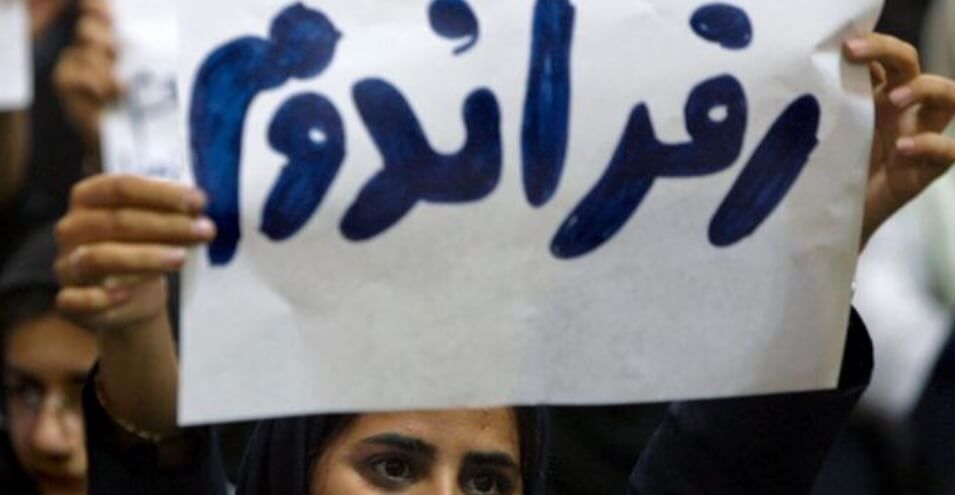
The 42nd anniversary of the Islamic Republic’s referendum, rather than reflecting a historic event and ceremonial occasion for the system, serves as a mirror reflecting the system’s failures and growing demand for a new referendum on the continuation or transformation of the political system. An analysis by Ali Afshari
After the Islamic Republic held an undemocratic referendum that violated the standards of free and fair elections by reconstructing the traditional concept of “allegiance,” it thereafter relied on direct public consultation only for approving initial and revised versions of the constitution, effectively closing the file on this decision-making method. The government has been unwilling to hold referendums even at lower levels of policymaking. Over the past two decades, demand for a referendum has grown significantly so that the fundamental question of the system’s survival or transformation could be put to a popular vote.
Forty-two years ago, Ayatollah Khomeini, through illegal, authoritarian, and willful intervention, limited the voting options to yes or no regarding the Islamic Republic of Iran, even though this system had no precedent in Iran’s past and encompassed no clear definition. It would not be wrong to say that the majority of those who voted for the Islamic Republic of Iran trusted Ayatollah Khomeini’s statements and promises, which soon proved to be unfounded and based on deliberate deception. The declining turnout in subsequent election periods and referendums is testimony to the fact that some voters later realized their mistake in optimism.
Ayatollah Khomeini labeled opponents of the Islamic Republic and defenders of a national or democratic republic as “enemies of Islam” and “holders of poisoned pens.” With these statements by Ayatollah Khomeini and the mobilization of all state institutions and resources to promote the Islamic Republic, the referendum became meaningless. In fact, the choice had already been made, and the founder of the Islamic Republic had already draped the Islamic Republic over the body of Iran. From his perspective, the referendum meant allegiance. He did not expect people to choose; rather, he asked them to confirm his will and decision. It was natural that once a revolution had taken place and people had risen against the rulers of the previous system, defenders of alternatives centered on the Islamic Republic were also branded as “traitors” and “holders of poisoned pens,” and elections transformed into a confrontation between Islam and infidelity, leaving no room for choice, and the Islamic Republic option emerged from the ballot box with high votes.
Therefore, this referendum lacked the necessary conditions for legitimate elections. Even though it was supposed to determine the fate of the monarchical system in the referendum, the ballot papers read opposite “no”: “the former regime”!! This very point revealed the theatrical and ceremonial nature of the aforementioned referendum.
Now, after 42 years, channels of political participation, contrary to the spirit of the February 1979 revolution and its anti-authoritarian orientation, have not been realized, and an authoritarian political system has taken shape and been consolidated with greater intervention in the public sphere. Moreover, structural blockages have gripped the country’s major supercrises. The current situation and conventional mechanisms are not capable of solving problems; even part of the ruling establishment has become aware of this impasse. Hassan Rouhani repeatedly proposed limited-scope referendums and governance policies that faced negative responses from the hardline core of power and the institution of the guardian jurist. Of course, Rouhani himself raised the issue of referendums in slogans and had no serious will to advance it.
The country’s macro superchallenges can be divided into smaller levels, encompassing multiple crises such as unemployment, economic prosperity, center-periphery issues, efficiency, high liquidity, water scarcity, authority, crisis management, foreign relations, brain drain, trust, the government-nation gap, women’s dissatisfaction, widespread class divisions, cultural confrontation, ineffective education system, systematic corruption, closed circuit of power transfer, disruption of information systems, rule by personal loyalty (absence of meritocracy), parallel institutions, marginalization, nihilism, intensified violence in social behaviors, high energy consumption, increased poverty and deprivation, expansion of drug addiction, military presence in politics, vulnerability to earthquakes, soil erosion, obsolescence of developmental infrastructure, expansion of money laundering, and lack of transparency.
The Islamic Republic is incapable of controlling and treating these superchallenges. The fundamental basis of these crises is the system’s prevention of political openings and the expansion of political participation. More precisely, the system’s self-created crisis—the inclination and will of the guardian jurist institution—is the main backbone of problems, as it deems it necessary to maintain and sustain a certain level of controlled crisis for its survival and supremacy. This will is the common denominator of the interventionist guardian jurist and the forces supporting and active in the guardian jurist institution and its subsidiaries. Under normal circumstances, bureaucracy and modern institutions carry out their specific functions and gradually become consolidated, and there is no longer room for the intervention of the guardian jurist and the representatives of his army. Likewise, deficiencies and shortages become apparent, and it becomes difficult to blame external enemies for incompetencies. Crisis and critical conditions, as if a great danger is lurking, are the prerequisite for the guardian jurist’s call to his followers for the “continuation of the revolution.” In this paradigm, law, custom, and rules have no value and are easily trampled upon. The guardian jurist’s army has the authority to act as a “lone wolf” and “revolutionary groups” and prevent the political and administrative organization of the country from being managed according to ordinary, rational, and established procedures and processes, which from the perspective of the hardline core of power ultimately leads to “compromise with the West.”
Structural constraints that have driven election-focused approaches in strategic and tactical domains to an impasse have inclined public opinion toward a desire for structure-breaking strategies. Saving the country requires recourse to public opinion to determine the fate of the macro power structure. Within the framework of the Islamic Republic system, the possibility of continuous and sustainable improvements does not exist.
The output of the Islamic Republic’s governmental system is internal tension, and part of its capacity is spent on resolving frictions and controlling elected institutions in the direction favored by the guardian jurist and the groups under his watch. This duality, based on the contradiction between the two dimensions of “republicanism” and “guardianship,” has various dimensions, but perhaps its most tangible aspect is the stability or susceptibility to social changes for the survival of the guardian jurist institution and the preservation of its dominant position in the power structure.
“Guardianship” and “republicanism” belong to two entirely different domains, and their ultimate purposes differ. These two cannot be directly reconciled in the modern age; therefore, the aforementioned contradiction has persisted in the power structure of the Islamic Republic and has imposed a perpetual crisis upon it. This crisis has no solution either, and the dispute must be resolved in favor of one of the two institutions with the elimination of the other.
The negative experience of the year 58 referendum is not reason to generalize it to the principle of referendums. A referendum is a principled method and procedure for decision-making based on direct and universal participation and does not inherently have populist characteristics. Therefore, a new referendum this time, concerning the continuity or transformation of the Islamic Republic, is an effective and practical approach to treating the country’s multiple superchallenges and breaking the structural blockade.
Source: DW