Destruction of Tehran Adventist Church, Destruction of Iran’s Cultural Heritage and Christianity; In Conversation with Mansour Borji/Interview by Mary Mohammadi
The confiscation and destruction of churches across the country in a systematic and organized manner by the Islamic Republic government is unprecedented and represents one of the notable cases in the 43-year record of this government’s rule.
The issue of confiscation, destruction, and sealing of churches (some of which are considered historical buildings) is not merely a religious issue or one pertaining to the Christian religious minority in Iran, but encompasses multiple dimensions.
Violation of human rights and freedom of religion and belief, tampering with and distorting the history of Iran and Christianity in Iran, obscuring cultural heritage, and denying religious diversity in Iran are among these dimensions. It appears that the government is in a desperate attempt to improve its image by laying the groundwork and preparing the stage to present a single vision of belief to the people of Iran, to justify creating a completely Islamic and monotheistic atmosphere and policymaking in Iran, to exonerate itself from religious extremism, and consequently to present an artificial and fabricated image of its apparently worthy and efficient performance to future generations.
In this way, important sections of history that could be visible and tangible to the general public daily are reduced to written documents that will only be accessible through research and investigation by a small and concerned minority, and even then with difficulties such as determining the authenticity and impartiality of documents.
The Seventh-day Adventist Church is one of the churches whose complete destruction was reported in the media in November 1399 (October/November 2020), although its destruction had begun several years earlier. This matter provided an opportunity to speak in this issue of Khat-e Solh with Mr. Mansour Borji, director of Article 18 Organization (which works in the field of freedom of belief), human rights activist and religious researcher regarding the issue of confiscation, destruction, and sealing of churches and its impacts. The full text of this interview follows:

Tell us about the characteristics and antiquity of the Adventist Church. When did the destruction of the Adventist Church begin?
The Seventh-day Adventist Church is considered one of the branches of Protestant Christianity. The presence of missionaries from the Adventist Church in Iran dates back to 1911, and the Adventist Church building was constructed in 1949 (1328 in the Persian calendar). The establishment of these churches during a period when Iran’s major cities witnessed the growth of buildings in a modern architectural style is part of our national history and culture.
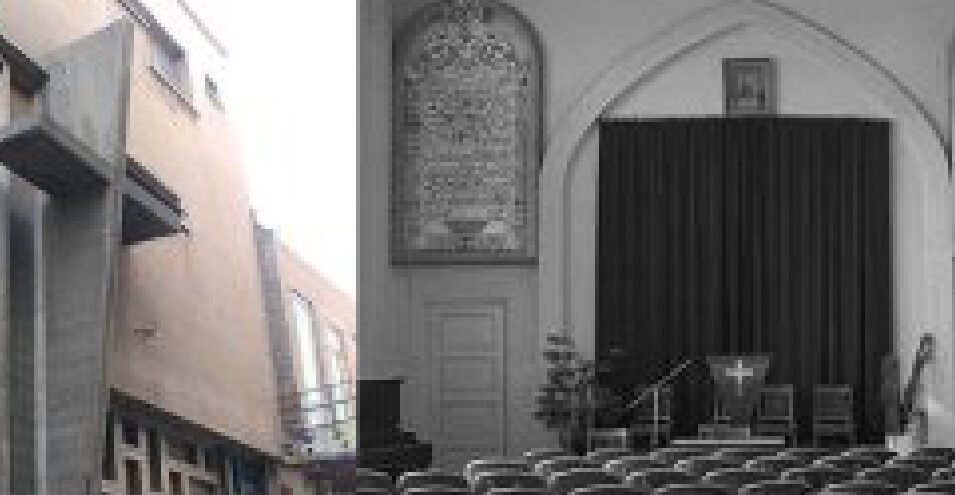
The Tehran Adventist Church, located on Jumhuri Street near Naderi Cafe and the Religions Square, was considered one of these symbols of modern architecture of the Pahlavi era. The mihrab and plasterwork of this church were decorated with the Ten Commandments of Moses, and the interior decorations were beautiful. The eight-meter cross of this church, as the largest concrete cross in Iran, was recognized as one of the identity markers of the city.
Unfortunately, in the past four decades, many places and institutions belonging to Christians, including hospitals, schools, and churches, have been confiscated or repurposed. The activities of Protestant churches in Iran have faced numerous pressures and restrictions, and were often forced to close. Some of these properties, such as the Episcopal Church in Kerman, eventually became ruins and were finally, after destruction, taken over by institutions such as the Foundation for the Oppressed or the Imam’s Executive Headquarters.
The destruction of the Adventist Church began in 1394 (2015). ISNA reported that “the owner of the southwestern building of the church, after purchasing several surrounding buildings, intended to build a tower on Jumhuri Street,” which is why the destruction of this church was put on the agenda. The publication of news about the destruction of one of the historical houses adjacent to the church caused a halt to this process for several years. Although the interior space of this church, including the mihrab, plasterwork decorated with the 10 Commandments of Moses, and interior decorations had been destroyed, and only the walls and outer facade remained intact. Until finally, this Adventist Church was destroyed overnight on Saturday, the 10th of Aban (November 1, 2020).
Some consider the Adventist Churches in Tehran not just as a church but as a historical building, and view its sale not only as a violation of the rights of Christians but also as tampering with the history of Iran and Christianity. In light of this, how do you assess the sale and destruction of this church and private ownership of it?
This building had a history of 71 years, and its structure was part of Iran’s architectural heritage. The fact that neither the Organization of Cultural Heritage nor the Tehran Municipality took any action to preserve it is, whether intentional or not, an unforgivable error. Nearly four months after the destruction of this building, no institution has yet explained how a waqf (endowed) property was sold to a private owner, and why the Cultural Heritage organization issued a demolition permit for this building in 1394.
What has been the reaction of Christians worldwide to reports of confiscation and destruction of churches in Iran? What approach does the international community take toward these events?
The destruction of the Episcopal Church in Kerman, the confiscation of Sharon Garden of the Divine Assembly Church in Karaj, the confiscation and attempt to seize the Evangelical Church in Tabriz are news items that have been reported by media in recent years. Beyond this, we are aware of the confiscation and closure of many other churches in Isfahan, Tehran, Hamadan, Mashhad, Arak, and Ahvaz. Some of these properties and churches have been removed from the access and use of Christians, and others continue their activities in church properties in a semi-functioning capacity, as if they were mere renters.
The publication of such news certainly has a negative impact on Iran’s image in the international community. Although governments and politicians may not show serious interest in engaging in religious and ecclesiastical discussions, their constituency voters may be Christians who, upon repeatedly hearing such news, may reconsider their voting choices and the scope of their demands from their elected representatives.
Moreover, the concern for respecting the rights of religious minorities is not limited to the followers of that particular group. We receive many messages expressing solidarity from Iranian Muslim compatriots and followers of other religions from around the world.
What kind of long-term impacts does the destruction of churches have on the Christian community?
Destroying the identity markers of a religious community has a negative impact on the entire society. Its devastating effect should not be sought only in a relatively small group of Christians. The elimination of religious, intellectual, and cultural diversity, and the attempt to make citizens of a country uniform, is the destruction of civilization. A single-voiced society will be deprived of dynamism, fertility, and creativity.
Christianity did not begin with the buildings we know today, nor should it end with their destruction. In the first 300 years of its history, Christians mostly gathered in private homes, on mountaintops, or in caves. During these same years, despite the most difficult conditions and painful persecutions, even with the outbreak of two epidemics in 165 and 251 AD, Christians transformed from a marginal movement into an influential force in society.
Perhaps the Communist government of China thought—and much of it still thinks—that by violating the rights of Christians and the right to religious gatherings, it could eliminate them from the political, social, cultural, and economic scene. But in this past century, the number of Christians in China has grown significantly despite strict restrictions on churches. The world’s largest collection of house churches can be found in China today.
Church buildings in Iran are, first and foremost, part of Iran’s cultural heritage, and then part of the cultural heritage of Iranian Christians. Of course, for the new generation of Iranian Christians, their historical connections with the past of the church and Christianity in Iran are of great importance, and I do not wish to minimize this reality either. But by destroying the markers of Christian presence in Iran, one cannot deny their history and positive impact throughout the history of this land. A large part of the church’s glorious history in Iran has been written and documented. A day will come when its roots will again reach water, its branches will reach the sun, and it will grow green again!
Source: Hrana