Child of 1988 Execution Victim: Islamic Republic Has Long Sought to Erase Khavaran
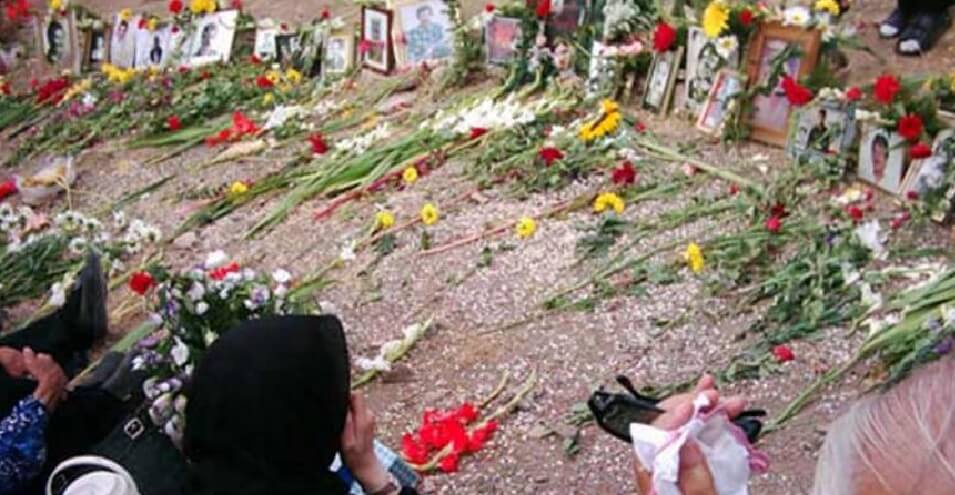
Following reports about forcing Baha’i citizens to bury their deceased in mass graves at Khavaran Cemetery and the circulation of images showing new graves at the cemetery, one of the survivors of those executed in 1988 states that Iranian authorities “have been trying for years to erase Khavaran from their record.”
Bahare Manshee Rudsari, who lost her father Abbasali Manshee Rudsari and several other relatives in the 1988 executions, told Voice of America that her father was buried in Khavaran. She said the Islamic Republic has been attempting for years to eliminate Khavaran, and in December 2008, they bulldozed the area under the pretext of developing and reorganizing cemeteries for religious minorities.
She, who believes all recent incidents at Khavaran are intended to pressure survivors of those executed in the 1960s, added: “They constantly harass and torment us, and they spare no one, not even the dead. Meanwhile, there are no bodies left, not even bones remaining.”
In recent days, at least 80 survivors of those executed in the 1960s sent a letter to Tehran’s mayor, requesting that Baha’i citizens not be forced to bury their deceased at Khavaran, stating: “Do not pour salt on our old wounds.”
These families, who demand that the cemetery be left untouched and unchanged, further stated: “It is our civic and human right as families to know the exact location where our loved ones were buried and to be able to honor their memory by visiting their graves.”
Bahare Manshee Rudsari, continuing her conversation with Voice of America, while emphasizing the Islamic Republic’s efforts to pressure Baha’i citizens and display ill will toward the families of the executed, said this is a document of crime and she hopes others will widely protest this issue.
The mass graves of Khavaran Cemetery, located in the southeastern part of Tehran, are the burial place of victims of the 1988 executions.
Earlier, Farhad Sabetan, spokesperson for the Bahai World Community, noting that Khavaran Cemetery currently appears as a flattened area and it seems the remains of those executed in 1988 have been removed from the cemetery, told Voice of America that if this is true, it is not only a problem for Bahas, but for all Iranians who have lost friends and family members; because “it is unknown where those bodies are now, so how can we place other bodies there… The Bahai community truly sees this issue as a form of spiritual torture; because… they are even denied their right to proper burial.”
In July and August 1988, on the orders of Ayatollah Khomeini, the leader of the Islamic Republic at that time, thousands of political prisoners opposed to the government were secretly executed. Some of them were executed despite having previously received prison sentences in court trials. Most of those executed were members and supporters of the Mujahedin-e Khalq Organization as well as other leftist groups and parties.
Several years ago, an audio recording of a meeting between Ayatollah Hosseinali Montazeri and Hosseinali Niri, the religious judge at the time, Morteza Eshraqi, the prosecutor at the time, Ibrahim Raisi, the deputy prosecutor at the time, and Mostafa Pourmohammadi, the representative of the Ministry of Intelligence at Evin Prison, was released. In that recording, Montazeri called these executions “the greatest crime.” Ibrahim Raisi, one of the members of this committee at the time, is now the head of Iran’s Judiciary.
Source: Voice of America