Protesters Enter Security Post in Zahedan; Mawlavi Abdolhamid Calls for Public Calm
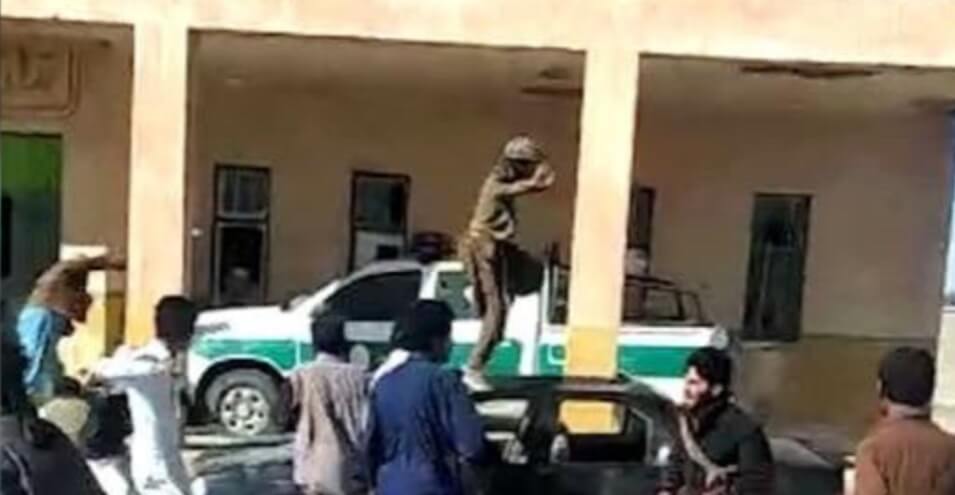
Concurrent with reports of strikes and business closures in several cities across Sistan and Baluchestan Province in protest against “the killing of fuel smugglers,” images were released on Wednesday showing protesters entering a security post in the city of Zahedan.
On the same day, Mawlavi Abdolhamid, the Sunni Friday prayer leader of Zahedan, issued an audio message calling on all residents of the region to remain calm, control their emotions, and exercise restraint.
Images circulated on social media showed a number of protesters entering the “Korin law enforcement post” and damaging the building and a vehicle in the post’s compound.
Meanwhile, reports indicated that clashes in the Korin district continued on Wednesday evening.
On the other hand, the governor of Zahedan county stated that during an “attack by armed vandals using light weapons and rocket launchers on the Korin post in Zahedan,” one law enforcement officer was killed.
According to IRNA, Abuzar Mahdi Nakhei, referring to reports about the killing of a fuel smuggler at the Shamsar post in Saravan, said that following this incident, “destructive elements” attacked the Korin post and Qale-ye Bid post with “light weapons and rocket launchers with the intention of seizing the Korin post.”
The Zahedan governor, however, emphasized that “calm is being maintained throughout Zahedan county and its affiliated districts.”
In this regard, video images of protests in the cities of Khash, Iranshahr, and Saravan have been circulated on social networks.
Social media reports also indicate that security measures have been intensified in Zahedan and shops and bazaars in the city were closed on Wednesday.
Mawlavi Abdolhamid Calls on People for Calm and Restraint
Meanwhile, Mawlavi Abdolhamid, the Sunni Friday prayer leader of Zahedan, issued an audio message calling on all residents of Sistan and Baluchestan Province to remain calm and exercise restraint.
He also asked the youth to refrain from attacking public institutions while controlling their emotions.
Mawlavi Abdolhamid further called on officials to impartially investigate the incident on Monday, which resulted in deaths and injuries to a number of people.
The Sunni Friday prayer leader of Zahedan also urged officials of the Islamic Republic to pay attention to the livelihood and employment situation in Sistan and Baluchestan Province.
Reports indicate that on Monday, the 4th of Esfand, during gunfire by Islamic Revolutionary Guards Corps forces in border areas of Saravan county toward a group of fuel smugglers, at least two civilians were killed and two others were wounded.
This is while some other news sources reported the death toll of the incident as “10 people.”
Based on videos released the previous day on social networks, particularly Twitter, a number of family members of fuel smugglers gathered in front of the Saravan governor’s office building and entered the building.
The “Razaq” Plan and Fuel Sales in Border Areas
Based on a government plan in 1390 (2011) that was implemented in 1392 (2013), border residents within a 20-kilometer radius of the border in four provinces of the country were permitted to sell fuel across the border.
In the plan approved by Mahmoud Ahmadinejad’s government in 1390, it stated: “The Ministry of Petroleum is obliged to establish fuel distribution stations at borders and official border bazaars and proceed with selling petroleum products to residents of border villages within a 20-kilometer border radius at equilibrium prices.”
According to the government’s initial plan, border resident families were to be allocated quotas whereby up to five-member households would be allocated 500 liters of fuel and households with more than five members would be allocated 1,000 liters of fuel for sale.
However, Quds Headquarters of the IRGC Ground Force, which is responsible for ensuring security in Sistan and Baluchestan and plays a key role in the economic activities of this province, presented a plan called the “Razaq Plan” to the Ministry of Interior in 1397 (2018) to organize fuel sales in border areas, which received the approval of the Ministry of Interior.
Mohammad Marrani, former commander of Quds Headquarters of the IRGC Ground Force in the country’s southeast, had previously stated in an interview with IRNA that the goal of the “Razaq Plan” was to create employment in border areas, saying that people would be permitted who “without legal prohibition take fuel across the border and sell it” if the IRGC has “identified them and confirmed their poverty.”
Mehran Mahmoudi, acting governor of Golestan, said in late Bahman of the current year that the Islamic Revolutionary Guards Corps began operations to monitor border pass cards from the beginning of Esfand and if a card was issued by mistake, it would be cancelled.
Implementation of the “Razaq Plan” is the responsibility of the Ministry of Interior, fuel supply is the responsibility of the Oil Company, and the IRGC is the executor.
In this regard, the governor of Sistan and Baluchestan had stated in Dey of the current year that “through discussions and dialogues conducted by Quds Headquarters of the IRGC Ground Force, Pakistani officials also accepted this plan.”
This is while critics say the goal of the Razaq plan is for the Islamic Revolutionary Guards Corps to “monopolize fuel sales.”
They say this plan not only fails to help reduce deprivation among poor border residents, but also adds to “discrimination” in this deprived province.
Social experts in Iran say unemployment, poverty, and widespread deprivation in Sistan and Baluchestan Province have caused fuel smuggling to become a major source of income for border residents and citizens in this province.
Source: Radio Farda