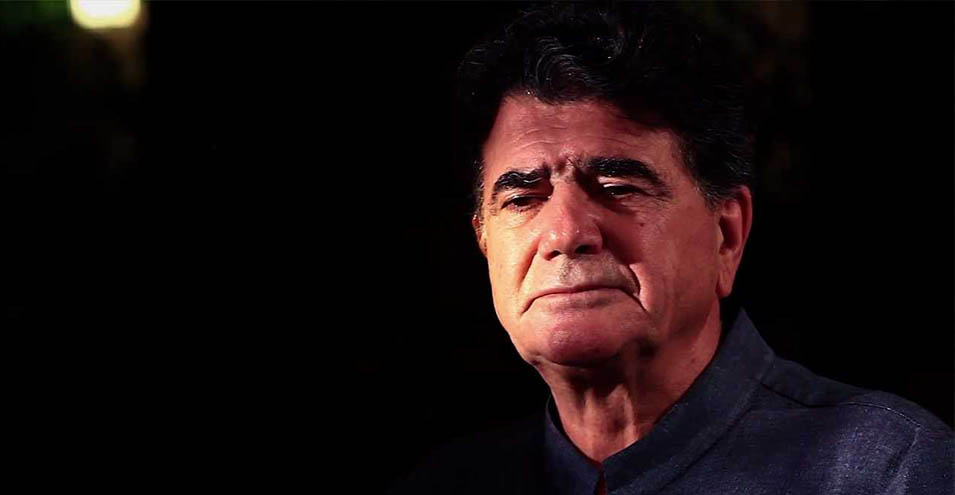
Shajarian’s Death and the ‘Cultural Disgrace’ of the Academy of Persian Language and Literature

The silence of certain Iranian government officials, including the Leader of the Islamic Republic, in response to the death of Mohammad-Reza Shajarian, the renowned master of traditional Iranian music, did not surprise his admirers, just as condolences from some international institutions and famous non-Iranian figures seemed natural in their view. However, few expected the Academy of Persian Language and Literature to remain silent—and such absolute silence at that.
As of today, the twentieth of Mehr, four days after Shajarian’s passing, this academy has not only issued no statement, but there is also no trace of the name or memory of “Iran’s most beloved contemporary cultural figure in art and literature” on its official website.
This silence in the face of the death of someone whose fame and credibility lay not only in singing and music but, as testified by countless masters of art and literature, in his unparalleled service to Persian poetry and literature through music, can have only one meaning: the political inclination of Gholam-Ali Haddad-Adel in his position as head of a cultural and literary institution.
No official public mourning was declared for Shajarian’s death, but all evidence and some statistics show that Iran was almost entirely grieving his passing. This public mourning was easily and openly visible on social media networks.
A social media researcher who collected online data on this matter wrote that in just the first two days, nearly one hundred thousand tweets about Shajarian were published, receiving more than 2 million and 270 thousand likes. During this time, a record for likes in the history of Persian Twitter was even broken by a tweet from Homayoun Shajarian confirming his father’s death.
According to statistics from Mohammad Rahnvari, a researcher, some of the videos posted on Instagram were viewed more than 148 million times in two days, and some posts about Shajarian alone received more than 59 million likes with more than 1 million and 230 thousand comments left on them.
Alongside these astonishing statistics, the statistics related to Shajarian-related posts on Telegram were equally astounding. In just the first two days, 103 thousand posts were published on 10 thousand channels, and these posts were viewed approximately 300 million times just on Telegram.
According to this social media researcher, these same 59 million likes and 1 million and 230 thousand comments on Instagram and 300 million views on Telegram demonstrate that Iranians from various classes and with all types of political, social, and even religious inclinations held public mourning for Mohammad-Reza Shajarian in the online space.
This was apart from special programs on Persian-language radio and television outside Iran, which, amid the silence of the Islamic Republic’s state media, broadcast various special programs mourning Shajarian in the first two days, helping millions of viewers participate in public mourning for this national figure of Iran.
In such a context, and when it comes to someone whose social status, alongside his unparalleled artistic position, is hardly questioned by anyone, condolences from various Iranian and international institutions as well as political figures from all inclinations seem less like comfort and more like an attempt to preserve their own cultural and social credibility among millions of people who are less fans of Shajarian’s works than unconditional admirers of the man himself.
Nevertheless, the silence of the Academy of Persian Language and Literature, as Iran’s highest official institution in the field of Persian language and literature, or an institution like the Saadi Foundation, which is an organization for the promotion of Persian language and literature abroad, will likely be recorded in the history of these institutions’ activities as a “cultural disgrace” stemming from its leadership. But how did this come about?
When Gholam-Ali Haddad-Adel is in the position of heading both institutions, understanding the silence of these two particular institutions is not difficult.
Gholam-Ali Haddad-Adel is the supreme advisor to Ali Khamenei, the Leader of the Islamic Republic, and the father-in-law of Mujtaba Khamenei, the Leader’s son. Much has been written in reports and articles about Mr. Haddad-Adel’s connection to Mr. Khamenei and the Leader’s support for him in positions he previously held and currently holds.
Therefore, the absolute silence of these two institutions can be seen as a continuation of the absolute silence of the Leader of the Islamic Republic himself, who, especially since 1988 onward, has not been pleased with Mohammad-Reza Shajarian and has had no hesitation in expressing this displeasure.
Mohammad-Reza Shajarian, continuing his thirty or forty-year social nature until 1988, when Mahmoud Ahmadinejad, the president favored by Ali Khamenei, called the protesting people in the streets “chaff and trash,” became angry and said “Death to the dictator” in the streets. By appearing in foreign media, he called himself “the voice of that very chaff and trash.”
Afterward, in protest against the broadcast of the national anthem “O Iran, O Abode of Hope” on state media during Islamic Republic political occasions, he sent a harsh letter to the head of this organization asking them to refrain from broadcasting his works.
Nevertheless, in that same letter, he “presented” his “Rabana” prayer and “Khatibe Esfahan’s Supplication” “to the Iranian people” and also released the single “Tongue of Fire” in support of the protesters during that period.
State media officials, in response, completely banned the broadcast of Mohammad-Reza Shajarian’s voice from state media, and this ban included the Rabana prayer during Ramadan.
Seven years later, when it was said that the Minister of Culture at the time had pursued the re-broadcast of “Rabana” from state media, Ali Khamenei said in a speech: “That in a situation where we have so many important cultural issues in the country, whether a certain song is broadcast before iftar or not becomes the main issue, they correspond about it; clearly this apparatus has become dysfunctional.”
Of course, Mr. Khamenei’s political stance on Shajarian was not entirely unprecedented and was rooted in his earlier peculiar position regarding Shajarian’s Rabana.
In 1991, Khamenei said in a meeting with some radio staff: “The Rabanas that Shajarian sang and that are played during Ramadan before the evening call to prayer is an artistic work. It is not a contemporary work. It is not appropriate that after the call to prayer someone would want to broadcast something in that manner. No. After the call to prayer, it seems to me that our regular mosque sound would be better and more appropriate.”
After Mohammad-Reza Shajarian’s death, a number of users known as “value-based” supporters of the Leader of the Islamic Republic, in condemning Shajarian’s support for the people in the 1988 protests, repeatedly used the keyword “injustice to the system.”
The expression “injustice to the system” was used by Mr. Khamenei following the Green Movement protests, when he said “the sedition following the elections was a great injustice to the system,” and subsequently entered the discourse of Revolutionary Guard commanders and other system officials, including Mr. Haddad-Adel, who in 2014 said that Mir-Hossein Mousavi and Mehdi Karroubi “committed an injustice to the revolution that Saddam, with all his cruelty, did not commit.”
Given these circumstances, one should not be surprised that the head of the Academy of Persian Language and Literature and the Saadi Foundation, in response to Shajarian’s death, chooses the political views favored by the Leader of the Islamic Republic over the culturally friendly behavior expected by the people, and even refrains from issuing a simple condolence message, as the director of the Arts Academy did, to fulfill the duty that literary figures expect from this academy.
Only hope remains that some members of the academy who are prominent and valued figures in the field of Persian language and literature will take individual action and not tarnish their own reputations with the “cultural disgrace” of their respective institution; just as some of them, such as Hossein Massoumi Hamdani and Mohammad-Jafar Yahaghi, have done.
Source: Radio Farda