Europe Prepares to Face Second Wave of Coronavirus
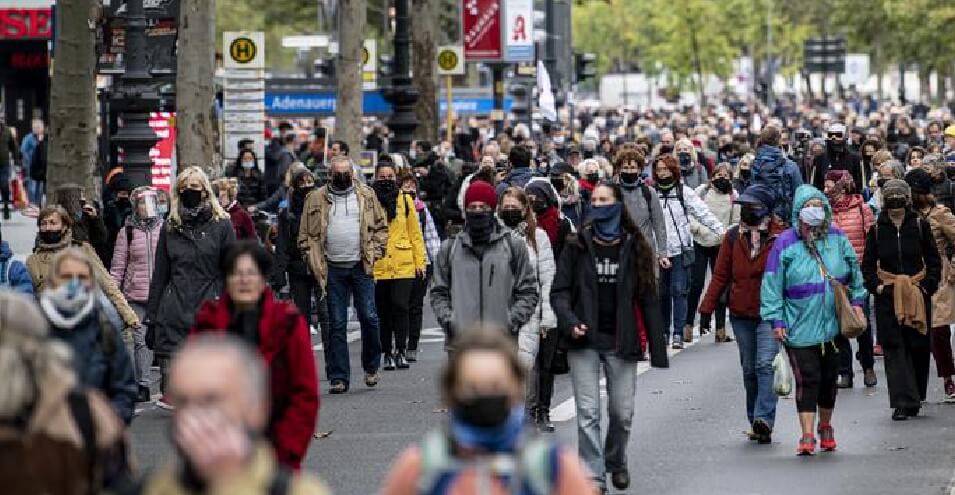
Daily confirmed cases of coronavirus in Germany have surpassed the 5,000 mark. A figure that has been unprecedented since April. The number of coronavirus patients in France, Spain, the Netherlands, Austria, and the Czech Republic has also increased significantly.
Several European countries have again introduced new restrictions to combat coronavirus. Cafes, bars, and restaurants have been closed in some countries. The European Union has designated three zones—red, orange, and green—for member states.
Following the onset of cold weather in Europe, the number of coronavirus cases has increased again. According to information announced by the Robert Koch Institute, on Tuesday, October 13 (Mehr 22), for the first time since April, the number of daily coronavirus cases in Germany exceeded the 5,000 mark.
The same institute announced that on that day, coronavirus tests for 5,132 people in Germany came back positive. A phenomenon that has been unprecedented in Germany since April.
In this regard, on Wednesday, October 14, Angela Merkel, Chancellor of Germany, is scheduled to hold a meeting with officials from the states of the country.
The purpose of this meeting has been announced as reaching a common solution to combat further spread of coronavirus in Germany. This comes as the situation regarding the coronavirus pandemic at Germany’s borders is considerably more severe.
Creating Three Zones in Europe
To assist those traveling in European countries, the European Union has defined three separate zones. Zones that effectively indicate the level of coronavirus spread.
The green zone includes countries and cities where the coronavirus spread rate is less than 25 cases per 100,000 people over a 14-day period.
Whenever the number of confirmed coronavirus cases on this basis is less than 50 people, that zone is orange, and more than 50 cases in a city or country means that zone is red.
These zones are being determined under conditions where the rate of coronavirus testing in different European Union member countries is not uniform.
Josep Borrell Also Goes into Quarantine
The European Union is discussing the division of different zones at a time when the coronavirus has also infiltrated European Union headquarters.
News agencies have reported that Josep Borrell, the High Representative for Foreign Affairs of the European Union, has gone into home quarantine as of Tuesday, October 13.
In addition to him, Janez Lenarčič, the Commissioner for Crisis Management of the European Union, is also in quarantine. Borrell and Lenarčič announced their home quarantine through a Twitter post.
Last week, several European Union commissioners were forced to enter home quarantine. For example, Ursula von der Leyen, President of the European Commission, has been in home quarantine since last week due to contact with a person infected with coronavirus.
Imposing New Restrictions
Many European countries have taken steps to impose new restrictions to combat the renewed spread of the coronavirus. In some countries, including parts of the United Kingdom, France, the Netherlands, and the Czech Republic, restaurants and bars have been closed for several weeks.
The use of masks has become mandatory even in open spaces in some countries. The possibility of closing schools and kindergartens in some countries is being discussed.
The World Bank has also, in its latest initiative, allocated $12 billion for the distribution of coronavirus vaccines in poor countries. One billion people in various countries are set to have access to the coronavirus vaccine.
This comes as a total of $160 billion has been allocated to assist poor countries in combating the consequences of coronavirus.
The number of coronavirus patients globally has reached 38.5 million, and more than one million people have died from COVID-19 so far.
Source: DW