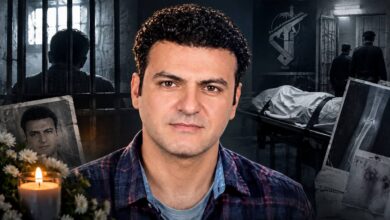
Account of Another Death Row Inmate; Hoshyar Alipour’s Brother Says This Kurdish Prisoner Was Forced to Confess Under Severe Torture
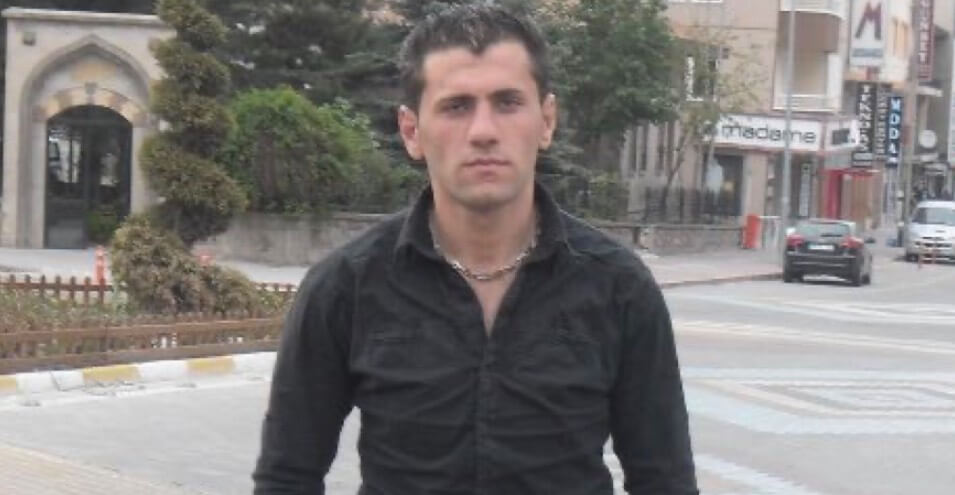
Hejar Alipour, brother of Hoshyar Alipour, an Iranian Kurdish political prisoner sentenced to death, says his brother faces an unjust death sentence at Sanandaj Central Prison while a co-defendant was conditionally released from prison in Ordibehesht of the current year.
Hejar Alipour, Hoshyar Alipour’s brother, told Voice of America that Hoshyar was sentenced to death and 16 years in prison by Branch One of the Sanandaj Revolutionary Court on charges of “moharebeh” (waging war against God), “membership in a party or group opposed to the system,” and “propaganda against the system,” while the sentence of Muhammad Estadqader, his co-defendant, who was convicted of the same charges to death and 11 years in prison, was reduced to 5 years at the outset and he was conditionally released from prison on February 22, 2020.
According to the brother of this political prisoner, Hoshyar Alipour was forced during interrogations to confess to “participation in clashes that occurred several years before his arrest in Kurdistan cities, Saqqez, and Sardasht, and even to operations that took place at the time of his arrest at one of the police stations in Saqqez; this is while Hoshyar was arrested in Baneh and had no prior participation in any operations.”
Hejar Alipour says that Hoshyar’s confessions “were obtained under torture, threats, and pressure through forced confession, false confessions that were broadcast several times on Iranian television.”
Iranian state television regularly releases images of televised confessions by security detainees to prove the legitimacy of their convictions, but to date, almost all detainees have retracted their televised confessions after being released from solitary confinement and transferred to prison wards, citing pressure, torture, and threats of harm to relatives by interrogators as reasons.
Forced confessions accompanied by violence by Iranian security forces have been raised repeatedly before. The use of this interrogation method, which has been criticized many times by human rights bodies, continues to be used by the Islamic Republic’s judiciary. Some of these forced confessions by detainees, such as those of Maziar Bahari, Maziar Ebrahimi, Sepideh Gholian, Ibrahim Bakshi, Saeed Malekpour, and dozens of others, have been broadcast on official Iranian television networks.
Hejar Alipour, regarding the status of his brother’s case, says that the case attorney has appealed the verdicts, with a cassation petition against the death sentence filed in the Supreme Court and an objection against the 16-year prison sentence filed with the Kurdistan Province Court, but to date no results regarding the review process have been announced.
Mr. Alipour says: “Our question to Iranian authorities is how, when two prisoners were arrested together, one faces a death sentence and the other is released? This is a great contradiction that if the case falls into the hands of an honorable person in the Supreme Court, they will understand that this sentence is unacceptable and we hope they will overturn it.”
According to him, Hoshyar Alipour and Muhammad Estadqader were initially transferred to Saqqez after their arrest by security forces near Sabdaloo village in Baneh county, and their case was examined at Branch 3 of the Saqqez Public Prosecutor’s Office; however, the Saqqez Public Prosecutor’s Office declared its lack of jurisdiction regarding the case, and the case was subsequently referred to the Sanandaj Revolutionary Court.
Hoshyar Alipour and Muhammad Estadqader were arrested on August 3, 2018 by Saqqez city security forces, and a death sentence was issued for Alipour on December 30, 2019. The Islamic Republic claimed the two were “members of a Kurdish party opposed to the system” and broadcast their confessions on Iranian state radio and television. Amnesty International at that time expressed concern in response to these confessions.
The brother of this political prisoner says that nearly two years and two months have passed since Hoshyar’s arrest, and during his detention he has only been able to meet with his family once, after which he was denied visitation.
Mr. Alipour told Voice of America: “Islamic Republic officials want us to remain silent and they are upset that we have launched a campaign to stop Hoshyar’s death sentence. We want to bring Hoshyar’s voice to all human rights organizations so that a fair trial can take place and by overturning this sentence, Hoshyar can be returned to us, because Hoshyar is innocent.”
Amnesty International’s office in England previously issued a call urging immediate action by human rights advocates to prevent the imminent execution of Hoshyar Alipour, an Iranian Kurdish prisoner who was sentenced to death in December of last year following an “unfair trial,” and asked its audience to correspond with Iranian judicial authorities demanding the suspension of this death sentence.
In recent months, the issuance of death sentences by Iran’s judicial system against opponents and participants in protests has been repeatedly criticized and condemned by human rights organizations. Human rights organizations say that the Islamic Republic does not fairly investigate charges and sometimes innocent people have been tried and even executed. For example, the Islamic Republic executed thousands of people during the 1980s who were serving prison sentences.
The United States has repeatedly condemned acts of violence and widespread suppression of protesters and civil activists in various instances, as well as the repeated and continuous violations of the rights of Iranian citizens by the ruling regime in that country.
Source: Voice of America