Continued Suppression of Religious Freedoms in Iran; Prevention of Release of Negin Ghadamian, Imprisoned Bahai Citizen
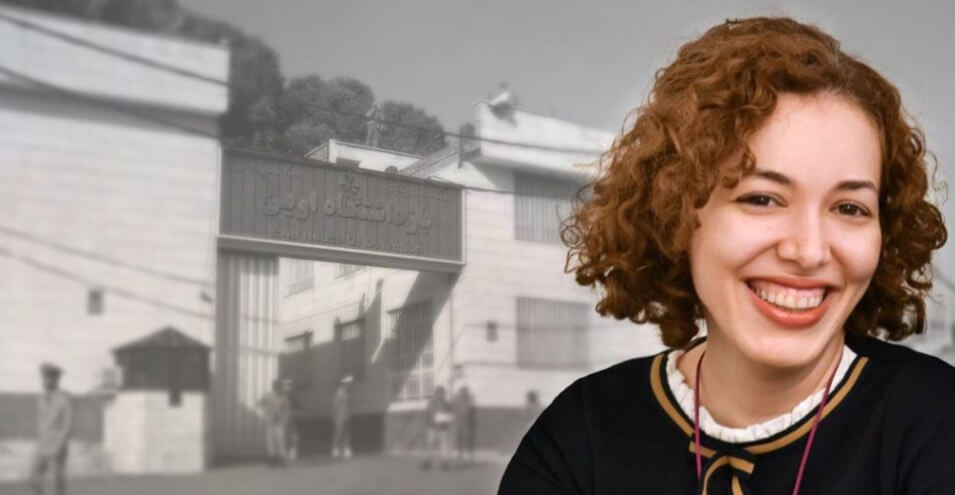
Negin Ghadamian, a Bahai citizen imprisoned in Iran who was arrested in late December 2017 and is serving a five-year prison sentence in Evin Prison, remains incarcerated despite a recent circular from the judiciary ordering temporary release or granting of furloughs.
An informed source told Voice of America on Wednesday, June 27, that this Bahai citizen was sentenced to five years in prison by Judge Moghadasi, head of Branch 28 of the Revolutionary Court, and has been in Evin Prison since late December 2017; however, despite the recent circular from the judiciary, authorities continue to oppose her release and prevent this Bahai citizen from being freed. Last December, the United States had sanctioned Judge Moghadasi for gross human rights violations.
According to this informed source, Negin Ghadamian’s family made considerable efforts to secure her release following a circular issued by the judiciary in late February of last year by Ebrahim Raisi, head of the judiciary, due to the spread of coronavirus in Iranian prisons; however, without providing a convincing reason to the family, authorities have prevented her release, and the only thing the family is told is that “the prosecutor has not yet agreed.”
These actions are being taken by authorities while, according to this informed person, the judge of sentence execution has repeatedly confirmed and emphasized that the aforementioned circular applies to Ms. Ghadamian’s case and she should have been released by now; however, officials have rendered the order of the head of the judiciary ineffective, and Negin Ghadamian is in a state of unlawful detention.
According to this informed source, the family of this ideological prisoner, in order to address her release status, has repeatedly tried to meet with Judge Ghasemi-Mehr, the general and revolutionary prosecutor of Tehran, through applications to the prosecutor’s office, but to date the family has not been allowed to meet with him, and the prosecutor’s deputies ultimately tell the family “we sent it to the prosecutor and they have not announced their final decision.”
It was in late February of last year that Gholam-Hossein Esmaili, spokesman for the judiciary, announced that approximately 10,000 prisoners whose sentences are less than five years in prison might be included in a pardon by the Supreme Leader of the Islamic Republic; however, despite this, the release of many ideological prisoners such as Negin Ghadamian, a Bahai citizen, has been prevented to this day.
This is not the first time that judicial authorities have fallen short in handling this Bahai citizen’s case. According to this informed source, previously when the family was following up on Ms. Ghadamian’s furlough during the spread of this virus, despite the opinion of the deputy supervisor of security crimes stationed in Evin Prison stating that she would be granted furlough, their follow-ups yielded no results, and even each time they went to the prosecutor’s office to obtain furlough, furlough request letters were not registered, and the first deputy prosecutor was not even willing to accept the furlough request letters.
This informed source told Voice of America that currently Negin Ghadamian’s family, having faced a dysfunctional system over this period, is concerned not only for Negin but for all prisoners in Iranian prisons; according to this informed source, despite the extremely limited facilities in Iranian prisons, the family of this ideological prisoner is also concerned about the spread of coronavirus in the prison.
Negin Ghadamian, a Bahai citizen detained in Evin Prison, was arrested on December 26, 2017 and after some time was tried in absentia by Branch 28 of the Revolutionary Court headed by Judge Moghadasi on charges such as illegal activities, membership in Bahai organizations, action against national security, and activities in an educational institution, and was sentenced to five years in prison; a conviction that was exactly upheld on appeal by Branch 36 of the Revolutionary Court headed by Judge Zargar.
Mike Pompeo, the U.S. Secretary of State, said recently at a press conference: “We have asked not only Syria, but also the Islamic Republic of Iran to release not only American citizens but all those who have been unjustly imprisoned in these circumstances. This is a humanitarian action, and beyond the fact that these people have been illegally imprisoned, in these circumstances humanitarian principles dictate that they should be released from prison.”
The prevention of the release of this ideological prisoner is taking place while the spread of coronavirus in Iran has not been completely controlled, and there is widespread reporting about the spread of this virus by human rights news agencies in Iranian prisons. The officials of the Islamic Republic had officially announced the death of 7,564 people until Wednesday, June 27, 2020, and the total number of those infected had reached 141,591.
This is while a World Health Organization official had previously stated that the figures announced by Iranian authorities regarding coronavirus cases are only one-fifth of the actual number of those infected. The official statistics of those infected and deaths from COVID-19 in Iran, China, and Russia cannot be verified by independent experts and cannot be considered authoritative and final.
Previously, the U.S. Commission on International Religious Freedom also expressed concern in its annual report regarding the state of religious freedoms in Iran, and in the section pertaining to Iran in this annual report, released on Tuesday, April 30, stated that the Islamic Republic is increasingly targeting Muslim minorities, particularly Sunnis and Sufis, as well as followers of other religions and denominations, including Bahais and Christians.
Source: Voice of America