Families of Executed: System Leaders’ Denial of Responsibility for 1988 Massacre is Public Deception
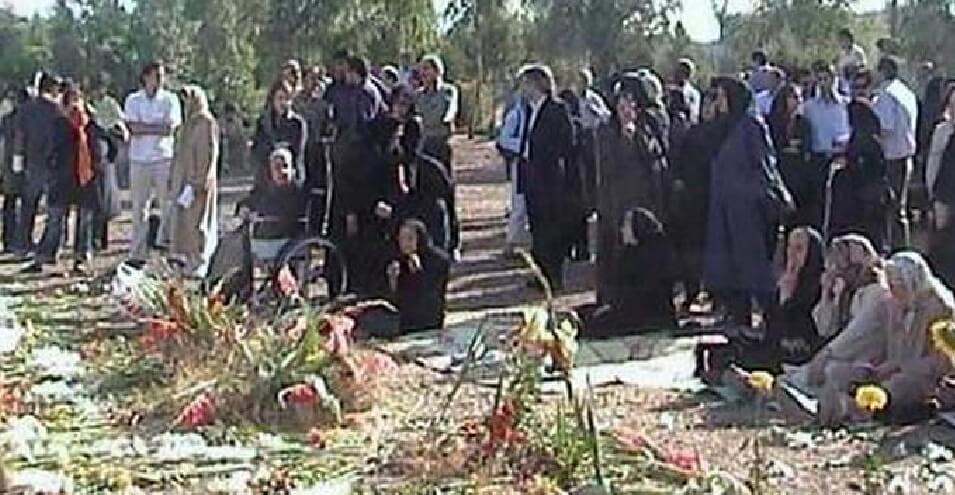
A group of families of those executed in the 1980s have protested in a letter against “distorting the reality” of the massacres of that decade. The subject of this group’s protest is a statement by 60 political activists in support of Mir-Hossein Mousavi and criticism of Amnesty International’s actions.
A large number of families of those executed in 1988 and the 1980s, a number of families of those killed in street protests from 2009 to 2019, and several civil and political activists, by signing a letter against “distortion of the undeniable reality of these crimes by a number of supporters or sympathizers of Mir-Hossein Mousavi who have opposed Amnesty International’s efforts to uncover the truth,” have lodged a protest.
The letter’s authors wrote: “We believe that these objections have been made deliberately and purposefully in order to lift the responsibility for accountability from the shoulders of certain parts of the government, including Mir-Hossein Mousavi and members of his administration.”
The letter’s signatories, naming the leaders of the Islamic Republic at the time from Khomeini and Khamenei to Mir-Hossein Mousavi and Abdullah Nouri, have considered all of them complicit in this crime.
The letter’s authors also criticized Ayatollah Montazeri, despite “his brave opposition to the execution of political prisoners,” and asked why, despite being aware of 1988 executions and writing a letter to members of the “death commission,” he did not inform the prisoners’ families of this crime and why he did not go directly to Tehran to meet with Khomeini.
The authors of this letter also consider current Islamic Republic officials, including Hassan Rouhani and Mohammad Javad Zarif, complicit in this crime due to “distortion, concealment, and even continuation of this crime through the destruction of individual and mass graves” and “assisting in the harassment of families,” “because the 1988 summer massacre is an ongoing crime.”
The signatories raised several questions, including: “Why and how were political prisoners who had prison sentences or whose sentences had ended, in the summer of 1988, behind closed doors and without the knowledge of political prisoners and families, and without a public and fair trial and in secret, massacred and buried in mass graves?”
They also asked: “Why do Mir-Hossein Mousavi and all those affiliated with Iran’s Islamic system, who have themselves been subjected to government persecution and have not been immune to the harm of human rights violations in Iran, not expose all their information and knowledge about the 1988 summer massacre to the view of families and society and constantly distort and conceal it?”
At the end, the signatories of this letter called on all those who have been subjected to harassment by the Iranian government over the past 41 years to “join their collective protest to clarify the truth of the crimes of the 1980s and the 1988 summer massacre and all state crimes committed to date.”
Protest Against 60 Political Activists’ Statement
The focus of the letter’s authors’ protest is a statement issued by a group of political activists in response to Amnesty International’s actions regarding the 1988 massacres.
In this statement, Amnesty International was criticized for publishing a report titled “Bloodstained Secrets” and accused of “obvious distortion and reversal of reality.”
In Amnesty International’s report, a document was published that indicated the knowledge of Islamic Republic officials about the 1988 executions. Additionally, a film was released of an interview by an Austrian journalist with Mir-Hossein Mousavi, the then Prime Minister, in which Mousavi refers to Operation Mersad and describes the “suppression” of opponents as a reaction to this operation.
The authors of this statement say that since the journalist’s question is not in the film and it is not at all clear what question Mousavi was answering when making this statement, one cannot conclude that Mousavi was speaking about executions.
They asked: “Where is the original version of the video? How did you reach these accusations based on an ambiguous and dubbed video and assume it to be proven? And what does this insistence and all this propaganda around it signify?”
The authors of the protest statement accused Amnesty International’s Iran section managers of excessive focus on Mir-Hossein Mousavi’s person, writing: “The managers of Amnesty International’s Iran section… in their interviews and writings on social media, have let go in some way the perpetrators and perpetrators of that crime and members of the death commission, and have continuously targeted Mir-Hossein Mousavi, Iran’s Prime Minister in the 1980s and one of the leaders of Iran’s Green Movement, who himself is under house arrest for claiming rights and accompanying the people and has no opportunity to defend himself.”
Mir-Hossein Mousavi said in a speech in 2010 about the 1988 executions: “We were in complete ignorance, and when we were informed, we tried to prevent those executions. The claim that I played a role is contrary to reality, and they did not even allow us to enter into this matter. Nevertheless, this is a crime that occurred, and the reality is that no one yet knows the true extent of it, and perhaps in the future it will be possible to address this event and its dimensions more comprehensively.”
In the statement protesting Amnesty International’s actions, the authors, while emphasizing that “pursuing the crimes of 1988 is a national and moral necessity,” criticized this organization’s method and said: “The manner in which Amnesty International’s Iran section managers have used to inform about that report during this period strengthens the suspicion that rather than being eager to uncover the truth, they are pursuing other goals.”
Some families of those executed in the 1980s, most of whom are inside Iran, have also accused Amnesty International of political bias and criticized on social media about “exploiting the massacre of prisoners.”
Including Zahra Ttankaboni, who herself was a political prisoner in the 1980s, wrote in a Facebook comment that she considers Amnesty International “a tool of political orientations of powerful governments.”
Families of political prisoners in a letter they have published also referred to this issue and wrote: “They [the authors of the protest statement against Amnesty International] are even willing to create division among families who have stood together for years to clarify the truth and seek justice, in order to achieve their goal.”
In the letter of families of political prisoners, it is stated: “We, the signatories of this letter, declare that any person and movement that in various ways wants to deny and conceal the responsibility and role of the leaders of Iran’s Islamic Republic and its important and influential figures in these crimes, has no credibility, and we consider it in service of the interests and political games of direct and indirect supporters of power and for the purpose of deceiving public opinion, and we will strongly stand against this approach that serves the violation of human rights and the continuation of crime in Iran.”
Besides the families of those executed in the 1980s, some families of those killed in recent protests have also signed this letter, including Shahrnaz Akamali and Mohammad and Maryam Karimbeigi, mother, father, and sister of Mostafa Karimbeigi, who was killed in December 2009 by direct fire from law enforcement.
Akbar Moosumbeigi, Anvar Mirzatari, Shadi Sadr, and Shadi Amin are other civil and political activists who have signed this letter.
In the summer of 1988, approximately five thousand political prisoners, all of whom had been tried and were serving their sentences, were executed by direct order of Ayatollah Khomeini with the formation of courts lasting only a few minutes.
To date, no official government official in Iran has specifically spoken about these executions, how they occurred, and also the reasons for secret and mass burials of the executed. Officials who have commented on this regard it as a reaction to Operation Mersad (Forough Javidan) by the Mujahedin-e Khalq and an attack on Iranian soil, while all those executed were in prison at the time this operation occurred.
Source: DW