Javad Larijani Denies Killing of “Protesters” in November Crackdowns
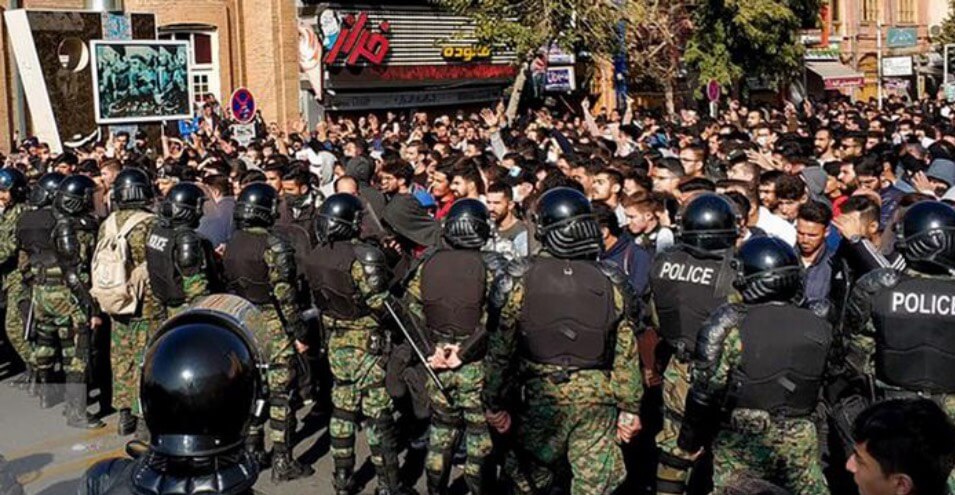
The Secretary of the Judiciary’s Human Rights Headquarters claims that among those killed in November protests, there were no protesters. The spokesperson of this branch called Amnesty International’s report of at least 304 deaths in the crackdowns an “allegation” but did not provide any alternative figures.
While Islamic Republic officials have refrained from providing accurate figures on deaths, injuries, and detentions from the November protest crackdowns over the past four weeks, the Secretary of the Judiciary’s Human Rights Headquarters has denied the very principle of violent encounters with protesters by announcing ambiguous statistics.
According to ISNA news agency, Mohammad Javad Larijani claimed on Tuesday, December 17, that 15 percent of those killed in November events were “terrorist forces” and 85 percent were security forces and individuals “defending their homes against rioters’ attacks.”
Therefore, as this senior judicial official has categorized the victims of November protest movements, no protesters were killed by security personnel.
The November protest movements began following an unexpected announcement of gasoline price increases. According to a decision by the Coordination Council of the Heads of the Three Branches, approved by Islamic Republic Leader Ali Khamenei, from dawn on November 15, the price of rationed gasoline per liter increased by 50 percent to 15,000 rials, and free-market gasoline tripled to 30,000 rials.
Protests that initially began in reaction to gasoline price hikes quickly took on an anti-government character, during which slogans against the Islamic Republic’s tension-provoking regional policies and criticism of officials’ inefficiency, mismanagement, and corruption were frequently heard.
Shooting at Protesters “With Intent to Kill”
Protesters in some cases chanted against Khamenei himself and set fire to his images. Apparently, this was one of the reasons for the violent suppression of protesters. Michelle Bachelet, United Nations High Commissioner for Human Rights, says the shooting at protesters “was intended to kill.”
Amnesty International in its latest report on recent developments in Iran estimates the death toll at a minimum of 304 people. Since the beginning of November crackdowns, the human rights organization has published several reports on this matter, with the number of victims continuously increasing.
The Secretary of the Judiciary’s Human Rights Headquarters attributed international organizations’ statistics about November events to “a political movement against Iran” and said: “I wrote a letter to the High Commissioner for Human Rights that we are witnessing the birth of a new ISIS group. The previous ISIS spoke of Islam, but these ones have different talk.”
Simultaneously, Gholam-Hossein Ismaili, the spokesperson of the Judiciary, called the figures announced by Amnesty International an allegation and a “propaganda scenario.”
One day after the protests began, Islamic Republic officials, including to prevent the spread of news and images of violent crackdowns, cut off global internet connectivity.
“Internet at the Service of Terrorist Objectives”
Mohammad Javad Larijani, in defense of this action, said: “The rioters’ think tank was outside the borders. They extensively used cyberspace capabilities and that’s why they were upset about the internet cut-off. In fact, the internet was placed at the service of terrorist objectives, and those who support the internet should consider this dimension of the internet—terrorist misuse of it.”
Larijani, who claimed that none of the deceased were protesters, acknowledges the existence of the protests themselves: “After the announcement of gasoline price increases, two incidents occurred; the first incident was people’s protest, which we should pay attention to, but the second incident was organized actions by experienced and directed groups that, with extensive capabilities, quickly hid themselves under people’s protests and resorted to violence, destruction, and killing.”
This judiciary official said regarding the number of those detained in November protests: “Currently, the number of prisoners is in the hundreds, not thousands.”
Etemad newspaper on December 5, citing Hossein Naghavi Hosseini, spokesperson of the National Security Commission of the Islamic Consultative Assembly, reported that approximately 7,000 people were detained during the recent unrest. This number has also been estimated at 8,000.
Jamal Arf, Deputy Political Minister of Interior, said in early December that in a meeting with other agencies, the task of presenting statistics regarding recent events was assigned to the Office of the Prosecutor General, who, based on statistics from the Coroner’s Office and other sources, would “soon” announce his opinion.
MohammadJafar Montazeri, Prosecutor General, on December 7, while denying the detention of thousands of people, said detainees are in three categories, with some “immediately” and others released “with very simple orders.”
He said: “A large number of them, for whom evidence and indications show they committed crimes at the protest scenes, are still in detention.” Montazeri, unlike Larijani, did not deny the killing of protesters and told ILNA news agency about their number: “Since I don’t have accurate information, I cannot announce it.”
Interior Minister’s Response to Shooting at Protesters’ Heads
This lack of accurate information and denial comes despite evidence, images, and videos circulated on social media and accounts by eyewitnesses and families of victims indicating that security personnel in some cases shot protesters at close range.
This issue was also raised at a meeting between signatories of the motion to impeach the Interior Minister and Abdolreza Rahmani Fazli. Mahmoud Sadeghi, one of the representatives present at this meeting, discussed the details of this meeting in a conversation with the “Emtedad” website published on December 25.
Sadeghi says that when a representative asked the Interior Minister why some protesters were shot in the head and whether they couldn’t at least shoot them below the waist, he responded: “Well, shooting in the legs has also happened.” The Tehran representative in parliament says the representatives present were “shocked” by Rahmani Fazli’s answer, which was described as “wishful thinking.”
Source: DW