Children of Sistan and Baluchestan Still Have No Roof Over Their Heads for Learning
Education in Sistan and Baluchestan has taken on a bitter meaning; a place where poverty, neglect, and forgetfulness have joined hands to deprive children of the most fundamental human right of learning in security.
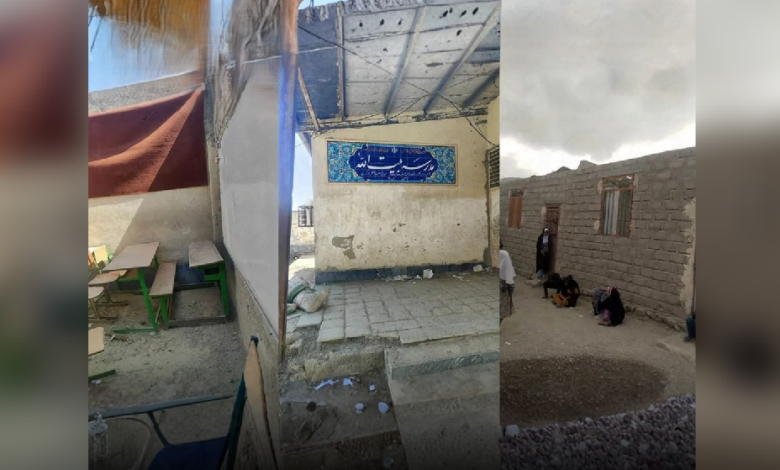
In the small and disadvantaged village of “Soldan” in Sistan and Baluchestan province, approximately 30 students gather in open air every day to study. Two years ago, the roof of the classroom—the only school in the village—collapsed, and since then, no government institution has taken action to rebuild it.
“Khosrow Hamedi,” a social activist in the region, stated: “The roof of Soldan School collapsed two years ago and since then, classes have been held in open air. Despite officials being aware of the situation, no action has been taken.”
Images sent by residents show children sitting on the ground under the sun and amid the seasonal winds of the region, studying beside an old blackboard. Families say they have sometimes built temporary shelters with wood and plastic, but the strong southeastern winds have destroyed them each time.
This situation is not limited to Soldan. According to reports from independent sources, hundreds of schools in Sistan and Baluchestan are in similar conditions. These schools are either without roofs and walls, or their buildings are dilapidated and unsafe.
One local teacher in an interview said: “In one school, 450 students studied in four classrooms, one of which was actually a storage room.”
In some parts of the province, students are forced to travel long distances on foot due to the lack of educational facilities. Teacher shortages have compounded the crisis. Multi-grade classes and overcrowding of students have effectively destroyed educational quality.
Based on recent data, Sistan and Baluchestan province has approximately 5 percent of the country’s population but experiences the lowest per capita educational expenditure. Experts refer to this situation as “structural inequality,” a discrimination that is not only geographical but also cultural and linguistic. Many Baloch children study in a language other than their mother tongue, and this deepens the learning gap.
According to a Crisis Group report, poverty, marginalization, and incorrect policymaking have turned education in this region into a chronic crisis.
Despite official promises for “free education through secondary school,” reality shows that millions of children in Iran still lack the most basic educational conditions. In Baluchestan, the concept of a “classroom” is sometimes reduced to just a wooden board in the shade of a tree.
But the children of Soldan still have hope. Every day they write with dusty notebooks and small hands beneath the hot sky, perhaps one day a roof will be built over their heads again—a roof that symbolizes respect for human dignity.
From a Christian perspective, every child is an image of God’s hope and light. Neglect of their education and safety is not merely a failure of human responsibility, but a failure of faith and justice.