One-Year Prison Sentence of Mitra Badrnzhad Executed: Judge Said “The Fact That You Are Bahai Means You Are a Criminal in My View”
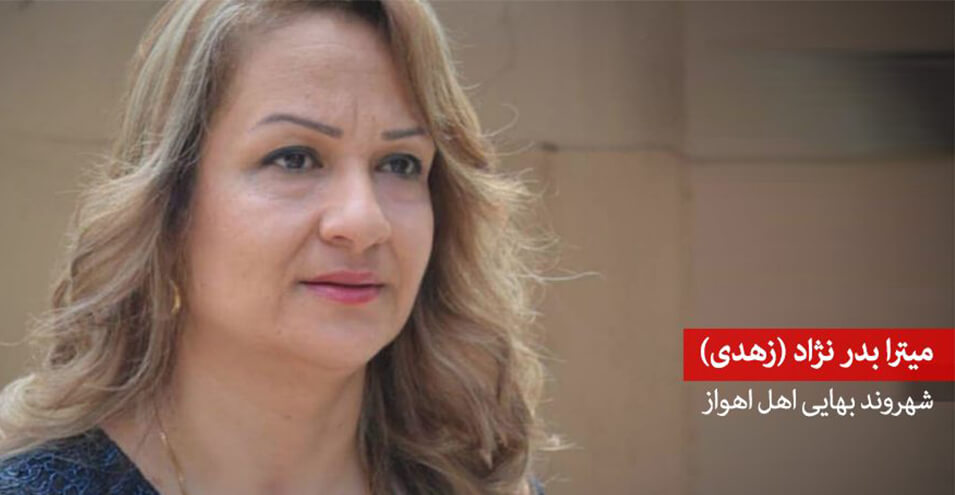
The son of Mitra Badrnzhad (Zahedi), a Bahai citizen residing in Ahvaz, told the Iran Human Rights Campaign that his mother, after receiving a summons from September 22, was transferred to Sepidari Prison in Ahvaz to serve a one-year prison sentence. Ms. Badrnzhad is among Bahais who were arrested on charges of “membership in Bahai organizations” and “propaganda against the system” and sentenced to imprisonment. According to Rouzbeh Zahedi, her son, Judge Zarea, judge of the second branch of the Ahvaz Revolutionary Court, told his mother: “The fact that you are Bahai means you are a criminal in my view.”
Rouzbeh Zahedi, who is currently in one of Turkey’s cities awaiting his asylum procedures to be completed, told the campaign about how his mother was arrested: “It was noon on March 3, 1996 when the agents entered our house. At that time, no one was home, and according to my mother, 17 or 18 male officers and one woman from the Ahvaz Intelligence Office entered the apartment. My mother thought it was my uncle’s wife who lives in the apartment below us at the door, but when she opens the door she sees the agents behind it and in the hallways, and some were also standing outside the apartment. They searched the house for two or three hours and seized all of the family’s personal belongings. Shortly after they arrived, my brother, who is a photographer, came home and they took his camera as well.”
According to Mr. Zahedi, the agents even “took gold items that had religious symbols or inscriptions on them along with several mobile phones, two computers and a laptop, and Bahai religious books. Ms. Badrnzhad’s son says that after a year and a half has passed since the seizure of the belongings and even after his mother was transferred to serve her imprisonment, their personal belongings have still not been returned to them: “My family followed up several times, but neither the mobile phones, nor the computers and laptops, nor my brother’s camera, nor the gold items have been returned. The strange thing is that even in the list of seized items that was given to us, the number of items was not mentioned.”
Ms. Badrnzhad’s son continued: “My mother spent 50 days in solitary confinement in the Intelligence Office detention center and Sepidari Prison and was ultimately released on bail. In fact, we put the deed to our house as bail for my mother.” Ms. Badrnzhad was arrested on March 3, 1996, and was released on May 15, 1997 on bail pending the issuance of a verdict.
Mitra Badrnzhad, a Bahai citizen from Ahvaz, was sentenced on September 28, 1997 in the second branch of the Ahvaz Revolutionary Court headed by Judge Zarea on charges of “membership in Bahai organizations” and “propaganda against the system” to five years imprisonment and two years banishment outside Khuzestan Province in one court session. However, this sentence was reduced to one year in prison by the court of appeal and the two-year banishment was also removed from the sentence. According to her son, the court of appeal’s verdict was announced to them in late July. About two months later, a summons was sent to Ms. Badrnzhad requiring her to report to the Sentence Enforcement Office in Ahvaz. On September 22, she went to the Sentence Enforcement Office where she was informed that she must be transferred to Sepidari Prison in Ahvaz to serve her sentence.
According to Mitra Badrnzhad’s son, the judge of the second branch of the Ahvaz Revolutionary Court explained the reason for his mother’s charges in the court session, saying: “The fact that you are Bahai itself means it is a crime, and in my view you are a criminal.” Regarding the court session, he said: “My mother’s lawyer defended her in the court session, saying that she has done nothing illegal and there is no evidence in her file proving her guilt. But Judge Zarea replied that in my view, the fact that you are Bahai means you are a criminal. This judge said that in the early days of the revolution, judges gave you good sentences, and I want to return the sentences to that period. The judge meant that in the early days of the revolution, blanket death sentences were issued for Bahais.”
Rouzbeh Zahedi, in response to a question about what evidence was against his mother, said: “Unfortunately, we do not have a copy of the verdict and they did not even give it to her lawyer. The lawyer was only allowed to read the verdict. As far as I know, they cited holding Bahai feast gatherings in our home and having religious books in the house as evidence of the charges. Bahais hold a feast gathering every 19 days, which is a religious practice, and my mother held these gatherings in her home and other Bahais in the city were invited.”
He continued: “Of course, Judge Zarea justified in the court session that my mother’s guilt was her being Bahai and that she was detained by the Intelligence Office, so she is guilty. He also said she has a complainant, but the complainant was never identified and specified.”
Ms. Badrnzhad’s son also talked about his mother’s interrogations: “My mother said that during all the interrogation days, she sat on a chair facing the wall blindfolded, and the interrogator had his back to her. My mother said that during the interrogations, they insulted her very badly and once told her that they could target her sons, which scared my mother. But fortunately, aside from psychological pressure, there was no physical torture.”
Source: Iran Human Rights Campaign