World Day Against the Death Penalty: Children, Hidden Victims
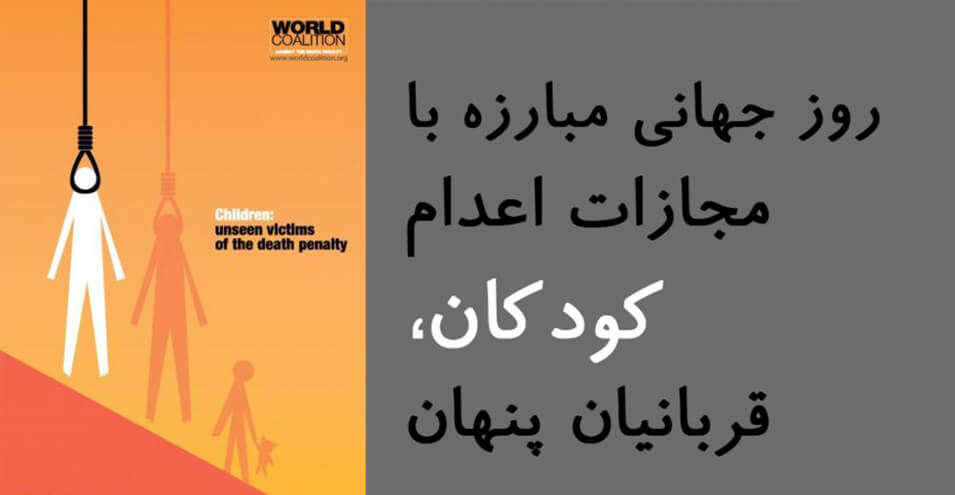
Dozens of human rights organizations decided seventeen years ago to designate October 10th, corresponding to Mehr 18th, as the “World Day Against the Death Penalty,” with the goal of striving to abolish this punishment worldwide; a punishment that, according to human rights advocates, is “inhumane” and violates the right to life.
October 10th this year has been dedicated to children whose loved ones—their fathers or mothers—have been taken from them forever by capital punishment; small victims for whom the execution of their parent is the greatest and most bitter nightmare of their lives, a nightmare with a dark shadow that follows them until the end of their days.
Children, hidden victims; a subject that human rights organizations decided this year to dedicate the World Day Against the Death Penalty on October 10th to, shedding light on small victims who are often forgotten.
It does not matter what crime they were executed for—murder, drug trafficking, armed rebellion, or espionage; a child has lost their father or mother due to what human rights organizations call state-sponsored murder, the death penalty! A punishment that deprives hundreds of children worldwide of their parents each year. Hundreds of children like Omid.
Omid was a very young child when his father was executed:
“My father saw me several times during visits in prison, but I have no image of him. As a child, you wonder where your father is? Talking about what happened to my father was not a normal discussion, and until I was fourteen or fifteen years old, I pretended that my father lived outside the country. I knew he was in hiding, there was a picture of him on the wall and I knew he wasn’t there for a reason. In school, when asked who my father was and where he was, I lied. But eventually I saw other children in the family who had fathers, and their way of life was different from mine. I always felt that empty space.”
The absence of one parent, a bitter feeling that hundreds of children in twenty countries worldwide experienced last year, headed respectively by China, Iran, Saudi Arabia, Vietnam, and Iraq; twenty countries that carried out executions in 2018 and left children forever mourning the loss of their mothers or fathers.
Children like Rabe’a, who finds the effects of her father’s execution indescribable:
“I couldn’t cry at all, not at all! My relationship with my father was very close. The impact of his execution was enormous. I still feel its effects, I still wait for my father to call me, I still see my father’s face before my eyes. I don’t know how to describe how negatively his execution affected me.”
According to Amnesty International, approximately 20,000 people worldwide faced death sentences last year, which means anxiety and concern for thousands of children who waited for their parents’ deaths—a bitter wait for a death predetermined in advance, on a specific day and time, in a heavy and painful atmosphere.
Tara was thirteen years old when she said goodbye to her father forever. She says:
“I really don’t know what people can say in these circumstances? What does this goodbye mean? What do you want to tell your father? I remember my feelings during that time very well and I don’t think I can forget how angry I was. For years, a long time, I really felt nothing, as if I myself were dead. Many things within me were lost, this is what happened, everything is darkness.”
A dark memory that executing countries in the world create for the children of executed individuals.
Mahmoud Amiri-Moghaddam, head of the Iran Human Rights Organization, speaking in Oslo, says:
“We condemn executions every day, but even human rights organizations pay far less attention to the effects of executions on the children of executed people—unseen victims of capital punishment. This year marks the 30th anniversary of the adoption of the Convention on the Rights of the Child, and we thought we could draw public attention to the violation of the rights of children of those sentenced to death or executed.”
Focus on small victims whose rights are violated according to the Convention on the Rights of the Child. Children who in their happy world may not even yet have a proper understanding of the concept of death, but are deprived of having their parents.
Hassan Nayeb-Hashemi, a human rights activist in Vienna, speaks of the violation of children’s rights in this incident:
“When a country carries out executions, it means it is effectively committing murder, depriving these children forever of the opportunity to be cared for by their parents. Therefore, it is not only the executed person who suffers; their spouse and children are also seriously harmed for the rest of their lives.”
Harms that begin from the stage of arrest of the parent, continue through trial and the issuance of the death sentence, and reach their peak with its execution.
Reza Kazem-Zadeh, a clinical psychologist in Brussels, believes that the execution of parents has multifaceted effects on children’s lives:
“Since the child is completely unable to understand such terrible and irreversible violence, in most cases they experience this as a psychological shock to their life. That is, their confrontation with this issue is accompanied by the generation of a sense of instability in life. They feel they have lost the secure environment that every child needs. In many cases, it has also been observed that drug use or delinquency increases in children of executed individuals. Moreover, the execution of a person is always accompanied for a child by a kind of feeling of social defeat—that is, the death sentence for a child is like a kind of social stigma, as if forever marked on their forehead and that of their family, and this is irreparable.”
Mehr 18th this year, the World Day Against the Death Penalty, has arrived as 142 countries worldwide have abolished capital punishment in law or in practice, but Iran last year, with at least 253 executions, not counting China, was responsible for one-third of all executions worldwide.
Mahmoud Amiri-Moghaddam speaks of the number of executions this year:
“According to statistics from the Iran Human Rights Organization, from the beginning of this calendar year until today, at least 210 people have been executed in Iran. Most of these individuals were sentenced for murder, and among those executed were at least two child offenders. Unfortunately, Iran continues to be considered one of the world’s largest executing countries.”
One of the world’s largest executing countries that years ago executed Omid’s father for political reasons.
Omid says he wishes his father were here so he could ask him questions and know him:
“I always had questions I wanted to ask my father and know what was on his mind. What I know about him are things I heard from my grandfather and grandmother and also from my mother about him, for example I know my father was a good painter, but I wish I could have seen all this. Sometimes I was angry that my father didn’t make me a priority in his life and chose the political path, but at the same time it is easy to criticize someone when they are not present and to demand accountability from them. Perhaps my father had his reasons, but I don’t have the opportunity to hear them from his own mouth.”
An opportunity that has been denied to hundreds or thousands of other children over the past four decades in Iran. A process that continues, and annually deprives dozens more children—dozens more Rabe’as, Taras, and Omids—of their mothers or fathers.
Source: Radio Farda