It Happens on Wednesday: Identifying ‘Mafia Gangs’ of Street Children
After 20 years of back-and-forth and various programs announced by government and non-governmental organizations, the collection and management of working children in Iran remains a tangled mess in the hands of municipalities, governorates, and welfare offices.
No Precise Statistics Available
The organizations responsible for managing ‘working and street children’ lack accurate and official statistics on the number of these children due to insufficient coordination, and no central agency has been established to collect data on this phenomenon over these years.
Tehran Municipality reports the presence of 15,000 working and street children, while Tehran’s Welfare Organization states the number is around 7,000. However, these organizations do not possess precise statistics.
The Office of Social Harms at the Ministry of Cooperation, Labor and Social Affairs attributes the different statistics among organizations to multiple ‘definitions’ of working and street children. Some statistics without clearly identified sources or surveys show that approximately 60 percent of street children are Iranian and 40 percent are of non-Iranian nationality (Afghan). Among these, children and adolescents aged 10 to 15 work in unofficial and unsafe workshops and basements, according to FARS News. Children as young as 7 or 8 are also employed in workshops on the outskirts of Tehran.
The Ministry of Interior implemented a plan to manage working and street children in 2018, but many child rights activists in Iran protested its implementation method after images emerged showing improper handling of working and street children by implementers. The plan yielded no results.
Expecting More Street Children
As Iran’s economic situation worsens, media outlets report an expanding presence of street children. The serious concern is that working children, due to reduced income in these unauthorized workshops lacking proper working conditions, may end up on the streets.
The pressure of rising prices and consequent reduction in household income are among the most important factors that could increase the street children population.
Some reports indicated that working children receive wages of slightly more than 350,000 tomans for 11 hours of work. However, the wages of street children, according to some child rights supporting organizations, reach up to 100,000 tomans daily.
Identifying Street Children Management Gangs
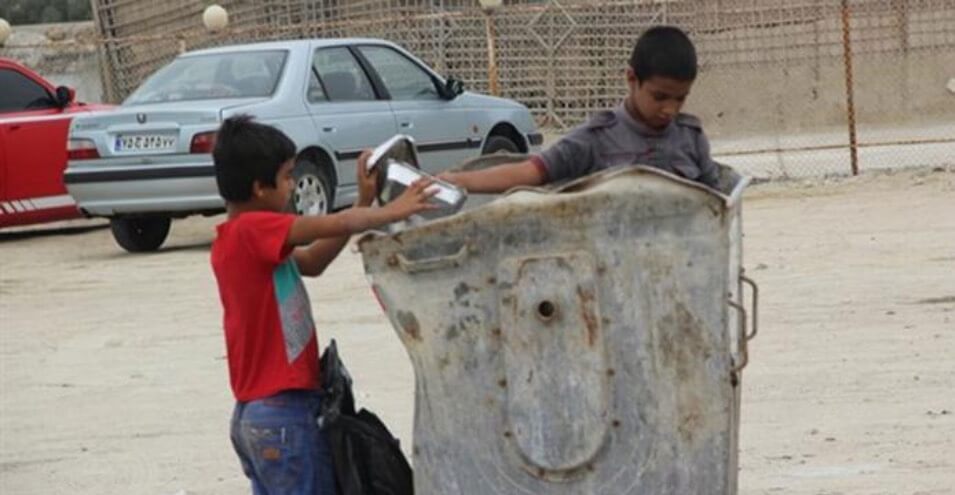
Waste collection and scavenging have currently become both bread and water for Iranian and non-Iranian children and for the ‘gangs’ and groups that organize these children.
Concurrent with concerns about the growing population of street children, Farzaneh Moravasti, director-general of the Office of Social and Cultural Affairs at Tehran Governorate, announced the implementation of a plan to identify what she calls ‘mafia gangs involved in street child trafficking’.
In this plan, scheduled to begin on Wednesday, December 11, law enforcement will work to identify gangs that, according to Moravasti, employ children at intersections and collect them at night.
The plan is to have the Welfare Organization cooperate with law enforcement. Welfare has consistently stated that it lacks the necessary budget for caring for orphaned children, let alone for caring for and supporting street children.
There has always been a claim that street children are organized by ‘mafia gangs’ and stationed in different centers and areas of cities, then returned to marginal residential centers after work hours. The proceeds from hours of ‘scavenging’ are collected at waste and debris accumulation centers and sold by contractors.
However, Sam Bourbour, director of the Child Rights Watch Association in Iran, told the newspaper ‘Iran’ that a group of municipal contractors ‘exploit’ children and send them to the streets to collect waste, garbage, and other materials.
Available statistics show that approximately 40 percent of children and adolescents referred to as street children hold non-Iranian citizenship.
Farzaneh Moravasti, director-general of the Office of Social and Cultural Affairs at Tehran Governorate, confirmed in an interview with ILNA the presence of these children who have entered Iran and emphasized that solving the problem requires addressing issues legally and internationally at both national and transnational levels.
According to her, in recent years, a number of Afghan children have been ‘smuggled’ into Iran, and because they lack guardians and identification documents, welfare cannot hand them over.
This Tehran Governorate official also stated that Tehran Governorate is not responsible for identifying and dealing with child traffickers but only witnesses the illegal entry of these nationals.
Many child rights activists have consistently said that as long as fundamental measures are not taken to address the economic problems of marginalized families, the situation will continue on the same path; welfare and municipalities collect a few children from the streets, but new children fill the empty spaces.
Source: DW