Lawyer of Masoud Kazemi, Journalist, After His Arrest: ‘The Court Has Strayed From Justice’
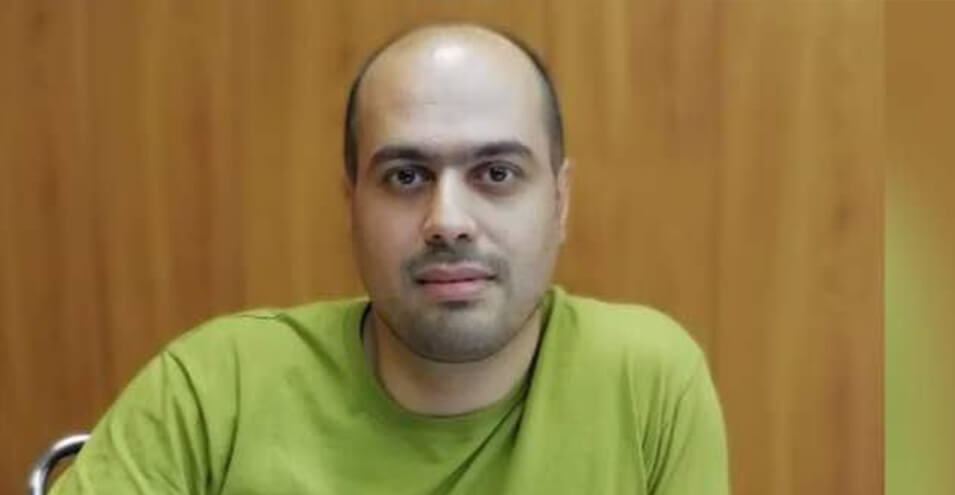
Masoud Kazemi, a journalist and former editor-in-chief of the monthly magazine Sedaye Farsi, was arrested on the morning of Wednesday, June 1st, after appearing in his court hearing at Branch 28 of the Revolutionary Court to address charges against him, and was transferred to Evin Prison. Judge Mohammad Moghisseh of the court, after presenting new charges, issued a heavy bail of one billion tomans for the journalist, which resulted in his transfer to Evin Prison due to his inability to pay such a substantial amount. According to his lawyer Ali Mojtahedzadeh, the charge of “gathering and collusion and actions against national security” was added to his other charges during the court session.
Ali Mojtahedzadeh, the lawyer of this journalist, announced the news of his arrest on Twitter, writing that during the court session, Judge Mohammad Moghisseh presented new charges against Masoud Kazemi that had not been raised during the investigation and prosecution phase. In other tweets, Mojtahedzadeh criticized the unlawful conduct of the judge of Branch 28 of the Revolutionary Court, stating that he cursed Masoud Kazemi during the court proceedings. The lawyer did not provide further explanation, but wrote that this behavior was unbecoming of a judge and clergyman, and that those present at the court session were astonished.
A few hours after the court session, this lawyer told the state news agency IRNA about Judge Moghisseh’s strange conduct: “The type of treatment I witnessed today from the judge of Branch 28, I had never seen in any court session. At the end of the session, I was given the opportunity to present a defense. During the session, I stated that the court has strayed from justice. Nevertheless, I will submit a petition.”
Mohammad Moghisseh, judge of Branch 28 of the Revolutionary Court, has been known since 2009 as one of the main judges of the Revolutionary Court in handling cases of ideological and political defendants and issuing severe sentences.
Mr. Mojtahedzadeh wrote in his first tweet: “In the session addressing the charges against #Masoud_Kazemi in Branch #Twenty_Eight_Revolutionary_Court, the bail of 500 million tomans was increased to a security deposit of one billion tomans, as a result of which he was #arrested and sent to #Evin, and new charges that had not been raised at the #prosecution were announced in #court!!”
In another tweet, this lawyer, referring to the fact that the judge “repeatedly” cursed his client, wrote: “The behavior we witnessed from Mr. #Moghisseh was in no way befitting of a #judge, let alone a #clergyman. He repeatedly cursed #Masoud_Kazemi during the court hearing—a strange behavior that did not even fit in my imagination. Surely Mr. #Raisi is responsible for such conduct by #judges in this world and the hereafter.”
Unlawful conduct, insulting the defendant, and even indictments lacking legal principles are typical of Revolutionary Court proceedings in examining cases of political and security defendants. Previously, an informed source told the Iran Human Rights Campaign about a session where the last defense statements of Sepideh Ghollian, Asal Mohammadi, and other labor activists were heard in Branch Seven of Evin Prison Prosecution that investigator Shah-Mohammadi dealt with the defendants harshly and loudly, and in his indictment cited one instance of their charges as causing discomfort to the leader.
Ali Mojtahedzadeh, alluding to Iran’s judicial system and addressing Ibrahim Raisi in another tweet, wrote: “Mr. #Raisi, you certainly know that the requirement of #justice is adherence to the principle of #impartiality on the part of the #judge. When throughout the entire court session Mr. #Moghisseh is busy cursing #Masoud_Kazemi, should we expect a #fair verdict to be issued!? I will soon present what happened in #court through an open letter.”
According to the tweets of Masoud Kazemi’s lawyer, after Judge Moghisseh announced the new charges along with curses, he converted the journalist’s previous bail of 500 million tomans into a security deposit of one billion tomans, and subsequently issued an arrest order for the journalist due to his inability to pay.
Masoud Kazemi, a journalist with previous work experience at the newspapers Shargh and Qanun, and who served for a time as editor-in-chief of the monthly magazine Sedaye Farsi, was previously arrested at his home on November 14th. Before his arrest, he had posted on Twitter about corruption in the Ministry of Industry and Mines and had posed critical questions to Hashem Aldin Ashena, an advisor to Hassan Rouhani, about serial killings. After his arrest, his lawyer posted on Twitter that his arrest occurred through an unlawful process without prior notice. Six days later, on November 20th, he was released on a bail of 100 million tomans. His lawyer said in an interview with IRNA in February 2019 that his client’s charges were: “spreading falsehoods, insulting officials and authorities, propaganda against the system, and insulting the position of the leader“
Previously, Marziyeh Amiri, journalist of the Shargh newspaper, was arrested on April 1st, 2019 while covering labor protests on International Workers’ Day. There is no information available about her status and charges. According to her colleagues’ Twitter posts, after being detained for some time in an unknown location, she was transferred to Ward 209 of Evin Prison. Since March 2019, at least four journalists have been arrested: Marziyeh Amiri, Keyvan Samimi, Masoud Kazemi, and Mohammad Reza Nasab Abdollahi, who was arrested on April 20th and released one month later on May 20th, though the reason for his arrest and charges remain unclear. Marziyeh Amiri, Keyvan Samimi, and Masoud Kazemi are currently in Evin Prison.
Despite Hassan Rouhani’s campaign slogans about respecting freedom of thought and civil rights, many journalists have been arrested since 2014 when his presidency began. Journalists such as Tahireh Riahi, Zeinab Karimian, Pouyan Khoshhal, Amirhosein Mirasmaeili, Ehsan Mazandarani, Saman Safarzaei, Isa Saharkhiz, and Afarin Chitsaz, as well as numerous newspapers and magazines, have been shut down.
Zahra Ershadi, Iran’s representative to the United Nations Human Rights Council, stated in early November 2017, a few days before Masoud Kazemi’s first arrest, in response to David Kaye’s report, the UN Special Rapporteur on freedom of expression and opinion regarding Iran: “The Iranian government is seriously committed to maintaining an open and vibrant media environment for all its citizens,” and claimed that all reports against Iranian media are false and that “the Islamic Republic of Iran has become the target of media warfare.”
Source: Iran Human Rights Campaign