Floods in Iran; Evacuation of 67 Villages in Khuzestan
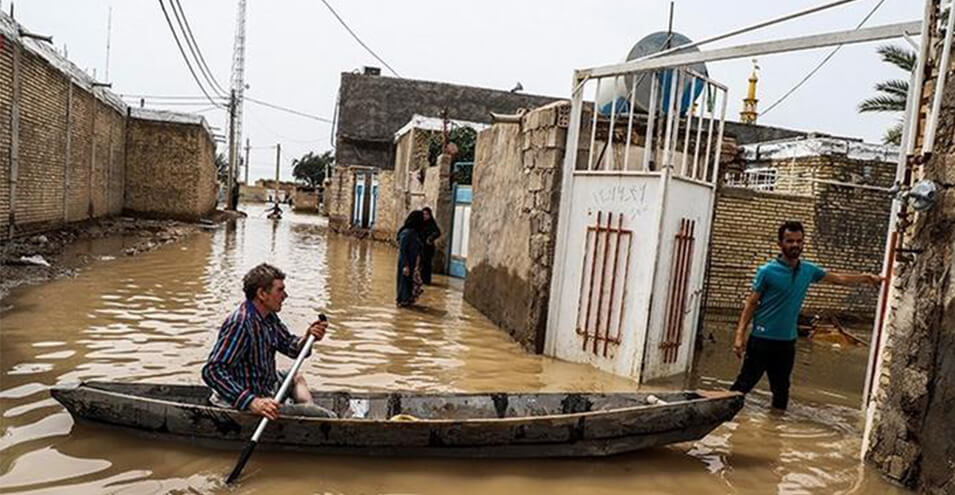
In Khuzestan, 67 villages at risk of flooding have been evacuated. Local officials say the number of flood-prone areas is increasing. In Dorud and Azna, 38 villages are also surrounded by floods, and communication with 250 villages in Delfan remains cut off.
● Floods in Iran; Crisis Management Responds Sharply to Revolutionary Guard Commander’s Remarks
The National Crisis Management Organization responded to statements by Commander Mohammad Pakpour of the Revolutionary Guard’s Ground Force regarding the situation of flood-affected people in Poldokhtar, stating that the commander’s remarks “were interpreted as aimed at weakening relief services in the region.”
Commander Mohammad Pakpour on Tuesday evening, April 3, 2019, upon returning from the flood-stricken city of Poldokhtar at Khorramabad Airport, told media that government officials were indifferent to the flood-affected people in the region. He said: “There are many problems and there is no management. No government official dares to go to Poldokhtar; the situation of this city following the flood is not satisfactory.”
Commander Pakpour added: “The people of Poldokhtar are in a very tragic situation and the conditions in villages and the city of Poldokhtar are very poor. The people are angry and upset, but they told us you are guards and they respected us.”
The National Crisis Management Organization responded on Wednesday, April 4, to the remarks of the Revolutionary Guard’s Ground Force commander. The organization stated in a statement that Commander Pakpour entered Poldokhtar hours after extensive communication barriers were removed by rescuers, and “his description of the region’s conditions was the result of a major natural crisis in the area.”
The Crisis Management Organization said that Commander Pakpour’s media remarks “would certainly, in addition to disappointing and disheartening the affected and trapped people as well as the general public, inadvertently bring joy and happiness to the enemies of the revolution and target the entirety of the Islamic system.”
The statement added that the Revolutionary Guard is a member of the Crisis Management Headquarters, and “it was expected that the esteemed commander of the Revolutionary Guard’s Ground Force, after observing shortcomings, would immediately convey the matter to relevant officials including the governor, Red Crescent officials, Ministry of Energy, Ministry of Jihad-e Agriculture, Ministry of Roads and Urban Development, Ministry of Health and other relief agencies, and if unable to resolve the problem in the region, would transfer it to the National Crisis Management Organization.”
● Evacuation of 67 Villages in Khuzestan
While floods have cut off communication in dozens of villages in Lorestan Province, flooding in Khuzestan is advancing. Kiamars Haji Zade, director general of Khuzestan’s Crisis Management Headquarters, says that so far 67 at-risk villages in Khuzestan on the edges of the Dez, Karun, and Karkheh watersheds have been evacuated. Haji Zade told ISNA: “Up to now, 11 villages in Shush, 9 villages in Dezful, 27 villages in Shushtar, 1 village in Shadegan, 1 village in Dasht-e Azadegan, 13 villages in Ahvaz, and part of the Seyyed Khalaf area in Ahvaz and four villages in Karun County have been evacuated.”
This local official in Khuzestan Province added: “These numbers continue to increase and we are constantly warning villages and at-risk cities to evacuate them as well.”
● Communication with 250 Villages in Delfan Remains Cut Off
Hashmat Bahmani, governor of Delfan in Lorestan, told the IRNA news agency on Wednesday, April 4: “Ground communication with 250 villages in this county remains cut off, and insufficient facilities have caused delays in reopening rural roads.”
According to the Delfan governor, these village roads have been closed due to landslides and rock slides and the destruction of more than 40 rural bridges in the past two days. 35 villages in this county still have no electricity, and drinking water in 60 villages is also cut off.
Bahmani added: “Rainfall in the county has stopped but water still exists in the homes of some urban neighborhoods including the slaughterhouse, municipality, Elft Abad, Basij neighborhood, Kharam Housing and Cultural organizations.”
The Delfan governor requested the deployment of helicopters for relief and patient transfer from some villages.
On Monday, April 1, three rivers—Khuram River and the rivers of Delfan, Kohdasht, Selseleh, Poldokhtar, Mamulan, Borujerd and Cheghni counties—overflowed, and the Marvak Dam in Dorud overflowed, prompting warnings to hundreds of thousands of residents to leave their homes. Electricity, water, and gas were cut off in many urban and rural areas of these regions, and many bridges on main and secondary roads collapsed.
● 38 Villages Surrounded by Floods
Majid Kianpour, representative of Dorud and Azna in parliament, told ISNA that 38 villages in the region are surrounded by floods. Kianpour regarding the general situation in Lorestan Province also said: “Unfortunately, the cities of Dorud, Nouraabad, Poldokhtar, Khorramabad and Kohdasht are struggling with floods.”
According to this parliamentarian, Dorud and Azna are in a critical situation and may even be beyond the red zone. Currently, communication roads to more than 13 villages are cut off, and 11 villages have no electricity. Eight villages are surrounded by floods, and floods have entered 20 villages causing significant damage to them.
● Drinking Water in 18 Kermanshah Villages Remains Cut Off
Hushang Bazvand, governor of Kermanshah, told IRNA on Wednesday, April 4, that drinking water in 18 villages in the province whose water supply systems were damaged as a result of floods in the past two days remains cut off.
According to the Kermanshah governor, due to heavy rainfall in recent days, significant damage has been inflicted on 400 bridges and waterways in the province. Currently, communication roads in all flood-affected areas of the province have been reopened and traffic is ongoing, and in some routes where bridges require time for reconstruction, alternative routes are being used.
Bazvand also said that the water levels in the Gamasiab and Qarachou rivers are receding and people are gradually returning to their homes.
In the past two days, eastern and southeastern Kermanshah Province, including Harseen, Kangavar, Sahneh and Sanandaj counties, were hit by heavy rain and floods.
● River Surge in Qom Claims One Life
Mahdi Farahani, spokesman for Qom Emergency Services, said: “The river surge in Qom and carelessness by a non-local individual claimed his life.”
This incident occurred on Tuesday, April 2, in the village of “Banabran.”
Farahani said that unfortunately, despite all recommendations and warnings, the river surge in Qom and carelessness by a non-local individual claimed his life. Despite the presence of an emergency helicopter and ambulance, it was not possible to provide medical treatment for the drowning victim, and the flood resulted in his death.
● Airports in Flood-Affected Areas Are Operational
Ali Abedzadeh, head of the Civil Aviation Organization, announced the resumption of flights in flood-affected areas and stated: “Airports suffered minimal damage from recent rainfall and are all active and operational.”
Amir Makri, CEO of Airport and Aviation Navigation Company, also said that during recent rainfall and floods, airports in the country have not suffered significant damage. Except for a few airports like Ilam and Yasouj, where we were forced to demolish airport walls to allow water passage, no damage has been inflicted on other airports.
According to Amir Makri, only the Khorramabad airport runway experienced waterlogging for 24 hours, but the parking lot and apron remained protected from flooding. Now Khorramabad Airport is operational, and if water infiltration has affected the runway, it will become clear after a few days when the water completely dries.
● New Rainfall System Enters Iran on Saturday
While vast areas in western Iran are dealing with the consequences of the flooding rains of the past two days, the Meteorological Organization announced: A new rainfall system will enter the country on Saturday, April 17, from the western corridor.
Amin-Hossein Naghshinehi, one of the experts of the Iran Meteorological Organization, told IRNA on Wednesday, April 4, that considerable rainfall is expected in Khuzestan, Lorestan, Ilam, Chaharmahal and Bakhtiari and Kohgiluyeh and Boyer-Ahmad provinces.
He continued: “Of course, the Meteorological Organization will issue a statement today Wednesday or tomorrow Thursday regarding this rainfall system, in which it will detail the overflow or flooding of rivers in the different regions and sectors affected by this system.”
According to this expert, areas such as Khuzestan, Kermanshah, Ilam and Kohgiluyeh and Boyer-Ahmad, which will be affected by this new rainfall system, are currently considered flood zones, therefore we will once again witness an increase in river water volume.
Source: DW