One Child Freed in a Safe House, Thousands Trapped in Child Marriages Violating Children’s Rights and the Necessity for Legal Change
The news of the marriage of an 11-year-old girl from Ilam to a man four times her age, whose seventh child was two years older than this girl, once again sparked public outrage over the law’s support for child marriage.
Although this child was able to receive legal protection and be transferred to a welfare safe house with the intervention of the Ilam prosecutor because her marriage took place without obtaining the court permission stipulated in the civil law, and in light of the wave of public protests, thousands of other children who are married every day for various reasons face similar circumstances with serious harms and damages from such a phenomenon.
Eradicating child marriage requires multidimensional planning in cultural, social, and educational domains, but removing the legal status from this act is the first and most urgent commitment of the government to protect children against violence and physical, sexual, and psychological harms resulting from marriage during childhood.
The Imam Ali Student Society, a non-governmental organization active in supporting women and at-risk children throughout the country, which first published the news of the 11-year-old girl’s marriage under the pseudonym Raha, wrote on its Twitter page about the prevalence of this phenomenon and the necessity for legal change: “Raha found freedom from slavery under a law that provides no guarantee for preventing or punishing marriage to children. According to statistics from 1395 (2016), 1,289 cases of marriages of girls under 14 years old to men over 30 years old were registered. 112 of them were in circumstances similar to Raha’s; that is, they married men over 40 years old. In 6 cases, the man was over 60 years old! Raha had the chance for her story to be heard by the people of her land. What will be the fate of other children who are treated away from the public eye? …”
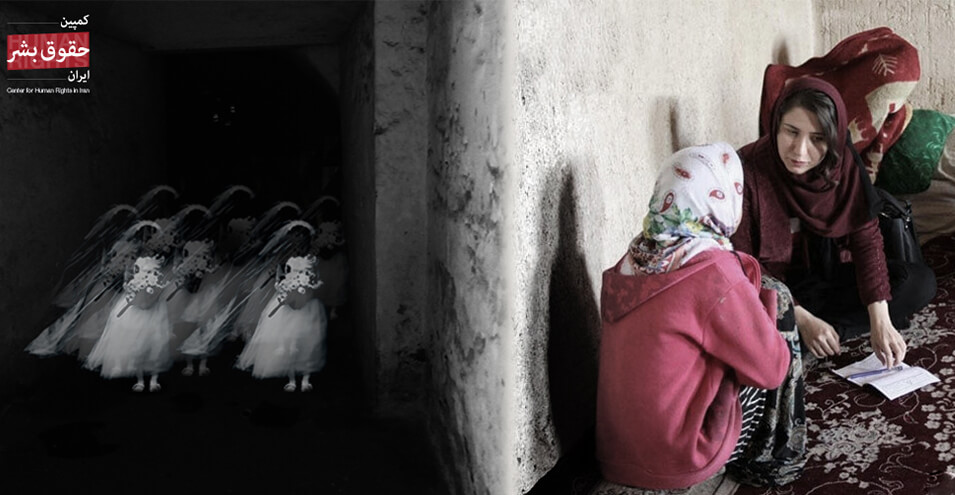
The news of the marriage of the 11-year-old girl from Ilam, who was introduced from the beginning under the pseudonym “Raha” to a man approximately 50 years old, was first published on February 9, 1399 (January 29, 2019) by the Imam Ali Student Society. According to Zahra Kahram, one of the active members of this organization, they accidentally discovered this marriage while implementing a plan for medical and psychological examinations of women in disadvantaged areas in one of the villages in the Hallilan region of Ilam province: “After filling out the identification form of local women, we became aware of this marriage. The marriage of a man who has seven children from his first wife. Raha has not yet reached puberty and experiences cohabitation with this man every night, suffering serious physical and psychological harms and frequent tears have deprived her of peace. Through the follow-up by the Imam Ali Society and understanding how this marriage began, we discovered that Raha was forced into marriage with her husband due to financial poverty and receiving only 15 million tomans from her family six months prior.”
Investigations revealed that this marriage took place without complying with the legal procedures outlined in the note to Article 1041 of the Civil Law, which makes the marriage of girls under 13 years old and boys under 15 years old conditional upon the request of a guardian and court permission with consideration of the child’s best interest.
On the other hand, Article 50 of the Family Protection Law passed in 1392 (2013) stipulates a sixth-degree prison sentence for a man who proceeds with marriage without obtaining such permission and for the father or paternal grandfather, mother, legal guardian, or any person responsible for the girl’s care who directly plays a role in the occurrence of such a marriage. Of course, according to the same article, if it is proven that sexual relations led to “loss of limb or permanent disease” of the girl or her death, the man, in addition to paying blood money, will be sentenced to fifth and fourth-degree imprisonment respectively.
Based on this article and in response to follow-up by the Imam Ali Society and the Welfare Organization, a ruling stripping Raha’s guardianship was issued and she was transferred to a welfare safe house. Her father and the man she married were also prosecuted for participation in this illegal marriage. Finally, on February 12, the Mizan News Agency reported the arrest of the man who married the 11-year-old girl.
Intensifying Condemnation of Child Marriage
The publication of the horrifying story of the 11-year-old girl from Ilam intensified protests against the lack of minimum age restrictions for marriage in Iran’s laws. Among them, Mohammad Shariatmadari, the Welfare Minister, reacted to this issue for the first time, and some parliament members, joining the social movement against child marriage, explicitly discussed its harms.
One day after the publication of this news, Ayatollah Asadollah Bayat-Zanjani, one of the sources of emulation, explicitly declared marriage to children as forbidden and said: “Marriage to children is unjust and because it is unjust, it is not permissible.”
Zahra Saei, a member of the Youth Faction and Social Commission of Parliament, also considered the marriage of girls under 13 as oppression and added: “Based on our investigations, we see that the divorce rate among groups that married young is high and consequently the resulting harms are greater… Given the physiology of girls’ bodies, we see that they differ from older women physically and are more slender. Society has imposed necessities on families. Today, a housewife must be literate and aware to properly educate her children. In this process, men and women must have specific physical and psychological conditions for a successful family to be formed. Boys and girls who marry at a young age have not fully developed their perspective, outlook, and understanding of their environment. Islamic jurisprudence has not set restrictions on marriage or specified a certain age, but when we investigate, we see that the fruit of marriage is forming a successful family. We must determine at what age marriage is good so that it leads to the completion and development of men and women.”
A lawyer named Ali Mojtahedzadeh, in response to the prosecutor’s involvement in Raha’s marriage issue on his Twitter page, wrote: “The involvement of #the_prosecutor_general in the issue of the Ilami child’s marriage despite the legal gap regarding such occurrences shows that society’s sensitivity and concern about these issues are being taken seriously despite the presence of powerful opponents… Reza Bahrami, a journalist and political activist, also raised this question in a tweet: “Those who oppose #banning_marriage for #children, do they have an answer to the tragedy of an 11-year-old girl marrying a 50-year-old man in #Ilam?” Hadiyeh Kimiyaei, a social harms correspondent, reacted as follows: “After public protests about Raha’s, 11 years old, marriage to a 50-year-old man, the Ilam prosecutor said: ‘Based on Article 50 of the Family Protection Law, perpetrators of this illegal act are subject to prosecution.’ So we have the law but we don’t enforce it. What about the fate of the Rahas who are silently becoming victims and have become victims?”
Continued Efforts in Parliament and Government to Ban Marriage of Children Under 13
Despite the rejection of the child marriage prevention bill in Parliament’s Legal and Judicial Commission, there remains the possibility of reviewing it in Parliament’s open session. Zahra Saei, a member of Parliament’s Women’s Faction, said in a conversation with the IRNA news agency regarding the latest status of this bill: “The Women’s Faction has submitted a request to the esteemed head of Parliament to place this bill on Parliament’s agenda for further consideration so that we can apply various perspectives and consequently extract good results from it.”
On the other hand, Masoumeh Ebtekar, Vice President for Women and Family Affairs of the Presidency, announced the drafting of a bill in her office to remove the note to Article 1041 of the Civil Law, which allows marriage of girls under 13 years old and boys under 15 years old with the permission of a guardian and court.
Source: Human Rights Campaign