Tehran’s New Gas Pumps: A Fresh Avenue for Street Vending
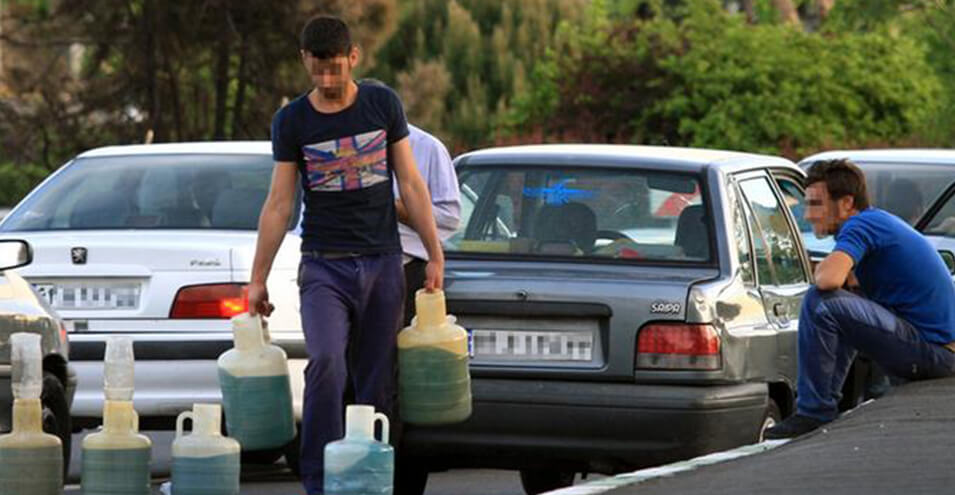
Tehran has seen the emergence of new gas pumps where street vendors sell each liter of gasoline in 20-liter containers and plastic vessels at two to three times the official government price. The circulation of images regarding this new method of street vending has sparked considerable reactions.
“Street vending of gasoline” on streets and highways leading to southern Tehran has become so visible these days that it caught the eye of a photographer from Mizan News Agency, affiliated with the judiciary.
The publication of a photo report about the booming and widespread market of gasoline street vending, which has been dubbed “new gas pumps,” was shortly republished by conservative media outlets and several other news websites, which called it an “abnormal phenomenon.”
Street Gasoline and Higher Prices
Gasoline street vendors set up shop in different locations of the capital every day, and according to Iranian media, by purchasing gasoline from fuel stations at the “free” price—that is, 10,000 rials (1,000 tomans)—they resell it in large 20-liter containers and plastic vessels at two to three times that price.
The approved rate for each liter of gasoline is 10,000 rials (1,000 tomans), but according to media reports, street vendors sell each liter of gasoline at two to three times the price of fuel stations; “5-liter containers for 10,000 tomans and 10-liter containers for 20,000 tomans.”
Gasoline street vendors also have competitors, as one Tehran resident told Tasnim News Agency: “Even if your car runs out of gas in the middle of Tehran and you call for roadside assistance, they’ll bring you gasoline and charge it at 2,000 tomans per liter.”
Gasoline street vending is not limited to Iran’s capital, and this situation has also been reported on highways in Khuzestan province: “On the Izeh road in Khuzestan, I bought gasoline for 3 tomans per liter. Anywhere… God forbid you break down somewhere, you’re stuck. By the way, is this street selling of gasoline safe?”
They Even Have Card Readers
The price of street-vended gasoline is determined according to weather conditions and cold winter days. Nowruz holidays should also be taken into account, to the point where “northern highways sell everything, even gasoline.”
Gasoline street vendors, whom some media outlets have introduced as “gasoline brokers,” are women and men who have provided facilities for gasoline buyers and are equipped with “card reader” devices and small and large containers. If the buyer wishes, the seller themselves takes on the responsibility of fueling motorcycles or cars.
Gasoline sales on Iranian roads are not a new phenomenon. What has caught the attention of the media is the growing increase of this situation as an “abnormal” phenomenon in Iran’s capital amid “severe economic hardship”; a situation in which, according to Saeed Bastani, a representative and member of the Parliament’s Industries and Mines Commission, the vulnerable and unemployed segments of society are more severely affected.
He views the 2019 budget bill optimistically and in line with attention to “eliminating absolute poverty” among vulnerable segments, which “could be a solution to the problems” of this segment of society.
The Poverty Line for Owners of New Gas Pumps
Gasoline street vendors apparently took action to solve their economic problems even before Parliament and the budget reconciliation commission, without waiting for the review of the 2019 budget bill for the entire country.
The budget bill is set to begin in Iran’s Parliament on Saturday, the 27th of Bahman. The coupon gasoline plan will also be reviewed in the same bill if it gains the approval of a majority of representatives, with the goal of “fair distribution” of energy subsidies.
Under this plan, for each national code, one liter of gasoline per day is deposited into the account of the household head, and every Iranian can use their gasoline quota in any way they wish or “sell all or part of it at the free price.”
Parliament members have identified support for the “deprived” segment as important in this plan. According to advocates of the return of coupon gasoline, if gasoline prices increase in 2019, which the government is pursuing, the deprived segment can sell their allocated gasoline at the “free price.”
Various proposals have been made for monthly gasoline quotas. Currently, the ceiling for monthly gasoline quotas has not been specified, but proposals ranging from 80 liters per month to 120 liters have been submitted to Parliament to be allocated to each Iranian at “subsidized prices.”
The price of coupon gasoline has also not yet been announced, and no discussion has been raised about it in Parliament or the government. Hopes for narrowing the gap between low-income families and owners of new gas pumps from the poverty line are not particularly optimistic.
The poverty line for a family living in Tehran has been announced at 4 million and 592 thousand tomans.
On the other hand, there are concerns about the unequal distribution of “hidden energy subsidies” among the people, to the extent that some representatives have warned that high-consumption and wealthy segments of society benefit from this hidden subsidy far more—even “up to 10 times” more—than low-consumption and poor segments of society.
Low-income families are those whom the media refer to as families below the poverty line, slum dwellers, and the bottom decile; some of these families, however, have established “new gas pumps” for themselves.
Source: DW