Iran Government Should End Use of Dual-National Citizens as Political Hostages
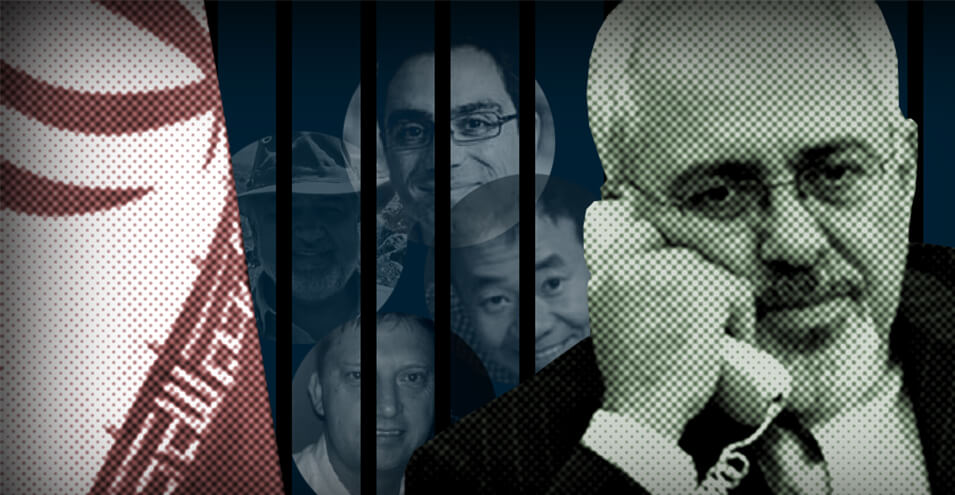
April 24, 2019 – Today’s statements by Iran’s Foreign Minister Javad Zarif regarding his “authority” to exchange dual-national prisoners held in Iran with the United States are a striking confirmation of the reality that these individuals are being held as political hostages in the country.
Hadi Qaimie, director of the Iran Human Rights Campaign, said: “If there was any doubt until now that imprisoned dual nationals in Iran are being used as political pawns, Mr. Zarif’s statements clarify that his government has taken such individuals as hostages. Iran’s foreign minister spoke in a manner as if discussing a commercial transaction, while talking about people whose lives have been seriously damaged by what they have endured.”
On April 24, 2019, Javad Zarif, speaking at the Asia Society, stated that he had proposed an exchange of Iranian-American prisoners held in Iran with Iranians imprisoned in American jails to the U.S. government, but had not received a response from them.
At this invitation-only event, he made clear: “I am putting this proposal on the table… exchange them… I am ready to do this and have the power to do it.”
Previously, whenever Javad Zarif or Hassan Rouhani have been confronted with questions about political prisoners, they have repeatedly claimed that the judiciary of the country is “independent” and that they do not have the ability to intervene in such processes.
Hadi Qaimie in this regard said: “Zarif’s statements today clearly expose the political nature of Iran’s judiciary and all the country’s legal processes.”
So far, at least eleven Iranian or dual-national citizens have been imprisoned in Iran, including Iranian-American citizen Siamak Namazi who has been in prison since 2015, as well as American-Chinese researcher from Princeton University Hu Weifeng and former U.S. Navy sailor Michael White.
European dual-national citizens are also currently imprisoned, including Iranian-Austrian citizen Kamran Ghaderi, Iranian-British citizen Nazanin Zaghari-Ratcliffe and Swedish-Iranian citizen Ahmadreza Jalali.
In March 2018, the family of dual Iranian-Canadian citizen Kavous Seyed-Emami was told that Mr. Seyed-Emami committed suicide while in Evin Prison during interrogation.
Based on a report by Seyed-Emami’s family to the Iran Human Rights Campaign, they were forced to bury Mr. Seyed-Emami’s body without an independent autopsy. Also, Mr. Seyed-Emami’s wife Maryam Moeini, who is herself a dual-national citizen, was barred from leaving the country after her husband’s death.
All of these prisoners have been arrested and detained by the Ministry of Intelligence and/or the Intelligence Organization of the Islamic Revolutionary Guard Corps, held in solitary confinement for months, and deprived of access to lawyers and legal counsel for extended periods.
Javad Zarif has spoken of handing over dual-national prisoners to the United States at a time when government officials and the judiciary have repeatedly stated that they do not recognize dual citizenship.
According to Nazanin Zaghari-Ratcliffe’s husband in August 2020, an Iranian judge told Nazanin Zaghari-Ratcliffe, a former employee of the Thomson Reuters Foundation and resident of London, that she would not be released until Britain paid its old debt to Iran.
The Campaign has learned that the issue of prisoner exchange has also been raised with some dual-national families in Iran.
Currently, the government is holding a large number of political activists, civil society activists, lawyers, labor activists, journalists, ethnic and religious minorities, and other citizens who are not dual nationals in prison.
Source: Iran Human Rights Campaign