Another Financial Corruption Case in Iran with “14 Trillion Tomans” in Debt Goes to Court
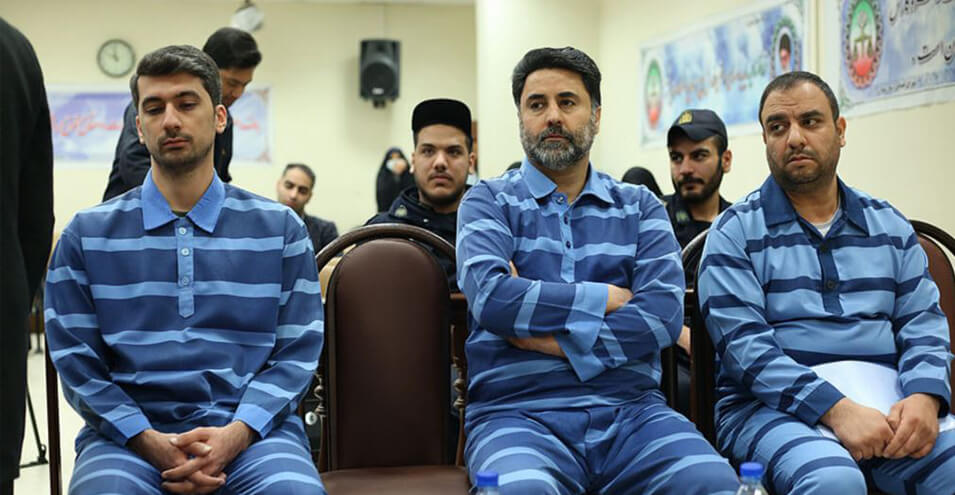
Another financial corruption case in Iran went to court on Wednesday, March 13, with the main defendant being Amir Hossein Azad, son of Ali Mohammad Azad, a former governor of Sistan and Baluchestan, Hamadan, and Ilam provinces during Mahmoud Ahmadinejad’s administration.
The Iranian news agency IRNA reported three other defendants in the case: Hassan Ghoriani, Mohammad Bahrami, and Ehsan Heidari, accusing them of “corruption on earth through major disruption of the economic system with knowledge of the effectiveness of their actions.”
These individuals are accused of establishing two financial institutions, “Alborz” and “Velayat-e Asr,” which collected deposits from 91,000 people. The Alborz institution had approximately 46 trillion tomans in financial transactions between 2012 and 2017, while the Velayat-e Asr institution had approximately 17 trillion tomans in transactions between May 2015 and March 2017.
According to IRNA, approximately 14 trillion tomans of Alborz institution’s obligations and approximately 259 billion tomans of Velayat-e Asr institution’s financial obligations to depositors remain unpaid.
The Revolutionary Court, headed by Judge Solwati, has now taken on the task of reviewing complaints from 6,036 depositors, with the case comprising 353 volumes of documents.
The report adds that the Hassan Rouhani government established a 700 billion toman credit line, tasking Bank Tejarat and Bank Keshavarzi to settle depositors’ claims.
Bank Tejarat has so far paid 630 billion tomans to 16,200 depositors of Alborz institute, while Bank Keshavarzi has paid 135 billion tomans to 15,000 depositors of Velayat-e Asr institute and settled accounts with them.
Economic corruption cases in Iran have experienced unprecedented growth in recent years, with most defendants committing crimes during the eight-year presidency of Mahmoud Ahmadinejad.
This occurs even as Ahmadinejad has consistently presented his government as “the cleanest” government in Iran, coming to power with slogans of fighting corruption, justice, and putting money in people’s pockets and households. Supreme Leader Ayatollah Ali Khamenei also described his government as “the best government to emerge in the country since the Constitutional Revolution to this day.”
Currently, at least 10 economic cases are being reviewed simultaneously in Iranian courts, including, besides the Alborz and Velayat-e Asr institutions case, cases such as “petrochemical corruption,” “Hossein Hedayati,” “Development Fund of Iranians,” and “Capital Bank.”
Financial and credit institutions, many of which are affiliated with or close to military, security, or prominent clergy figures in the Islamic Republic, have faced crises in recent years, leading to large gatherings of depositors who had invested in these institutions in various Iranian cities.
As Sadegh Larijani, the former head of Iran’s judiciary, stated on July 24 of this year, the Hassan Rouhani government paid “30 trillion tomans” from the general budget to depositors to prevent this issue from becoming a larger crisis.
Source: Radio Farda