Rouhani’s Slogans Backfire; Who Is Responsible for Filtering and Absence of Free Media?
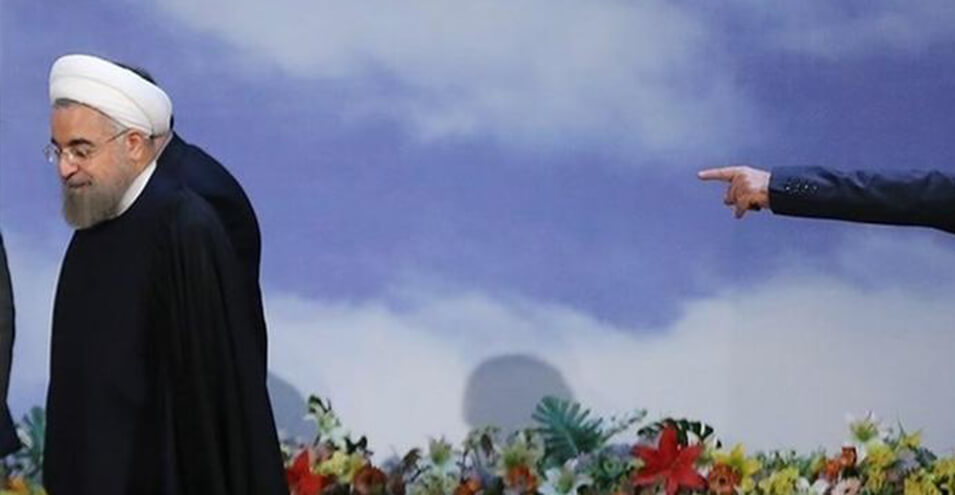
Rouhani’s criticism of filtering and the absence of free media faced harsh reactions. Principalists accuse him of “filtering people’s problems.” Others ask what steps he himself has taken for media freedom and against filtering?
Former Iranian President Hassan Rouhani’s recent remarks criticizing filtering and the absence of free media in the country sparked numerous reactions in media outlets and social networks, making it to the front pages of Iranian newspapers. However, it appears that his slogans during a speech to officials at the Ministry of Communications, aside from the predictable attacks from “hardliners,” have not produced results in line with the twelfth administration’s objectives and have instead drawn widespread criticism toward Rouhani himself as the “responsible” official.
Media outlets affiliated with the hardline principalist faction have fiercely attacked Rouhani, accusing him of filtering and “censoring people’s problems” and promoting secular governance based on American demands.
Hossein Shariatmadari, editor-in-chief of Kayhan, wrote in that state newspaper’s editorial on Tuesday, the second of Bahman (January 22): “The remarks of the twelfth administration’s head indicate that you are recommending a version of Vatican for Islamic Iran, and you believe—God forbid—that the government has no responsibility other than verbally or in writing conveying religious principles regarding people’s welfare and happiness!”
Ayatollah Khamenei’s representative at the Kayhan Institute, referring to Rouhani’s opposition to any blocking and the necessity of users’ freedom to access cyberspace and recognizing their free choice, added: “This perspective is even more dangerous than Vaticanismand its meaning is precisely that we abandon youth, teenagers, and all people in the dangerous realm of cyberspace and only introduce good and bad to them, without having the slightest responsibility for preventing serious and dangerous harms in this space!”
“Promoting Secular Governance in Line with America’s Will”
Shariatmadari also wrote in Kayhan’s editorial titled “Mr. Rouhani! This Is Not the Vatican!” “Is this perspective of yours—of course without your knowing—promoting the same secular governance—normalism—that American officials and think tanks constantly boast about their efforts to impose in Islamic Iran and ultimately not only dependence but the enslavement of the nation to America?!”
Khamenei’s representative at the Kayhan Institute ultimately complained about “religious scholars” for not making sufficient efforts against “these deviant views and perspectives” so that people like him would not need to “enter this path.”
Kayhan also dedicated its front-page headline to Rouhani’s remarks, writing: “In his remarks yesterday, the president made no reference to people’s real problems and did not address the fact that real filtering is censoring people’s problems and forgetting promises, not wordplay and false dichotomies that solve none of people’s problems.”
In this state newspaper’s “analytical report,” Rouhani was accused of “creating false polarities” and “populist rhetoric,” and it wrote: “The president interprets public will in a way that doesn’t harm the government and its actions and no one questions it. The point here is: is people’s livelihood and economy, which are in danger today, not part of public demands? Is the government’s inaction in this regard not illegitimate and illegal based on the interpretation Rouhani presents?”
Kayhan found Rouhani’s remarks about the absence of free media in Iran to be “strange and surprising,” saying his government “holds the record for complaints against newspapers and media.” According to this newspaper: “There is no critical media that the government has not complained about or threatened.”
“Filtering People’s Problems”
The Javan newspaper also dedicated its front-page headline with the title “People’s Problems Were Filtered!” to Rouhani’s remarks, writing that since he has “nothing to say” in ministries like Labor, Industry, or Health, he went to the Ministry of Communications, where he “can talk at length about Telegram, filtering, and cyberspace as he wishes.”
The Javan newspaper adds: “Mr. President, you yourself played the role of a filter. You talk about ‘freedom’ being wasted in the media so no one asks about the achievements of the JCPOA! You talk about people’s fantasies and joys in cyberspace so no one mentions the real joys of having adequate income and a market without inflation. You yourself filter housing, livelihood, employment, and independence and talk about poetry, songs, and lyrics.”
This newspaper affiliated with the Islamic Revolutionary Guard Corps finally addressed Rouhani: “If filtering is bad, please step aside because the real filtering is hiding people’s actual problems and creating fantasies and telling stories from radio and Reza Qolderaz.”
Remarks Contrary to Rouhani’s “Record and Track Record”
The attack on Rouhani for his criticism of filtering was not limited to hardline principalists’ interpretation of his remarks. Some media outlets, including those affiliated with this faction, have addressed his role in efforts to block social networks and the free flow of information.
The Islamic Azad University News Agency (ANA) considered Rouhani’s remarks criticizing filtering contrary to his “record” in the 1990s, writing that “the law on entering people’s homes to collect satellite equipment” was approved in one of the sessions of the fourth parliament chaired by Rouhani. According to this news agency, the “law prohibiting the use of satellite equipment,” passed on February 12, 1995, was approved after four sessions in the fourth parliament when Ali Akbar Nateq Nouri, then parliament speaker, had appointed Hassan Rouhani as his “full representative” in these sessions.
The ANA news agency, after referring to “multiple security and military records” of the moderate sixth administration’s head, asked: “Has Rouhani departed from his previous positions or is he trying to attract the gray zone?”
The Tasnim news agency also considered Rouhani’s criticism of filtering contradictory to his previous “circular” on “dealing with VPN users.”
In his remarks yesterday, the Iranian president, referring to “if you filtered, what do you do about VPN users?” and “in this one year that Telegram was filtered, we all lost,” said: “The problem is that we thought this device is under our command that we order it to filter, and it filters? Well, it was filtered, what do you do? What do you do about VPN users? What do you do about the next VPN? What do you do when a new VPN comes daily?”
The Tasnim news agency published an image of a circular dated December 16, 2017, marked “highly confidential” and signed by Hassan Rouhani, in which the Iranian president, addressing his minister of communications, requests “effective dealing with VPN users.” In this circular, which according to Tasnim was published on social networks on May 7, 2018, and the government never denied, Rouhani, with an implicit reference to the nationwide protests of December 2017, asks Mohammad Javad Zarif to take measures “urgently” noting that “in light of recent events and the impact of cyberspace on increasing societal tensions.”
According to this news agency close to Iranian security institutions, “Reza Taghipour, one of the real members of the Supreme Council of Cyberspace, later reported Rouhani’s emphasis on organizing VPNs and effectively dealing with VPN users and proper management to benefit legitimate users of cyberspace and organizations, saying: We cannot sit and watch the enemy indoctrinate whatever it wants in society. After these events, it became clear that Telegram is run with direct support from America and Israel, and their goal is to spread obscenity and corruption in Iranian society.”
“Doctor Rouhani, What Have You Done for Media Freedom?”
Criticism of Rouhani’s remarks for their contradiction with his government’s actions on issues like filtering Telegram was not limited to “hardliners.” Some political figures and analysts who are generally considered supporters of the government have also joined critics alongside social network users.
Ali Mohammad Namazi, a member of the central committee of the Builders Party, wrote in today’s issue of the “Morning Star” newspaper: “What does it mean that the executive head of the country criticizes filtering, but social networks are filtered under his own government? Rouhani talks about issues that people are already aware of, but practically see no action from the government. Telegram was filtered during Rouhani’s time […] The writer believes it is better for officials to talk less and act more.”
This former parliament representative then, while requesting the Iranian president to “guarantee citizens’ rights,” wrote that from people’s perspective, Rouhani’s campaign promises do not align with his government’s performance.
Sadegh Zibakalam, a reformist analyst, has also turned the edge of Rouhani’s criticism of the absence of free media back to Rouhani himself and tweeted: “Venerable Dr. Rouhani, the absence of freedom of the media in Iran and their monopoly by the ruling establishment is not a new issue. The novel point is what steps you, as the second personality of the system and having responsibility to implement the constitution with the backing of 24 million votes, have taken to free the media?”
Criticism of Filtering or “Farewell Poem to Instagram”
Rouhani’s remarks that “we don’t have free media, we only have state media” faced a wave of criticism on social networks. Maziar Khosravi, a journalist in Iran, was among these critics who tweeted to Rouhani: “Sir! Why tell us? You are president, not leader of the opposition; well, don’t filter, let media be free. We are trapped…”
Mehdi Mohammadi Azad, a political analyst based in Germany, looked at the issue from another perspective and tweeted that Rouhani’s “harsh remarks” yesterday are “probably a farewell poem to Instagram.” According to Mohammadi Azad, Rouhani: “Two weeks before filtering Telegram, he also gave the same ‘warning.’ On December 31, 2018, Javad Javidnia, deputy of cyberspace at the prosecutor general’s office, had said a court order for filtering Instagram was issued but they are waiting for an opportunity…”
Ali Afshari, a political analyst and human rights activist based in America, also tweeted: “Hassan Rouhani, in continuing false propaganda and slogans that confused the presidency with a pulpit, put it on people’s heads that comfortable use of cyberspace is thanks to the moderate administration! While widespread filtering is in place and where it isn’t, it’s because the dominant security faction hasn’t finalized it.”
Another social media user tweeted: “Every time Hassan Rouhani talked about lifting filters and free media, we witnessed a new wave of journalist arrests and blocking of social networks.”
Another user, in response to Rouhani’s criticism of filtering and the absence of free media in Iran, wrote sarcastically: “Mr. Rouhani. Hello. You’ve said these slogans and words several times and we voted twice. We have no more votes to give, can you get to work?”
“National Media” Supporter of Filtering
In his remarks yesterday, the Iranian president, by announcing the absence of “free media” in Iran and the existence of “only state media” in the country, implicitly questioned the freedom and impartiality of “national media.” The state newspaper Kayhan, in its “analytical report” today, while noting that “IRIB has provided the most support for the government in sensitive moments,” complained that attacks on Iran’s state radio and television “have become the front-page headline of most government-supporting media.”
The Islamic Republic of Iran Broadcasting (IRIB), whose head is a member of the Supreme Council of Cyberspace, is among the supporters of filtering in Iran. Rouhollah Sepandarand, a journalist, in today’s issue of the Shargh newspaper lists among the “multiple reasons” for Iran’s state radio and television’s approach in confronting social networks and supporting their filtering: “Without doubt, a structure that has held the monopoly on multimedia content production all these years cannot tolerate the presence of a serious competitor. Especially when this competitor is a good measure for the poor quality of IRIB programs.”
This journalist also, referring to the poor quality of “national media” programs and the “significant gap” between IRIB’s audience numbers and those of independent media productions in cyberspace, reports an increase in the number of “prominent figures” who “prefer” to communicate with people not through state radio and television, but “through social networks.”
The Shargh article cites another reason for IRIB’s support of filtering: “IRIB’s support for filtering, more than having roots in concerns raised by some factions, stems from major financial and economic calculations; because this organization, knowing its ineffectiveness in producing desirable media content, knows what enormous profit the widespread access of people to media productions in cyberspace would deprive IRIB of. This is while independent media sectors operating in cyberspace, with costs far lower than IRIB, have greater returns.”
The author, given these factors, does not find IRIB’s insistence on filtering in Iran “strange,” because according to him “the emergence of social networks and expansion of cyberspace” has reduced “the media power” of this institution.
Internet and social networks in Iran face extensive filtering. International non-governmental organizations also call the Iranian government one of the “enemies of the internet.” Following the nationwide protests of December 2017, filtering of social networks entered a new phase, which included the blockade of Telegram. Meanwhile, government promotion for using domestic messaging apps has had no effect on social network users.
Despite this, Javad Javidnia, head of the cyberspace affairs office at Iran’s prosecutor general’s office, announced on December 31 last year that a “court order” for filtering Instagram had been issued. The remarks of this judicial official faced severe reactions, including within Rouhani’s government and denials by some representatives opposing filtering.
Source: DW