Mohammad Khatami: Islamic Republic Should Be Implemented
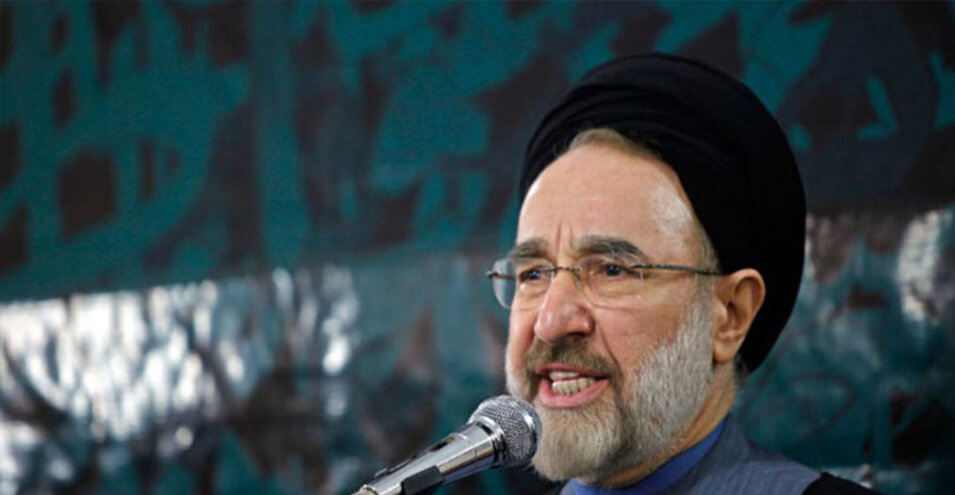
Iran’s former president, while criticizing what he called “pumping despair and hopelessness” aimed at discouraging youth from supporting reforms, emphasized that “reforms are anti-overthrow.”
Mohammad Khatami, in a meeting with members of the Novandish Muslim Women’s Association, referring to December protests, said: “Foreigners feel that as long as the reform movement exists that supports stability and opposes foreign interference, there will be no way for overthrows, therefore they strike hard, and inside the country too, some groups say these reforms are a thorn in our side and we must strike them.”
According to Khatami’s website, he added: “While there are flaws in the reformists, but be aware of where reforms are being hit from. Reforms are anti-overthrow.”
Iran’s former president also said that “the Islamic Republic should be implemented, meaning we should understand Islam in a way that is compatible with the standards of republicanism, and we should understand republicanism in a way that is compatible with Islam’s fundamental values.”
He also called on youth not to succumb to “pumping despair and hopelessness” that is “targeting” them.
Although nationwide December protests in more than 100 Iranian cities started with slogans against Hassan Rouhani at a gathering on the seventh of December in Mashhad, some protesters shouted slogans against all officials of the Islamic Republic from that very day, and in subsequent days, some protesters called for regime change in their slogans.
Among these, the protesters’ slogan “Reformist, hardliner, the story is over,” was among those that received extensive coverage in media and social networks.
Hossein Dhaulfaqari, the security deputy of the Minister of Interior, acknowledged at the time that December protests “transcended all political currents in the country.”
Also, in recent months, a campaign titled “Overthrow” has formed on social media networks.
Talk of regime change in the Islamic Republic of Iran is considered a red line, and none of the groups and political figures within the system speak of overthrowing the existing order.
In another part of his remarks, Khatami said: “What Iranian women have achieved is not little; of course, we should demand that the rights of women that have been doubly violated be realized, but women’s rights cannot be advanced through conflict.”
He added: “During our time, we were able to bring a few ladies into the cabinet who, although they did not become ministers, were deputies; Mr. Ahmadinejad took a step forward and appointed a female minister, and Mr. Rouhani took a step back.”
He also said that in Hassan Rouhani’s government, several women were appointed as vice ministers, directors general, governors, and sub-governors.
Following the establishment of the Islamic Republic system in 1979, only during Mahmoud Ahmadinejad’s administration was Marzieh Vahid Dastjerdi the only woman who received the parliament’s confidence vote for the health ministry.
In Hassan Rouhani’s government, despite multiple requests, no woman was appointed as a minister.
In Mr. Rouhani’s first administration, for the first time in various provinces, a number of women were appointed as deputy governors, governors, and sub-governors.
In this government, four women were also appointed as vice ministers. Among them, Marzieh Shahidaei was the first woman who, after the 1979 revolution, was appointed as CEO of the National Petrochemical Industries Company and deputy petroleum minister.
Hassan Rouhani’s government was also the first government to appoint a woman as Iran’s ambassador to another country, sending Marzieh Afkham, the former spokesperson of the Foreign Ministry, for this purpose to Malaysia.
Meanwhile, the number of women representatives in the tenth parliament also increased to 17 people, which is the highest number of women representatives in the parliaments of the Islamic Republic.
Nevertheless, Leila Fallahi, director general of international affairs at the Women and Family Affairs Office of the Presidency, announced on December 23 of last year that Iran’s ranking in the gender gap index in 2017 was 140 out of 144.
Source: Radio Farda