Four Arab Countries Call on Qatar to Uphold ‘Six Principles’
Four Arab countries that severed ties with Qatar and had demanded that Doha accept their 13 conditions for resuming relations are now calling on Qatar to comply with what they call the “six principles” to counter extremism and terrorism.
Saudi Arabia, Bahrain, the United Arab Emirates and Bahrain have asked Qatar to declare its commitment to “six principles” to counter extremism and terrorism and to negotiate with these countries on implementing a plan that would lead to their acceptance. According to the Associated Press, this move could potentially resolve the crisis that has emerged in the Middle East region.
In mid-June, the four Arab countries severed all relations with Qatar and closed all entry and exit routes to the country, accusing Doha of “supporting terrorism,” “interfering” in the affairs of some countries, and “endangering” security and stability in the region. Qatar rejected these accusations and accused the four countries, led by Saudi Arabia and the UAE, of attempting to interfere in its affairs and violating its national sovereignty.
The Arab countries had previously sent Qatar a list of conditions for resuming relations, which included drastically reducing relations with Iran, shutting down the Al Jazeera network, and dismantling Turkey’s military base. Doha rejected these conditions.
Abdullah Al-Mouallimi, Saudi Arabia’s representative to the United Nations, said on July 18 that the four countries are now calling on Qatar to comply with six principles that foreign ministers agreed upon at a meeting in Cairo on July 5. Mr. Al-Mouallimi expressed hope that Qatar would also declare its commitment to these principles.
Saudi Arabia’s representative to the United Nations also said that these countries can engage in dialogue and interaction regarding the details, “tactics,” and “tools” needed to implement these principles: “We can negotiate and cooperate.”
Al-Mouallimi told reporters that preventing incitement to violence and extremism is a priority, but details such as “shutting down Al Jazeera” may not be necessary: “If the only way to achieve them (the six principles) is to shut down Al Jazeera, we accept it; and if we can reach them without closing the network, that is also fine.”
The New York Times reported that Saudi diplomats and their allies have said that the four countries are no longer discussing the specific details that Qatar must comply with. Their objective is commitment to principles for countering terrorism and extremism, preventing the provision of financial resources and safe haven for terrorist groups, preventing the promotion of violence and hatred, and refraining from interfering in the internal affairs of other countries.
The UAE’s minister for international cooperation also said that all five countries have strong relations with the United States “and we believe America has a very constructive and important role in bringing about a peaceful solution to the current crisis.”
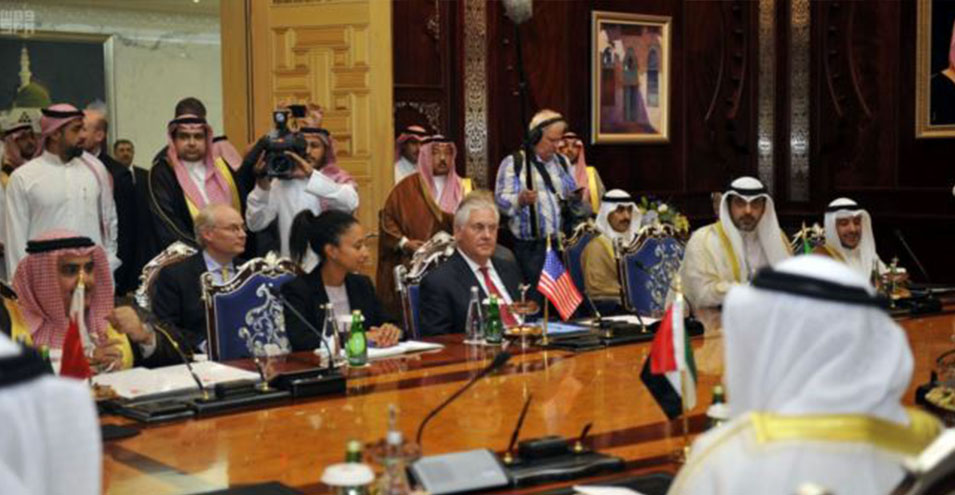
U.S. Secretary of State Rex Tillerson recently traveled to the Middle East region and met with officials from Qatar and the four Arab countries; meetings that were part of Washington’s efforts to resolve the crisis. In Doha, Tillerson and his Qatari counterpart signed a memorandum of understanding to counter terrorism and financing of “terrorist groups.” The Arab countries welcomed this move hours later in a statement, but said it was insufficient.
Abdullah Al-Mouallimi also said that Qatar’s future lies in cooperation with its neighbors, which is assured, and “not in distant places”; the Associated Press noted this is a clear reference to Turkey and Iran, which have supported Doha in recent weeks.
Saudi Arabia’s representative to the United Nations said “Our Turkish brothers need to understand that the era of covert, and in a sense, unwanted interference in the Arab world ended long ago. If Turkey wants to play a constructive role, we welcome it, but attempting to play a role through establishing military bases and military interference will not be effective and will damage Turkey’s image in the Arab world.”
The UAE’s minister for international cooperation also said “The ball is now in Qatar’s court.”
Source: Radio Farda