Zarif: We Have Information That Saudi Arabia Supports Terrorists Near Iran’s Borders
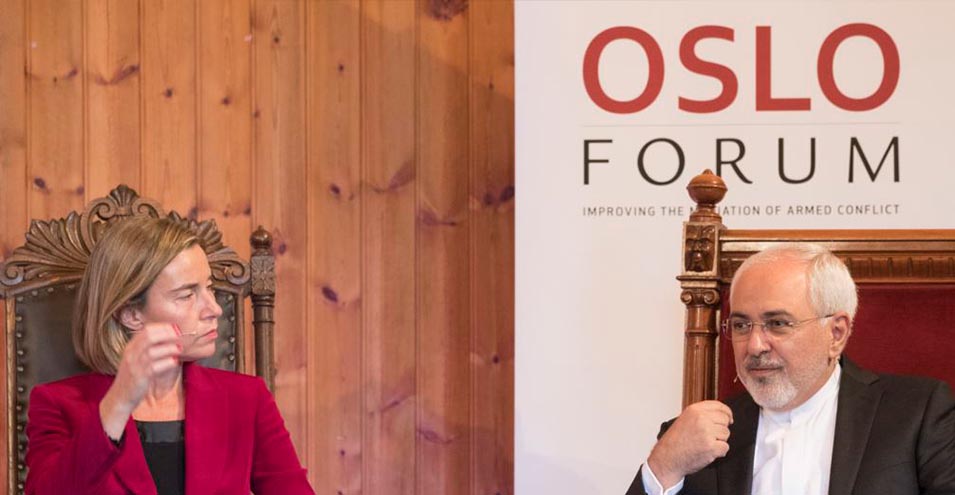
Mohammad Javad Zarif, Iran’s Foreign Minister, stated on Tuesday, June 13, at the Oslo Forum in Norway that Iran has information indicating that Saudi Arabia is supporting and backing “terrorists” in proximity to Iran’s borders.
Iran’s Foreign Minister, speaking at a joint session at the Oslo Forum, responded to a question about Iran’s reasons for holding Saudi Arabia responsible for last Wednesday’s deadly attacks in Tehran, saying: “Saudi Arabia is actively exploiting extremist and radical groups in the Balochistan region as well as western Iran.”
Mr. Zarif continued: “Some Saudi officials, including the country’s Defense Minister, announced about a month ago that we will bring war into Iran’s borders.”
Zarif described these statements as “a dangerous threat” and said: “After that, precisely on the day the terrorist incident occurred in Iran, Saudi Arabia’s Foreign Minister wrote on Twitter that Iran should be punished, and just hours later this terrorist incident happened in Iran.”
According to Javad Zarif, Iran possesses “solid information” demonstrating that “Saudi Arabia is actively supporting extremist and radical groups operating in the Balochistan region, utilizing the territory of one of our neighboring countries despite that neighbor’s reluctance.”
Iran’s Foreign Minister described “the objective of these groups as orchestrating attacks against Iran” and referred to the attacks in the spring of this year in which nine Iranian border guards were killed.
Iran’s chief foreign policy official also accused Saudi Arabia of conducting “similar activities” in western Iran, which according to Zarif involves “exploiting the hospitality of another of Iran’s neighbors.”
Iran’s Foreign Minister emphasized that “the security of Iran’s neighbors is of great importance to Iran.”
According to Mr. Zarif, “Iran is very secure, but we also need a secure region so we can enjoy our own security.”
He stressed that “for Iran, security in Saudi Arabia is as important as security in Qatar and other neighboring countries.”
In another part of his remarks, he emphasized that “the Iranian people express their demands and protests at the ballot box, not by strapping on suicide belts.”
Mohammad Javad Zarif, who traveled to Norway to participate in the Oslo Forum, made these comments at a joint session held with Federica Mogherini, the European Union’s foreign policy chief, the foreign ministers of Norway and Indonesia, and John Kerry, former U.S. Secretary of State.
Following these remarks, Mohammad Javad Zarif posted a series of tweets stating: “In the 1980s, fear-mongering about Iran diverted the West from sustaining the promotion of Wahhabism globally, resulting in al-Qaeda, ISIS, and al-Nusra.”
Iran’s Foreign Minister continued in another tweet: “American complicity in sidelining reasonable Muslim groups once again opens the field significantly for recruitment by Wahhabi extremists.”
Iran’s chief foreign policy official concluded this series of three tweets by stating: “Recent developments underscore the necessity of our long-standing proposal for comprehensive and rational dialogue in the Persian Gulf.”
In this context, Hossein Amir-Abdollahian, former Deputy Foreign Minister and special advisor to the Speaker of the Islamic Consultative Assembly for International Affairs, also tweeted: “Riyadh is the prime suspect in Tehran’s terrorist incidents.”
According to this former Iranian Foreign Ministry official, “Bandar, the head of Riyadh’s security service, directed terrorist operations in November 2013 against Iran’s embassy in Beirut, and now Riyadh is the prime suspect in Tehran’s terrorist incidents.”
Previously, several other Iranian officials and military commanders, including General Mohammad Ali Jafari, Commander-in-Chief of the Islamic Revolutionary Guard Corps, had stated: “We have precise information that Saudi Arabia has supported terrorists and demanded they carry out such operations in Iran.”
Saudi Arabian officials have denied these accusations.
In two simultaneous attacks on Wednesday, June 7, on the Iranian Parliament and the Mausoleum of Ayatollah Khomeini in Tehran, 17 people were killed and over 50 were wounded.
The group known as the Islamic State or ISIS claimed responsibility for both attacks and also emphasized carrying out further such operations in Iran in the future.
Tensions between Iran and Saudi Arabia have escalated in recent years, with the two countries in dispute over various regional issues including Syria, Yemen, Bahrain, Iraq, and the Qatar crisis.
Source: Radio Farda