A Wounded Church, Yet Standing in Urmia
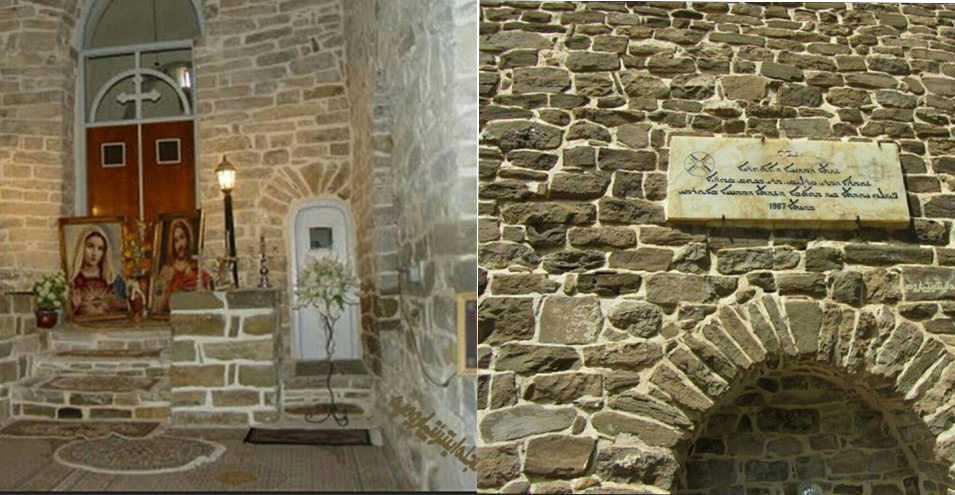
Sohila. S. – FCN News Agency: It is a stone structure. Located on the slope of a hill overlooking the city with tree-filled gardens on both sides. There is no reliable information about when this building was constructed, but it is said to be nearly a thousand years old. Or perhaps even older.
Nevertheless, it is a respected place for Christians around the world.
The nearly 500-person population of the village of “Janu Solo” near this structure does not appreciate its value. They are all Muslim, and no one believes that until 100 years ago, the entire Assyrian and Armenian population of this settlement had great regard for this stone structure.
Now all of them have migrated to surrounding cities or perhaps have left Iran for countries where there are no restrictions on being Christian and worshipping God.
Of course, this demographic change in Janu Solo does not diminish the significance of this stone structure, known as the “Church of the Holy Mary.”
From Word-of-Mouth Stories to Domestic Media Narratives
Various stories have been passed down orally regarding the motivation and time of construction of this stone structure.
Some attribute its antiquity to the time of Khosrow II, the Sassanid king. They believe that Shirin, an Armenian wife of Khosrow, built this church to fulfill her vow following the defeat of the Romans by the Iranians, to serve as a place of worship for Christians.
Another story traces back to the time of the birth of Jesus Christ. It is said that the church building was originally a Zoroastrian fire temple, but three Zoroastrian priests who, guided by a star in the sky and following it, witnessed the birth of Jesus Christ, upon their return from their journey to Jerusalem, transformed the structure from a fire temple into a church. Thus they became messengers of Jesus Christ.
However, the guardian of this church recently told ISNA news agency: “This small house is actually the burial place of a very faithful woman for whom lands were dedicated over time, and a structure was built over her grave for those who light a candle here and worship for a few minutes in its small carpeted room; but this place is what is written on its door: the Church of the Holy Mary, where stones should not be attached to its walls and one should not enter the building with shoes.”
However, this guardian’s interpretation and this news agency’s account differ greatly from the stories that indicate the antiquity and historical background of the church.
Parthian and Sassanid Architecture in the Church
In any case, whatever the story, the reality reveals that the Church of the Holy Mary, or the Church of Mother Mary, in terms of antiquity is the second church in the world after the Church of the Nativity.
This structure is the smallest church in Iran, but its historical significance can be observed in Marco Polo’s travel writings, and in the interest of tourists who traverse main and secondary roads to Urmia to see this sacred stone structure.
However, unfortunately we have witnessed improper restoration efforts striking this structure, leaving wounds as reminders. While this church is registered on UNESCO’s World Heritage List and has international renown.
The Church of the Holy Mary has been restored many times and has taken on various forms. In 642 AD, a Chinese princess named “Bafri” undertook restoration work on this structure.
This Chinese princess, along with fifty leaders of her country, traveled to Mesopotamia in 642 AD to meet with the Archbishop of “Nineveh” and from there went to Urmia, where they resided in this church for some time.
This structure is built of stone and mortar, and there is no trace of religious paintings and images anywhere in the church.
The current structure of the Church of Mother Mary, particularly its domes, arches, and foundations, according to archaeological experts, belongs to the Sassanid period, and its internal architecture is a blend of Sassanid and Parthian architecture.

The Church of the Holy Mary has 9 pews and 9 places for confession or preaching by the priest, with a low-height entrance door facing the courtyard.
On the left and right sides of the church entrance corridor are two passageways with inscribed gravestones that were the burial place of Christian clergy, and the current gravestones in the passageways belong to three leaders of the Assyrian Church of the East and one missionary of the Russian Orthodox Church.
To the right of the sanctuary’s niche is a narrow and short corridor with a wall oven built into the right wall of this room, which was used for baking sacred bread. Near this oven is a small stone basin inside the wall for the baptismal ablution of children.
The Church of the Holy Mary has a relatively large courtyard. The church courtyard is accessed by two entrances to Holy Street and the alley on the western side. The ancient section and most of the church buildings are located on the northern side of the courtyard.
There is much discussion about the antiquity of this place; some say that 1300 years ago this was a place of worship for Assyrian villagers, while others say it is no more than 800 years old.
This structure was one of the stone monuments of the province, and all its walls and ceiling were constructed very skillfully with irregular stones for maximum strength. The structure consists of two sections, including a relatively short entrance, the first prayer hall with a sanctuary and surrounding rooms. The next section is another hall that runs parallel to the first hall and small rooms connected to the back of the sanctuary.
The interior view of both halls is simple and covered with plaster. The halls are covered with barrel and tunnel vaults in the form of half-ellipses, reminiscent of ancient architecture. Behind the church building and connected to it is a small space containing a room and a vault beneath it, which serves as the church’s retreat room.
The Church of the Holy Mary is located in Urmia city and is a pilgrimage site for all Christians, including Assyrians and Armenians.
[layerslider id=”31″]