Lashing and Monetary Penalties for 20 ‘Fasting Breakers’ in Qazvin
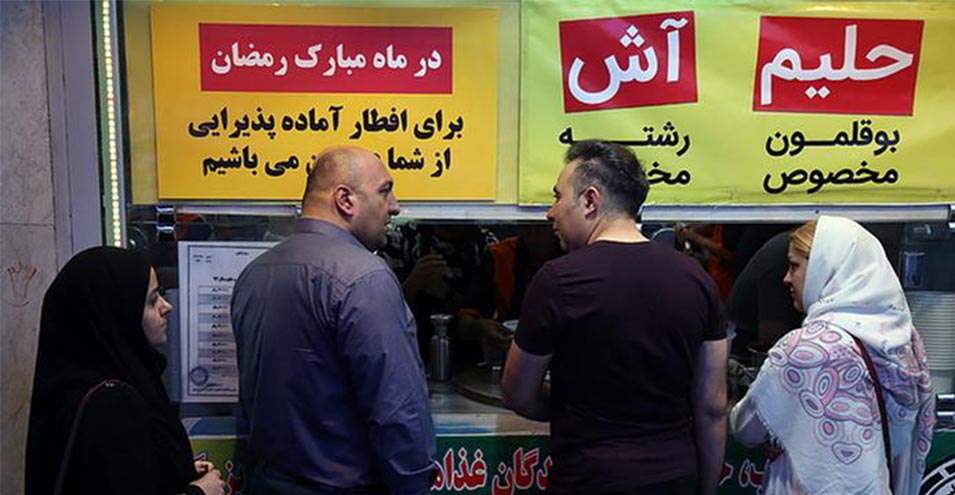
In Qazvin, 20 people were arrested for “breaking their fast” and in addition to paying monetary fines, they were also lashed. Even some religious scholars consider the Islamic Republic’s strict laws that lead to pretending to fast as unjustifiable.
Mehr News Agency reported on Sunday (June 21) citing the prosecutor general of Qazvin that a group in the city of Qazvin was lashed for the “charge” of breaking their fast. Hojjat al-Islam Ismail Sadeghinia Niarki told the news agency: “Nearly 90 cases have been filed for people who broke their fast, of which 20 cases were sent to a special branch established for this purpose in the prosecutor’s office on the day of arrest with the issuance of an indictment, and on the same day the cases were specially reviewed, and the perpetrators were sentenced to lashing and monetary penalties, and the verdict was executed.”
He referred to this punishment as “an unprecedented measure” that “was welcomed by believers and citizens.” In Iran, every year during the month of Ramadan, groups who do not want to observe mandatory fasting or cannot do so for medical reasons face inhumane punishments such as lashing for openly breaking their fast.
According to Article 638 of the Islamic Penal Code, publicly breaking the fast in Iran is considered a crime and is punishable by 10 days to two months imprisonment and up to 74 lashes. This is why we frequently encounter news like what Mehr News Agency published during this month.
The aforementioned law forces citizens to pretend to be religious with punishments such as lashing. According to some analysts, this could contribute to people becoming disillusioned with religion rather than bringing them closer to the system and Islam; something that some religious thinkers also reject.
Hassan Yousefi Eshkevari, a former clergyman and religious thinker, emphasizes: “We do not have such a law and such a ruling in Islamic law. Prayer, fasting, pilgrimage, alms, or such matters that are among the secondary precepts of Islamic law, are part of Islamic worship, and worshipful acts are matters of will and choice, and each person must perform them according to their own desire and inclination. Such matters are not inherently subject to coercion.”
According to him, based on the principle of “There is no compulsion in religion” mentioned in Surah Al-Baqarah of the Quran, no one can force another person to perform religious obligations; neither a man his wife, nor a father his children, nor a neighbor another neighbor.
A Tool for Settling Scores
Many believe that if the goal of the Islamic Republic was to encourage people to be religious, it might have used other methods to bring them closer and strengthen religious beliefs in them.
According to them, however, these pressures—from mandatory hijab to punishments for eating and drinking in public, strictness in school and university curricula, violation of people’s right to privacy, and pressuring youth not to enjoy their youth and vitality—are not for preserving religion, but rather using religion to preserve power.
Even political score-settling is done under the pretext of “breaking the fast.” For instance, in the summer of 2010, Ali Karimi was expelled from Steel Azin Club, and the club’s officials cited breaking the fast as the reason for his expulsion. However, it was later said that behind the scenes lay some disagreements between this player and Mostafa Ajroloo, a member of the Islamic Revolutionary Guards Corps and CEO of Steel Azin Club, as well as his solidarity with protests against the results of the 2009 elections.
At that time, Fars News Agency wrote: “Ali Karimi was confronted with advice from Steel Azin officials after breaking his fast before practice, and after their discussions continued his work again. The 700 million-toman player of Steel Azin had previously caused controversy during World Cup qualifying matches by wearing a green wristband.”
Source: DW