Amnesty International: Iran Responsible for Over Half of All Recorded Executions in 2017
Amnesty International, on Thursday, April 12, released its annual report on the use of capital punishment in 2017, describing execution as a “cruel and inhuman” penalty and introducing Iran as the second country in the world in terms of high execution statistics.
The report states that 142 countries have abolished or suspended the use of this punishment in their laws, but last year 23 countries, including Iran, continued with executions.
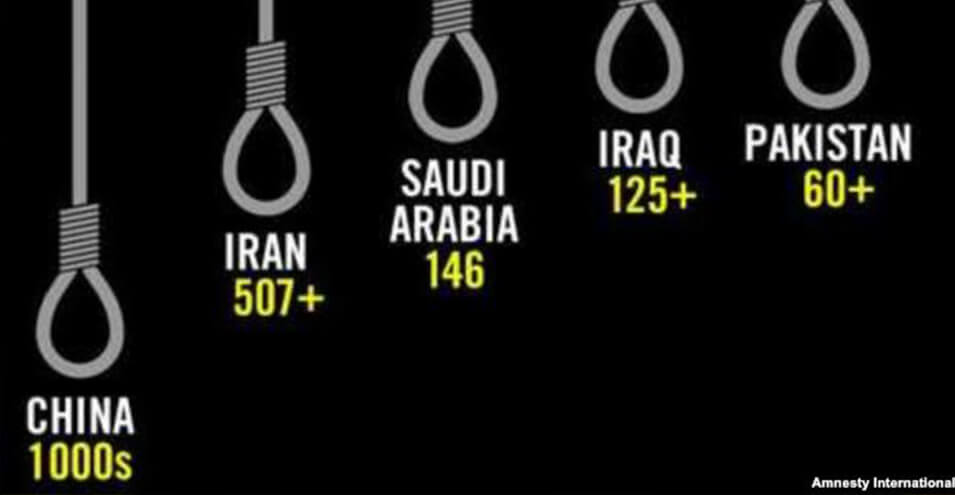
According to Amnesty International’s report, at least 507 people were executed in Iran last year, accounting for more than half of all recorded executions globally. This number represents an 11 percent decrease compared to the number of executions in 2016, but it remains significantly higher than other countries.
Of the 507 executions carried out last year, 205 were related to drug offenses and 240 were related to retaliatory killings (qisas), marking the first time that executions for drug crimes fell below executions for other crimes.
Amnesty International states that last year efforts were made in Iran to reduce executions related to drug offenses. The organization is referring to a new law approved by the Islamic Consultative Assembly in autumn 2017 that restricts the use of capital punishment for drug-related crimes.
- In 2017, 993 people were executed worldwide, representing approximately a 4 percent decrease compared to the previous year.
- Most executions took place in Middle Eastern and North African countries.
- Of the 193 UN member states, 170 countries did not use capital punishment.
- With at least 507 executions, Iran has the highest number of executions in the world after China.
- Capital punishment still exists in the laws of 56 countries worldwide.
- In 15 countries worldwide, capital punishment is still used for drug offenders.
- The United States and Japan are the only G8 member countries that use capital punishment.
- In 2017, 23 people were executed in the United States and four in Japan.
- After Iran, Saudi Arabia ranks third with 146 executions.
Simultaneously, Amnesty International expressed concern about the use of capital punishment in Iran for certain other crimes, noting in its report that charges such as moharebeh (waging war against God), efsad fil-arz (spreading corruption on earth), and sabb al-nabi (insulting the Prophet) face capital punishment in Iran, whereas these offenses are not considered serious crimes under international law and should not result in death sentences.
The report also states that the legal proceedings and trials of many individuals sentenced to death in Iran are “unjust,” and their confessions are obtained “under torture and mistreatment,” with some confessions being broadcast on Iranian television.
The execution of 31 death sentences in public and the execution of at least four juvenile offenders (individuals under 18 years old at the time of committing the crime) in Iran are among other matters criticized by Amnesty International.
According to the organization, 80 other juvenile offenders are awaiting the execution of their death sentences in Iranian prisons, a situation that violates international laws and the Convention on the Rights of the Child.
Based on the report by this human rights organization, hundreds of other death sentences were also issued in Iran last year, but the organization was unable to verify exact figures.
According to Amnesty International, since the number of executions in China is classified as state secret and precise statistics are unavailable, Amnesty International’s reports and statistics have been published without including Chinese execution figures; however, the number of executions in China is likely higher than in all other countries.
On this basis, Iran, along with three countries—Iraq, Pakistan, and Saudi Arabia—accounted for 84 percent of all executions carried out in 2017.
After Iran, Saudi Arabia with 146 executions and Iraq and Pakistan with 125 and 60 executions respectively in 2017 had the highest number of executions in the world.
At the conclusion of its report, Amnesty International stated that the report was prepared using information from various sources, including official statistics, court judgments, death row inmates or their families and lawyers, reports from civil society organizations, and media outlets.
The use of capital punishment and high execution statistics in Iran are among issues that have been criticized in recent years by the United Nations, Western countries, and several human rights defenders.
Source: Radio Farda