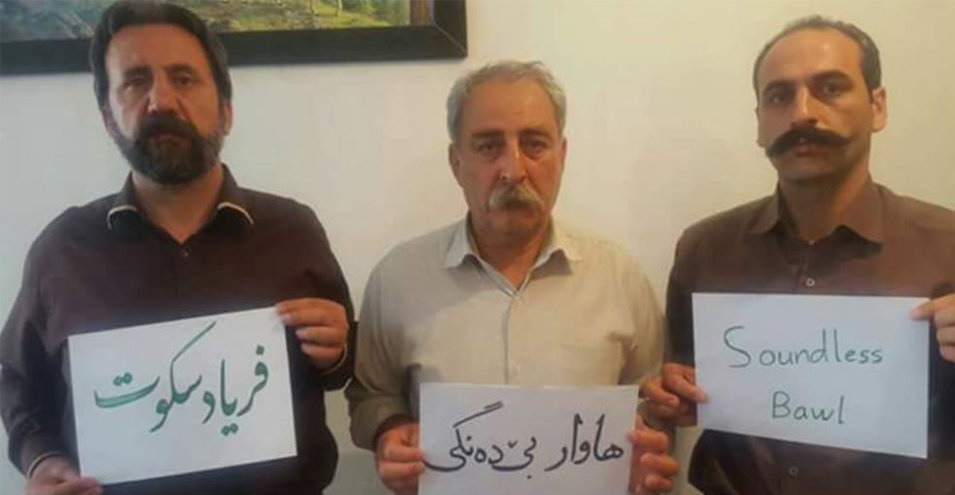
Three followers of the ‘Yarsan’ faith sewed their lips shut in protest against “discrimination” against adherents of this faith, coinciding with Hassan Rouhani’s visit to Kermanshah Province.
The Kurdistan Democracy and Human Rights Center reported on Sunday (July 18) the protest and “silent fast” of these three Yarsan activists.
The identities of these individuals were announced as Siavash Hayati, Amin Abbasi, and Noshad Taheri, who took this action in response to “discrimination and neglect of the wishes and demands of the Yarsan community.”
The three also stated in a issued statement that they sewed their lips shut following the failure of “years of efforts by the advisory council of Yarsan civil activists to arrange a meeting” with the president.
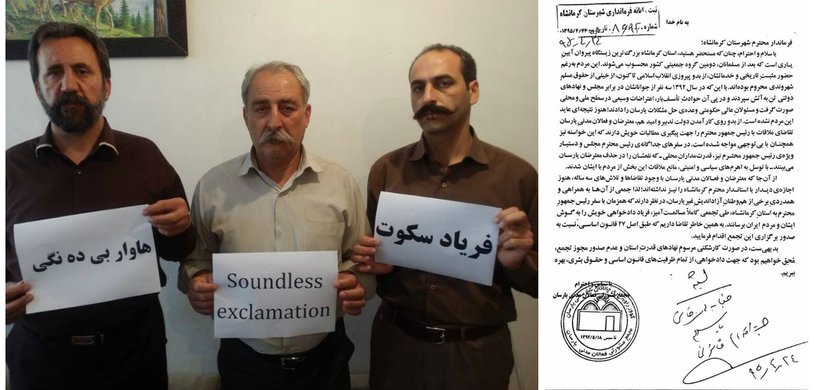
They stated that the purpose of meeting with Rouhani was to “find solutions to address the discrimination imposed against the Yarsan people.”
“The lack of transparency regarding why the president’s election promises regarding the rights of ethnic groups and religious minorities have not been implemented” was cited as another focal point of these activists’ protest.
“Neglect of backwardness and lack of development in Kurdish regions” and “the presence of an inefficient non-native power mafia in Kermanshah Province” are among other issues that these three individuals protested in their statement.
Followers of the ‘Yarsan’ faith in Kermanshah Province have been protesting “discrimination” and “injustices” against adherents of this faith for years, and in some cases their protests have been accompanied by self-immolation.
Mordad of the year 2013 one of the followers of the ‘Yarsan’ faith set himself on fire in front of the parliament building and died after being taken to the hospital.
Followers of the ‘Yarsan’ faith, along with another group of residents of Kermanshah Province, took to protest again coinciding with Hassan Rouhani’s visit to the province, urging officials to address their demands.
Ali Younesi, the president’s special advisor on ethnic and religious minorities, had previously met with some followers of the Ahl-e Haq (Yarsan) faith and confirmed that there are certain “narrow-mindedness” toward them in the country and promised to defend their “civil rights.”
On Sunday, during Rouhani’s speech to a gathering of Kermanshah residents, slogans were raised protesting “unemployment” and “discrimination.”
On July 14, the assembly of representatives of Kermanshah announced in a letter to Rouhani that “if the plan to create a free trade zone and complete the railway in Kermanshah is not implemented,” they would not accompany his convoy.
According to Mohammad Shariatmadari, the executive deputy of the presidency, during Hassan Rouhani’s visit to Kermanshah, 69 projects will be inaugurated, of which 51 projects are related to the decisions of previous governments.
Ahl-e Haq or Yarsan is a faith with mystical practices found primarily in Iranian Kurdistan and Iraq. The exact date of this faith’s formation is unclear, but its followers believe in the eternal and timeless nature of their faith. This religion has gone through various phases throughout different historical periods. Although the oldest Yarsan religious texts date back to the 2nd century of the Islamic calendar and some of its prayer sites predate Islam, its current structure originates from the 7th century of the Islamic calendar and was established by Sultan Sahak, who holds the highest position in the beliefs of Yarsan followers.
Although a set of shared beliefs exists among Yarsan followers, different customs and beliefs exist among them depending on which of the eleven families they are affiliated with. Yarsan is also known by the names Ahl-e Haq, Ayin-e Yari, Kish-e Haqiqat, Taifeh-san, and Kakei.
For more information about “Yarsan,” refer to this article.
Sources: Radio Farda and Wikipedia Encyclopedia