Ahvaz’s Battle with Floods; 230 Villages in Khuzestan Evacuated
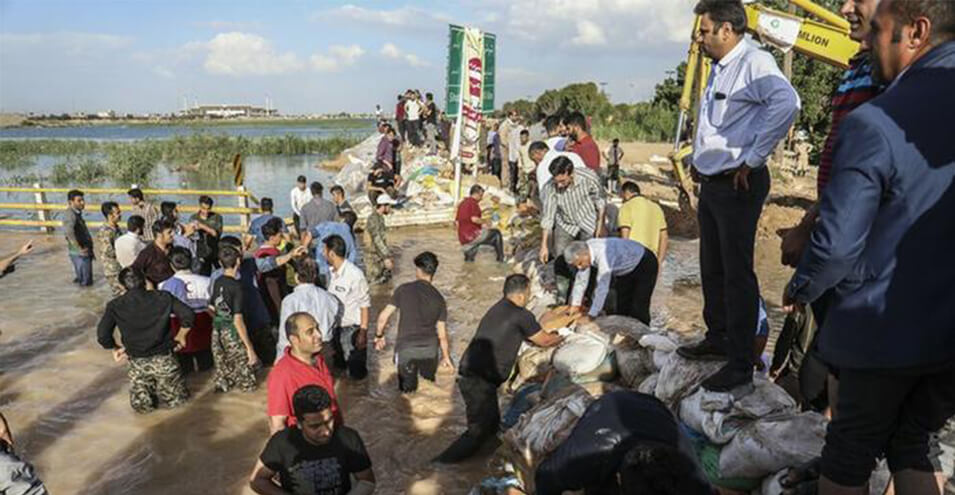
Ahvaz spent the past 24 hours in fear of flooding. However, the majority of the city remained safe from inundation. Currently, only one area of Ahvaz is flooded. But 230 villages in Khuzestan have been evacuated due to floods.
After yesterday afternoon (Wednesday, April 11), when the Salman Canal dam broke, the Karun River water was diverted towards Ahvaz, putting the metropolis at risk of flooding. However, it appears that the efforts of residents and municipal authorities to save Ahvaz over the past hours prevented the flood from entering major parts of the city.
Alirez Alipour, Deputy Director of Municipal Services at Ahvaz Municipality, told the “ISNA” news agency Thursday morning, April 12, that currently only the “Ein 2” area of Ahvaz is experiencing flooding.
Alipour added: “During this period, with good forecasting by the Water and Power Organization, the Karun River’s discharge was predictable in advance, and accordingly, we increased the height of the flood barriers and reached an acceptable level of safety, such that there was always a difference of one meter to 50 centimeters between the water level of the flood barriers and the river.”
Jamal Alami, the governor of Ahvaz, also said “no danger threatens Ahvaz, and the only problem created in Ahvaz is due to water overflow from the Elahi and Hamidiyeh sides into Ahvaz, which is being managed and there is no cause for concern.”
According to Jamal Alami, Ahvaz is not threatened by the Karun. Although the Karun River’s discharge reached a high level, the flood barriers had sufficient strength.
Evacuation of 230 Villages in Khuzestan
Nevertheless, flooding in Khuzestan has led to the evacuation of hundreds of villages. According to Ali Khadadadi, CEO of the Iranian Red Crescent Society in Khuzestan, at least 230 villages have been evacuated over the past two weeks.
Khadadadi told “ISNA” that since April 3, the cities of Behbahan, Lali, Gachsaran, Izeh, Shushtar, Baghmollek, Haftkel, Abadan, Shadegan, Hoveyzeh, Ramhormoz, Andimeshk, Andika, Bavi, Masjed Soleyman, Dezful, Susa, Ahvaz, Dasht Azadegan, and Karun have been affected by flooding.
According to him, in some cities the floods have subsided, while in other areas flooding and its consequences still exist. Areas of the cities of Shushtar, Ahvaz, Dasht Azadegan, Susa, Bavi, Hamidiyeh, Karun, and Shadegan are severely affected by floods.
However, Ali-Asghar Peyvandi, Chairman of the Iranian Red Crescent Society, who went to Khuzestan alongside the Interior Minister to directly oversee the flood crisis management process, tweeted about the current situation in Khuzestan: “The situation has not yet reached a critical stage, but it is concerning.”
Warning of Heavy Rainfall in 14 Provinces
While large parts of Iran continue to deal with the consequences of flooding over the past two weeks, the “National Crisis Management Headquarters” announced on Thursday the arrival of a new rainfall system to the western regions of the country. This rainfall system will enter Iran from Friday afternoon, April 13, and will affect 14 provinces of the country for three days.
According to the National Crisis Management Headquarters announcement on Saturday, April 14, in the provinces of Mazandaran, Golestan, Bushehr, Fars, Qom, Yazd, and Isfahan, rainfall accompanied by squalls and thunderstorms is expected, and in the provinces of Hormozgan, western and southern Kerman, and the southern half of Sistan and Baluchestan, rainfall accompanied by squalls, thunderstorms, and temporary strong winds are expected.
On Sunday, April 15, rainfall accompanied by squalls and thunderstorms is expected in the provinces of Golestan, Mazandaran, and North Khorasan, and rainfall accompanied by squalls, thunderstorms, and temporary strong winds in the provinces of Semnan, eastern half of Isfahan, Razavi Khorasan, South Khorasan, Yazd, eastern Fars, Kerman, southeastern Hormozgan, and Sistan and Baluchestan.
On Monday, April 16, in the provinces of Golestan, North Khorasan, Razavi Khorasan, and southeastern Kerman, and rainfall accompanied by squalls, thunderstorms, and temporary strong winds in the north of South Khorasan, north of Yazd, and the northern half of Sistan and Baluchestan are expected.
Comprehensive Flood Crisis Management is the Responsibility of the Interior Minister
On Thursday, President Hassan Rouhani also issued an order to Interior Minister Abdolreza Rahmani Fazli, emphasizing: “Comprehensive management of the recent flood crisis is the responsibility of the Interior Minister, and restrictive regulations should not prevent cooperation of all institutions in this important incident.”
According to the President’s Official Website, in Hassan Rouhani’s order it states: “Comprehensive management of the recent flood crisis (prevention operations, preparedness, response, reconstruction, recovery, coordination, and division of labor) in all executive bodies and all cooperating and effective organizations and institutions is the responsibility of the Interior Minister (Deputy Chair of the National Crisis Management Headquarters).”
In his directive, Rouhani also wrote: “All ministries, organizations, and government institutions, military and law enforcement forces, judicial and public non-governmental institutions are obliged to cooperate and precisely implement the orders and programs issued by the Interior Minister.”
Source: DW